













US Jobs Slow as Inflation Persists and Bond Yields Surge | Weekly Recap: 28 September-2 October 2026


Our Weekly Market Recap breaks down the key economic developments, market moves and events shaping global markets each week.
Global markets navigated conflicting signals last week as weaker US employment reduced expectations for another Federal Reserve rate increase, while persistent inflation and rising borrowing costs kept pressure on bonds and broader risk assets.
The US 10-year Treasury yield reached 5.34%, its highest level since 2002, while the dollar strengthened and gold fell. Equity performance was more divided, with technology shares remaining resilient even as broader US and European markets faced pressure from elevated borrowing costs.
Economic Overview
Markets balanced evidence of cooling US employment against persistent inflation and rising global borrowing costs.
The US economy added 29,000 jobs in September, below the 90,000-increase expected by economists. Payroll growth for July and August was revised down by a combined 60,000, while unemployment rose to 4.2% from 4.1%. Average hourly earnings increased 0.1% month on month and 3.0% year on year. The weaker report reduced expectations of another Federal Reserve rate increase in October.
Other US data reinforced that divide. Job openings fell to 7.08 million in August from a revised 7.34 million, while the quits rate remained low. Manufacturing activity remained resilient, however, with the ISM manufacturing index at 54.5 in September, little changed from 54.6, while rising input costs pointed to continued inflationary pressure.
Inflation remained persistent. The PCE price index rose 0.3% month on month and 3.4% year on year in August, while core PCE increased 0.2% monthly and 3.0% annually. Consumer demand also remained firm, with spending rising 0.9% despite personal income increasing just 0.2%, partly supported by a decline in the saving rate to 4.1%. Meanwhile, the third estimate showed the US economy expanded at an annualised 2.2% in the second quarter, revised up from 1.5%.
The Reserve Bank of Australia raised its cash rate by 0.25 percentage points to 4.60%, citing domestic capacity pressures, higher energy costs and elevated inflation expectations.
Euro area inflation accelerated to 3.8% in September, its highest level in three years, while core inflation increased to 2.5%. The rise strengthened expectations of further European Central Bank tightening.
In Asia, China’s official manufacturing PMI rose to 50.1 from 49.8, signalling a return to expansion. Japan’s Tankan index for large manufacturers increased to 24 from 22, pointing to improved business confidence.
Overall, the data presented central banks with an increasingly difficult mix: employment showed signs of cooling, but resilient activity and persistent inflation provided little room for policymakers to declare victory over price pressures.
Equities, Bonds and Commodities
Equities
US equities ended the week mixed, with technology continuing to outperform the broader market. The Nasdaq Composite gained 0.5%, while the S&P 500 declined 0.3% and the Dow Jones Industrial Average fell 1.3%. Technology shares remained comparatively resilient, supported by continued artificial intelligence investment and Nvidia’s announcement of a US$150 billion increase to its share repurchase authorisation.
Weaker payroll growth supported equities on Friday as expectations for an October Fed increase fell. However, elevated borrowing costs and energy prices continued to limit broader gains.
European markets weakened as rising inflation, higher government borrowing costs and French fiscal concerns affected sentiment. The STOXX Europe 600 declined 1.1% over the week. The FTSE 100 fell 2.2%, its steepest weekly decline since April, as the global bond sell-off weighed on risk appetite.
Bonds
Government bonds experienced another volatile week. The US 10-year Treasury yield reached 5.34%, its highest level since 2002, before ending Friday near 5.28%. UK gilt and euro area government bond yields also rose, while the spread between French and German 10-year yields widened amid concerns about France’s fiscal position. Japanese government bond yields remained close to multi-decade highs.
Commodities
Brent crude settled at US$102.25 per barrel on Friday and was approximately unchanged over the week on a comparable front-month basis. Prices reflected conflicting signals from improving Middle Eastern exports, renewed geopolitical risks, Chinese fuel export restrictions and plans to release emergency oil and diesel reserves.
Spot gold declined approximately 3.4% over the week to around US$4,140 per ounce. A stronger dollar and elevated Treasury yields reduced demand for the non-yielding metal.
Sector Performance
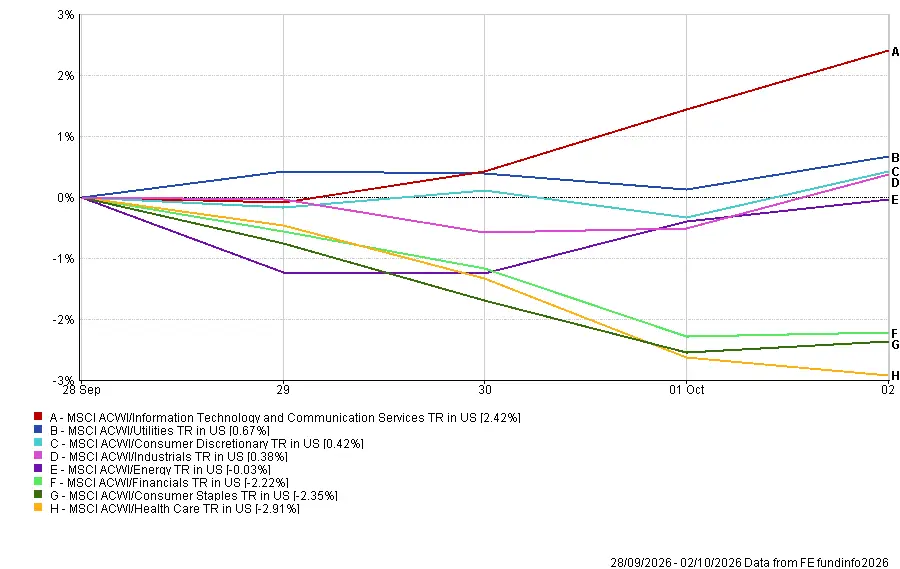
Information Technology and Communication Services was the strongest sector, gaining 2.42%, as artificial intelligence and semiconductor-related companies continued to attract investor demand. Utilities advanced 0.67%, Consumer Discretionary rose 0.42% and Industrials gained 0.38%.
Energy declined 0.03%, while Financials fell 2.22% and Consumer Staples lost 2.35%. Healthcare was the weakest sector, declining 2.91%. The pattern showed continued strength in technology alongside broader weakness across financial and defensive areas.
Sector Performance September 28th – October 2nd 2026
Source: FE Analytics. All indices total return in USD. Past performance is not a reliable indicator of future performance. Data as of 2 October 2026.
Regional Markets
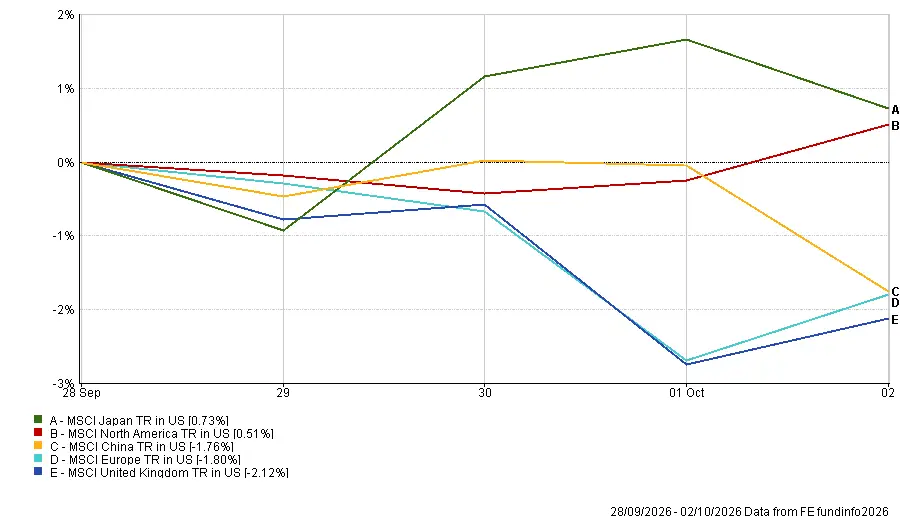
Japan led regional performance, with the MSCI Japan TR gaining 0.73% in US-dollar terms, supported by improved business confidence and strength in technology-related shares.
North America gained 0.51%, while China declined 1.76%. Europe fell 1.80%, with the United Kingdom the weakest region at -2.12% as inflation and fiscal concerns weighed on sentiment.
A stronger US dollar also reduced translated returns from several overseas markets.
Regional Performance September 28th – October 2nd 2026
Source: FE Analytics. All indices total return in USD. Past performance is not a reliable indicator of future performance. Data as of 2 October 2026.
Currency Markets
The US dollar strengthened against the euro and yen as elevated Treasury yields and concerns surrounding European inflation and fiscal conditions supported the currency.
EUR/USD moved from Monday’s opening level of 1.1388 to close at 1.1254 on Friday, leaving the euro weaker against the dollar.
GBP/USD moved from 1.3245 to 1.3243, leaving sterling almost unchanged but marginally weaker against the dollar.
USD/JPY increased from 157.23 to 157.86, meaning the yen weakened despite improved Japanese business confidence. The gap between elevated US yields and Japanese interest rates continued to support the dollar.
GBP/JPY rose from Monday’s opening level of 208.33 to Friday’s close of 209.04. Sterling therefore strengthened against the yen over the week.
Outlook and The Week Ahead
Attention now turns to the Federal Reserve’s September meeting minutes on Wednesday. Investors will be looking for further detail on the decision to raise interest rates and whether policymakers still see another increase as appropriate following weaker employment growth.
The US ISM services survey, trade data, weekly jobless claims and preliminary University of Michigan consumer sentiment index are also due, providing further signals on economic activity, employment and inflation expectations.
In Europe, ECB communications and economic data will be monitored for indications of further tightening. The Reserve Bank of New Zealand also delivers its latest policy decision, while Chinese markets reopen following the Golden Week holiday.
On the corporate calendar, PepsiCo and Delta Air Lines report quarterly results, providing further insight into consumer spending, travel demand and cost pressures.
Bond yields, oil prices and developments in the Middle East are also likely to remain important influences on sentiment.
With US employment cooling but inflation still elevated, the key question is whether weaker labour-market data will be enough to reduce the case for another Fed rate increase.