














Share Buybacks and EPS: How Fewer Shares Can Increase Earnings Per Share


Share buybacks and EPS are closely connected. Here’s how reducing the number of shares can increase earnings per share, even when company profit does not rise.
A company reports little or no increase in total profit, yet its earnings per share rises. This can happen when the company reduces the number of shares used in the earnings per share calculation.
Earnings per share depends on two factors: the company’s profit and the number of shares among which that profit is divided. If the share count declines, the same amount of profit can be distributed across fewer shares.
Higher earnings per share can therefore result from stronger profit, fewer shares or a combination of both.
What Is Earnings Per Share?
Earnings per share, commonly called EPS, estimates how much of a company’s profit is attributable to each share.
The simplified calculation is:
Earnings per share = Net income attributable to ordinary shareholders ÷ Weighted average number of shares outstanding
The weighted average share count accounts for changes in the number of shares during the financial period.
Companies commonly report basic and diluted EPS. Basic EPS uses the weighted average number of ordinary shares outstanding. Diluted EPS also considers the potential effect of share options, restricted shares and other securities that could increase the share count. It therefore generally provides a more conservative measure when potentially dilute securities exist.
What Is a Share Buyback?
A share buyback, also known as a share repurchase, occurs when a company uses cash to purchase some of its own shares.
Repurchased shares may be cancelled or held as treasury shares, depending on the company and the applicable accounting rules. When fewer shares remain outstanding, the company’s profit is divided among fewer shares.
A buyback does not directly increase sales or net income. It changes the denominator used in the EPS calculation.
How a Share Buyback Can Increase EPS: An Example
Consider a hypothetical company with net income of £100 million and 100 million weighted average shares.
Before the Buyback:
£100 million ÷ 100 million shares = £1.00 EPS
Assume the company repurchases enough shares to reduce its weighted average share count to 90 million, while net income remains £100 million.
After the Buyback:
£100 million ÷ 90 million shares = approximately £1.11 EPS
EPS has increased by approximately 11%, even though total profit has not changed. The increase occurred because the same profit was divided among fewer shares.
This is a simplified hypothetical example for educational purposes and does not represent an actual company.
How Share Buybacks Can Affect EPS
EPS has two main components: profit is the numerator and the weighted average share count is the denominator.
EPS can increase when profit rises, the share count falls or both occur together. A declining share count can amplify EPS growth when net income is increasing. It can also limit an EPS decline when profit falls.
Companies may repurchase shares to return surplus cash to shareholders, offset shares issued through employee compensation programmes or adjust their capital structure. However, buybacks are only one possible use of cash. A company may instead reinvest in its operations, reduce debt, make acquisitions or pay dividends.
The effectiveness of a buyback depends on the company’s financial position, the price paid for the shares and whether the cash could have been used more productively elsewhere.
Apple: How Buybacks and a Lower Share Count Affected EPS
Apple provides a useful example because it has regularly repurchased substantial amounts of its own shares.
Between fiscal 2020 and fiscal 2025, Apple’s weighted average diluted share count declined from approximately 17.528 billion to 15.005 billion. During the same period, net income increased from $57.411 billion to $112.010 billion and diluted EPS increased from $3.28 to $7.46.
The relationship is particularly clear in fiscal 2023. Apple’s net income declined from $99.803 billion in fiscal 2022 to $96.995 billion in fiscal 2023. However, diluted EPS increased slightly from $6.11 to $6.13 because the weighted average diluted share count fell from approximately 16.326 billion to 15.813 billion.
The lower share count did not prevent net income from declining. Apple spread its remaining earnings across fewer shares, which caused diluted EPS to rise slightly.
In fiscal 2025, Apple’s net income increased to $112.010 billion, while its weighted average diluted share count declined further to approximately 15.005 billion. Diluted EPS consequently rose to $7.46. In this case, both stronger net income and the lower share count contributed to the increase.
Apple repurchased approximately 402 million shares for $89.3 billion during fiscal 2025. Its year end common share count declined from approximately 15.117 billion to 14.773 billion after accounting for repurchases and shares issued during the year.
Apple: Net Income, Diluted Shares and Earnings Per Share, Fiscal 2020-2025
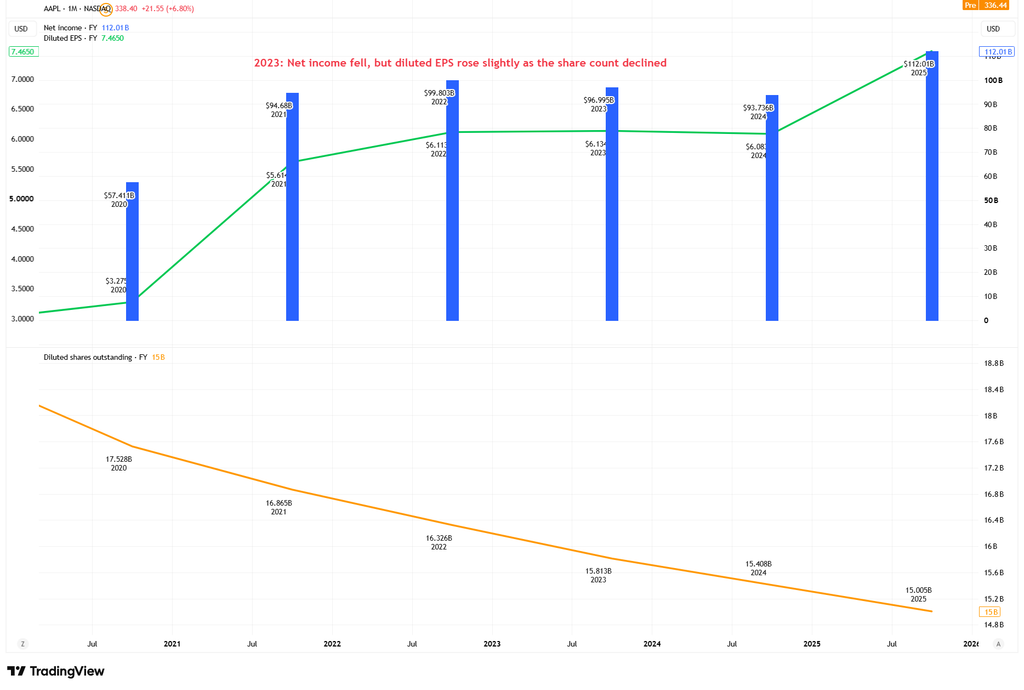
Apple’s diluted share count declined throughout the period. In fiscal 2023, net income fell from approximately $99.8 billion to $97.0 billion, but diluted EPS increased slightly from $6.11 to $6.13 as the weighted average diluted share count declined. In fiscal 2025, the rise in EPS reflected both stronger net income and a further reduction in the share count.
What Should Investors Examine Alongside EPS Growth?
EPS growth should not be assessed in isolation. Investors may also examine changes in net income, the diluted share count and the amount of cash spent on repurchases.
Comparing EPS growth with net income growth can help show whether the increase primarily reflects stronger profitability, a declining share count or a combination of both.
Free cash flow, debt, capital expenditure and stock-based compensation are also relevant. A company may repurchase a large number of shares while simultaneously issuing new shares to employees, reducing the net effect on the diluted share count.
Buybacks may be less effective if shares are repurchased at an expensive valuation, if the company takes on excessive debt or if necessary investment is neglected. A repurchase announcement also does not guarantee that the full authorised amount will be spent. Apple states that its programmes do not oblige the company to acquire a minimum number of shares.
Buybacks should therefore be considered alongside profitability, cash generation, debt and the company’s long-term strategy.
Bottom Line
Earnings per share can rise even when total profit does not because EPS depends on both profit and the number of shares.
Share buybacks can reduce the denominator in the calculation, allowing the same amount of profit to be divided among fewer shares. When profit is also rising, the lower share count can amplify EPS growth.
Stay Up to Date
Explore the latest Market News and Trading Education daily with EC Markets.