




Fed Hikes as Global Central Banks Confront Persistent Inflation | Weekly Recap: 14-18 September 2026


Global monetary policy moved firmly back into focus as the Federal Reserve and Bank of Japan raised interest rates, while the Bank of England held rates but warned that persistent energy pressures could require tighter policy.
Markets responded unevenly. Technology shares remained resilient despite higher rates, the US dollar strengthened and government bond yields stayed elevated. Meanwhile, oil recorded its first weekly decline in three weeks, providing some relief from the energy-driven inflation pressures that have dominated recent market moves.
Economic Overview
Central bank decisions dominated markets as policymakers responded to persistent inflation and elevated energy prices.
The Federal Reserve raised its target range by 0.25 percentage points to 3.75%-4.00% on Wednesday, its first increase since 2023. The decision was unanimous. Chair Kevin Warsh said inflation remained too high and that underlying price pressures had not improved meaningfully, while describing economic activity as solid and the labour market as close to full employment.
Updated projections reinforced the more restrictive message. Policymakers raised their median federal funds rate forecast for the end of 2026 to 4.1%, from 3.8% in June, indicating that another increase remained possible. The median projection for 2026 economic growth rose to 2.3%, while unemployment was lowered to 4.1%. Headline and core PCE inflation forecasts increased to 3.7% and 3.4%, respectively.
US retail sales rose 1.2% month on month in August, their strongest increase since March, while the control group used in GDP calculations increased 1.4%. Industrial production was unchanged, with manufacturing output declining 0.3%. Initial jobless claims fell to 196,000, pointing to continued labour market resilience.
The Bank of England held Bank Rate at 3.75% by a 6-3 vote, with three members preferring an increase to 4.00%. Policymakers warned that prolonged Middle East conflict and higher energy prices had increased upside risks to inflation. The Bank also introduced a multi-year plan for quantitative tightening, with £20 billion of annual gilt sales alongside maturing bonds.
UK inflation accelerated to 3.1% in August from 2.9% in July, although core inflation remained at 2.6% and services inflation held at 3.4%. Retail sales volumes increased 0.5% in August, exceeding expectations.
The Bank of Japan raised its policy rate from 1.00% to 1.25%, the highest level in 31 years, and signalled that further increases remained possible. In China, industrial production growth accelerated to 5.2% year on year in August, but retail sales growth slowed to 0.4% and fixed asset investment fell 7.2% during the first eight months of the year.
Overall, the week showed that economic activity remained resilient, but persistent inflation and energy price uncertainty were encouraging major central banks to maintain or adopt tighter policy settings.
Equities, Bonds and Commodities
US equities diverged as continued enthusiasm around artificial intelligence helped technology stocks withstand the pressure from higher interest rates. The Nasdaq Composite gained 0.7%, while the S&P 500 slipped 0.1% and the Dow Jones Industrial Average fell 1.7%.
Technology shares remained comparatively resilient as investors continued to favour companies exposed to artificial intelligence and data-centre investment. However, the Federal Reserve’s rate increase and higher projected policy path weighed on more interest-rate-sensitive and economically exposed areas.
European markets weakened. The STOXX Europe 600 fell 0.6% over the week, ending Friday at 635.45. Volkswagen declined after reducing its outlook because of weaker conditions in China, restructuring costs and charges linked to Porsche. The FTSE 100 recorded a modest weekly gain despite falling 1.4% on Friday to 10,659.13, when financial and energy shares came under pressure.
Government bond markets remained volatile as investors absorbed a renewed shift towards tighter monetary policy. The US 10-year Treasury yield returned to around 5% following the Fed decision, while Japanese yields remained under pressure after the Bank of Japan raised rates.
UK gilt yields eased following the Bank of England decision and changes to its longer-term quantitative-tightening framework, with the 30-year yield retreating from its highest level since 1998.
Brent crude settled at US$104.87 per barrel on Friday and recorded its first weekly decline in three weeks ( down approximately 4.20% from from its Monday opening high). Prices approached four-month highs earlier in the week after attacks damaged Saudi Arabia’s East West pipeline, but eased as China encouraged Iran to help limit further Houthi attacks and Saudi Arabia worked to restore capacity.
Gold gained approximately 1% over the week, reaching a one week high and trading near US$4,390 per ounce on Friday. Lower oil prices reduced some inflation concerns and prompted investors to unwind bearish positions, although the stronger dollar and higher interest rates remained headwinds.
Sector Performance
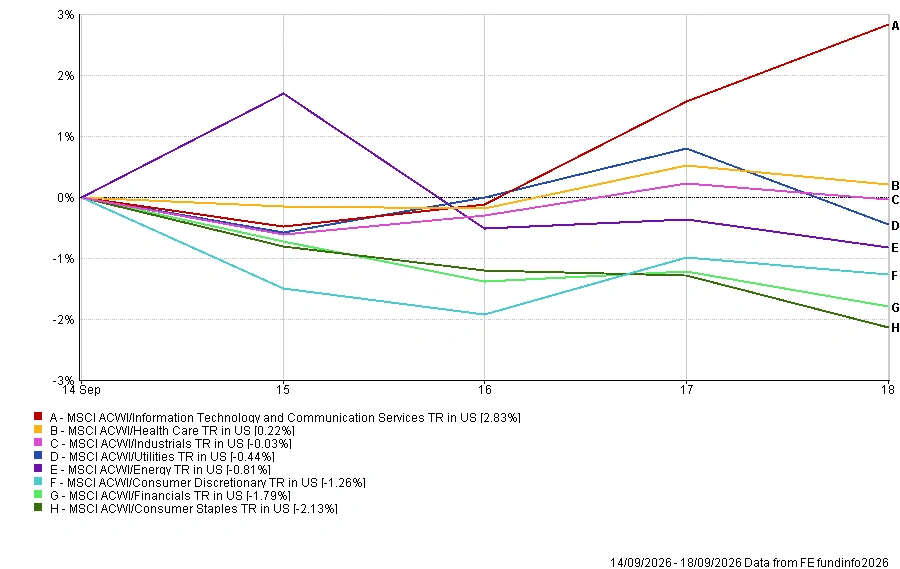
Sector performance reflected the week’s wider divergence, with technology significantly outperforming as AI and data-centre demand continued to attract investors despite higher interest rates.
Information Technology & Communication Services gained 2.83%, making it the clear outperformer, while Healthcare was the only other sector to advance at 0.22%.
Industrials was broadly unchanged at -0.03%, followed by Utilities (-0.44%), Energy (-0.81%), Consumer Discretionary (-1.26%) and Financials (-1.79%). Consumer Staples was the weakest sector, falling 2.13%.
The pattern reflected concentrated strength in technology while higher rates and weaker risk appetite pressured much of the broader market.
Sector Performance 14-18 September 2026
Source: FE Analytics. All indices total return in USD. Past performance is not a reliable indicator of future performance. Data as of 18 September 2026.
Regional Markets
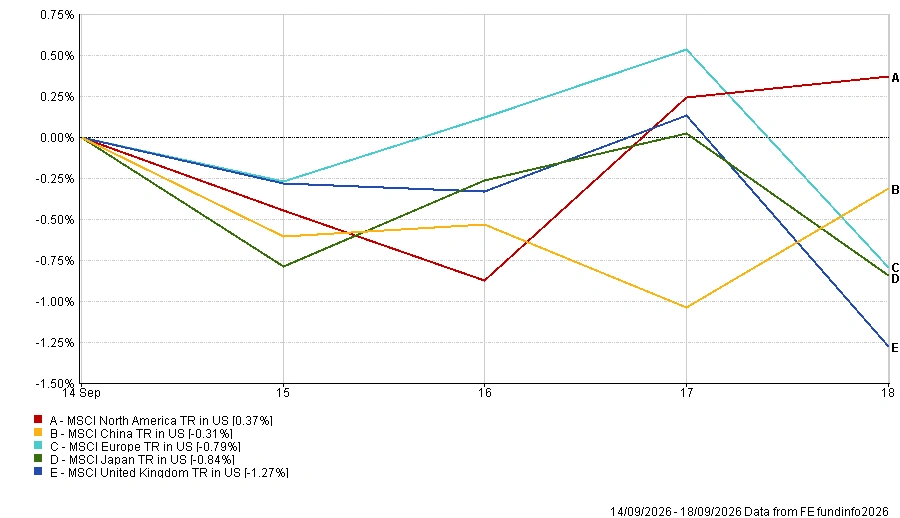
North America was the strongest region, with the MSCI North America TR gaining 0.37% in US-dollar terms, supported by the resilience of technology shares.
China declined 0.31%, as stronger industrial production was offset by weaker consumption and investment data. Europe fell 0.79%, Japan declined 0.84% and the United Kingdom was the weakest region at -1.27%.
Currency movements also affected US-dollar returns, with sterling, the euro and yen all weakening against the dollar during the week.
Regional Performance 14-18 September 2026
Source: FE Analytics. All indices total return in USD. Past performance is not a reliable indicator of future performance. Data as of 18 September 2026.
Currency Markets
The US dollar strengthened broadly following the Federal Reserve’s rate increase and more restrictive policy projections.
EUR/USD fell from 1.1593 to 1.1484, while GBP/USD declined from 1.3525 to 1.3395 despite resilient UK retail-sales data.
The yen also weakened despite the Bank of Japan’s rate increase, with USD/JPY rising from 153.45 to 156.89. GBP/JPY increased from 207.67 to 210.15, meaning sterling strengthened against the yen even as it weakened against the dollar.
Overall, the week’s currency moves highlighted the relative strength of the US dollar as markets adjusted to the Fed’s higher policy path.
Outlook and The Week Ahead
Following a week dominated by central banks, attention now shifts back to economic activity and whether higher interest rates are beginning to weigh more heavily on growth.
Preliminary September PMIs for the United States, United Kingdom and euro area will provide the first broad assessment of business activity, employment and price pressures since the latest round of policy decisions.
In the US, weekly jobless claims and new-home sales follow on Thursday, with durable-goods orders and the final University of Michigan consumer-sentiment reading due Friday. Investors will also monitor Federal Reserve speakers for further guidance on whether another rate increase remains likely.
Corporate attention turns to Costco’s quarterly results on Thursday, offering another indication of consumer resilience and the impact of inflation on household spending.
Geopolitics will remain an important source of uncertainty, with markets monitoring developments in the Middle East alongside US-China discussions on trade, artificial intelligence and critical minerals.
With major central banks maintaining a restrictive stance, markets now face a critical question: can economic activity remain resilient as higher rates and persistent inflation continue to work through the global economy?