













Why Earnings Revisions Can Move Stocks Before Results Are Published


Table of Contents
A company’s share price may rise or fall several weeks before it publishes its financial results, even though investors have not yet seen the final revenue or profit figures. This can make it appear as though the market is reacting to information that has not yet been released.
Markets, however, are forward looking. Analysts and investors continually update their expectations as new information becomes available. Changes in those expectations can affect a company’s share price before its formal earnings announcement.
What Is an Earnings Estimate?
Before a company reports its results, analysts produce forecasts for important financial measures.
Revenue represents the income generated from the company’s operations, while net income is the profit remaining after expenses, interest and taxes. Earnings per share divides the profit attributable to shareholders by the weighted average number of shares. Analysts may also forecast profit margins and free cash flow, which measures the cash generated after operating expenses and capital expenditure.
These forecasts are informed estimates rather than confirmed results.
An analyst consensus combines forecasts from several analysts, usually as an average or median. The exact calculation may differ between data providers. When results are published, markets commonly compare them with this consensus rather than considering the reported figures only in isolation.
What Is an Earnings Revision?
An earnings revision occurs when an analyst raises or lowers a forecast for a company’s future earnings.
Consider a simplified hypothetical example. An analyst expects a company to earn $2.00 per share during the financial year. After receiving new information, the analyst increases the estimate to $2.20. This is an upward earnings revision. If the forecast falls from $2.00 to $1.80, it is a downward revision.
One change may have limited significance. Markets may pay greater attention when several analysts revise their forecasts in the same direction or when the overall consensus changes materially.
Why Analysts Change Their Forecasts
Analysts adjust forecasts when new information changes their assumptions about a company.
Management may raise or lower its guidance for revenue, profits or margins. Customer demand, commodity prices, currency movements and wages can also influence expected earnings. New contracts, regulatory developments and results reported by competitors may provide further information about trading conditions.
Analysts may respond by changing their revenue assumptions, cost forecasts, expected tax rate or estimates for interest expenses. A revision to earnings per share can therefore reflect several underlying developments rather than one isolated change.
Why Share Prices Can Move Before Results
A share price reflects the market’s collective expectations for a company’s future performance.
If expected earnings increase, investors may become willing to pay more for the shares. If forecasts fall, the valuation investors are prepared to accept may decline. The market does not need to wait for the scheduled earnings announcement when new information has already changed the likely outcome.
This adjustment may occur gradually as analysts publish separate revisions. It can happen much faster when a company changes its guidance or releases a trading update.
The eventual results may confirm those expectations, but they can also contradict them. This is why a company can report higher profits and still see its share price fall if the results are weaker than investors expected, or report lower profits and see its shares rise if the outcome is better than anticipated.
Direction, Size and Breadth
Three characteristics can help explain the significance of earnings revisions.
Direction shows whether forecasts are moving higher or lower. Size measures how substantially estimates have changed. Breadth describes how many analysts or companies are experiencing revisions in the same direction.
Broad upward revisions across several companies may indicate improving expectations for an industry. Widespread downward revisions may point towards weaker demand or pressure on profit margins. However, revision breadth does not predict share price movements or economic conditions with certainty.
Earnings Revisions and Valuation
Changing earnings expectations can also affect valuation ratios.
Suppose a company’s shares trade at $40 and its expected earnings are $2 per share. Its forward price-to-earnings (P/E) ratio is 20. If the earnings forecast falls to $1.60 while the share price remains unchanged, the ratio rises to 25.
The shares have become more expensive relative to the revised earnings forecast. The price may therefore adjust as investors consider whether the higher valuation remains justified.
Valuation multiples are also influenced by interest rates, market sentiment, company quality and expected long-term growth. An earnings revision is only one part of the assessment.
Nvidia: How Expectations Changed Before Final Results
Nvidia provided a clear example in August 2022.
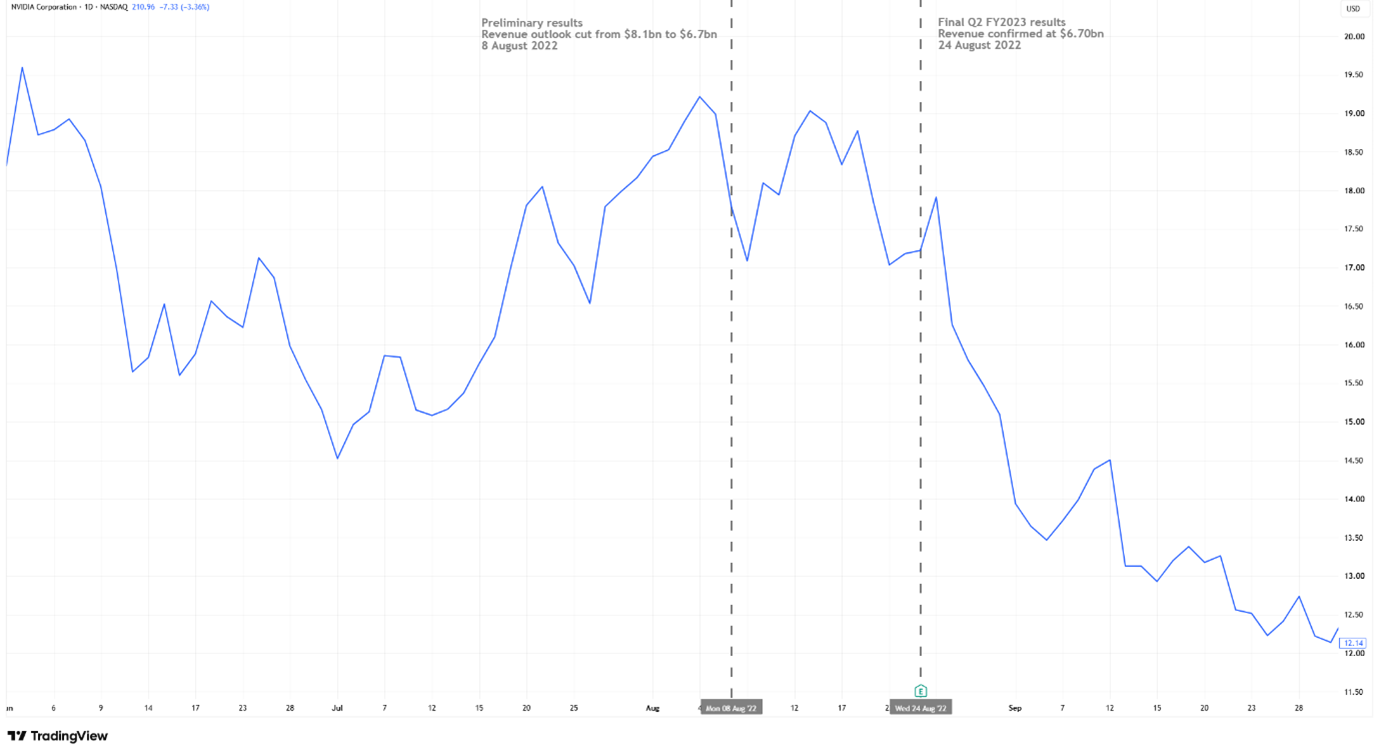
The company had previously forecast revenue of approximately $8.1 billion for its second quarter of the 2023 financial year. On 8 August, more than two weeks before its scheduled results, Nvidia released preliminary figures reducing the expected revenue figure to approximately $6.7 billion.
The company attributed the shortfall mainly to weaker gaming revenue. It also expected adjusted gross margin of 46.1%, compared with its earlier outlook of 67.1%. Nvidia shares fell approximately 6% during regular trading that day as investors responded to the weaker preliminary figures.
On 24 August, Nvidia published its final results and confirmed quarterly revenue of $6.70 billion. The final announcement therefore largely confirmed information that investors had received earlier rather than revealing the revenue weakness for the first time.
Nvidia Share Price Around Preliminary and Final Results
Source & Methodology: TradingView. Data as of 15 September 2026.
Nvidia reduced its expected second-quarter revenue before publishing its complete financial results in August 2022. The shares declined as the weaker expectations became public, while the final results later confirmed revenue of $6.70 billion. Broader equity market conditions and other developments may also have influenced Nvidia’s share price during the period.
What Earnings Revisions Cannot Tell Us
Analyst forecasts can be incorrect, incomplete or based on similar assumptions. Analysts may also revise forecasts only after the share price has already responded to new information.
Consensus figures can conceal disagreement between individual analysts. Higher forecasts do not guarantee a rising share price, as valuation, guidance, cash flow and expectations already reflected in the price also matter.
Bottom Line
Share prices do not wait for completed financial results. Markets continually adjust to new information, and changes in company guidance, analyst forecasts and investor expectations can affect valuations before the scheduled reporting date.
Earnings revisions can help show how expectations are changing, but they should be considered alongside valuation, company guidance, financial performance and broader market conditions. They do not predict how a share price will respond when results are eventually published.