














Strong US Jobs, Oil Rally and Bond Volatility Shift Rate Expectations | Weekly Market Recap: 31 August-4 September 2026


Strong US employment data, renewed oil supply concerns and sharp moves across global bond markets reshaped interest-rate expectations during the first week of September. US payrolls comfortably exceeded forecasts, Brent crude gained more than 7% and government borrowing costs climbed across several major markets. With inflation data and the European Central Bank’s latest rate decision ahead, investors now face another important week for the global monetary policy outlook.
Economic Overview
Investors focused on US employment data, renewed energy supply concerns and the outlook for interest rates during a volatile week for global bond markets.
The US economy added 162,000 jobs in August, well above economists’ expectations for an increase of 56,000. July’s figure was revised from a decline of 23,000 jobs to an increase of 21,000, while June and July were revised higher by a combined 55,000. The unemployment rate remained at 4.1%.
Labour force participation edged up to 61.6%, while average hourly earnings increased 0.3% month on month and 3.1% year on year. The stronger report eased concerns about a sharp deterioration in the labour market but increased expectations that the Federal Reserve could raise interest rates at its September meeting.
Earlier in the week, the July Job Openings and Labor Turnover Survey showed that vacancies were little changed at 7.3 million. Hires and total separations both stood at 5.1 million, while the quits rate remained at 1.9%, indicating that labour demand was broadly stable.
Elsewhere, euro area inflation increased to 3.3% in August from 2.9% in July, largely because annual energy inflation accelerated to 14.3%. Inflation excluding energy remained at 2.2%. Business surveys were more encouraging, with the euro area manufacturing purchasing managers’ index rising to 52.7, its highest level since May 2022. China’s private manufacturing index also increased to 51.5.
Overall, the week highlighted the challenge facing central banks: economic activity remained resilient, but elevated energy prices and persistent inflation continued to support the case for tighter monetary policy.
Equities, Bonds and Commodities
Global equity markets were mixed as resilient economic data and artificial intelligence demand supported parts of the market, while higher oil prices and rising government bond yields limited broader gains.
In the United States, the S&P 500, Nasdaq Composite and Dow Jones Industrial Average were broadly unchanged over the full week. All three indices declined on Friday after the stronger employment report increased expectations for a September interest rate rise. The S&P 500 fell 0.38% on Friday, while the Nasdaq declined 0.29% and the Dow dropped 0.51%.
Broadcom provided the week’s main corporate update. The semiconductor company reported third quarter revenue of US$29.59 billion, supported by artificial intelligence semiconductor revenue of US$16.7 billion, which increased 221% year on year. However, a softer near term revenue outlook limited the positive market response as investors assessed whether strong artificial intelligence demand was already reflected in expectations.
European markets were weaker. The STOXX Europe 600 declined 0.8% over the week as higher energy prices, inflation concerns and rising borrowing costs outweighed a late rally in Volkswagen following the announcement of a restructuring plan.
Government bond markets experienced sharp swings. The US 10-year Treasury yield approached 4.80%, while the two-year yield finished Friday near 4.37% after the employment report. Japan’s 10-year government bond yield reached 3% for the first time since 1996 as higher energy prices, fiscal concerns and expectations for further Bank of Japan tightening intensified selling pressure. Longer term UK and euro area borrowing costs also touched multiyear highs. Concerns about government debt, persistent inflation and expectations for further interest rate rises contributed to the broader selloff.
Brent crude gained 7.6% over the week to settle at US$96.28 per barrel, while WTI surged 9.69% to US$91.48. Renewed military exchanges between the United States and Iran and continued disruption through the Strait of Hormuz revived concerns over global oil supplies, driving both benchmarks sharply higher.
Gold moved in the opposite direction, falling more than 3% over the week and slipping below US$4,450 per ounce. The precious metal lost nearly US$147 as stronger US employment data pushed Treasury yields higher and increased expectations for a September Federal Reserve rate rise. Despite the weekly decline, gold remained up more than 10% over August, highlighting the strength of the rally that preceded the pullback.
Sector Performance
The FE Analytics sector data showed a varied performance pattern, with Financials, Utilities and Energy leading while consumer related sectors lagged.
Financials delivered the strongest return, rising 1.37%, as higher government bond yields supported expectations for stronger banking margins. Utilities gained 0.81%, while Energy advanced 0.65% alongside the sharp increase in crude oil prices.
Information Technology and Communication Services rose 0.63%, supported by continued demand for artificial intelligence infrastructure, while Healthcare gained 0.58%. Industrials declined 0.35% and Consumer Staples fell 0.39%.
Consumer Discretionary was the weakest performing sector, falling 1.43%, as higher fuel costs and tighter financial conditions created additional pressure on consumer facing companies.
The overall pattern showed investors favouring Financials, Energy and selected defensive areas, while businesses more exposed to household spending came under pressure.
Sector Performance August 31st – September 4th 2026
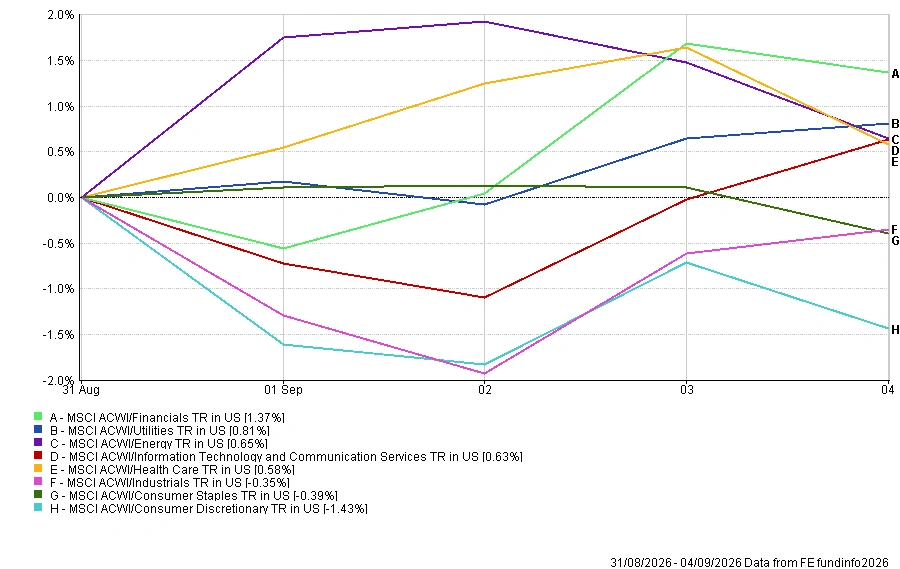
Source: FE Analytics. All indices total return in USD. Past performance is not a reliable indicator of future performance. Data as of 4 September 2026.
Regional Markets
Regional performance was mixed, with Japan outperforming North America, Europe, the United Kingdom and China.
Japan delivered the strongest return, gaining 1.12%. The yen strengthened considerably during the week, which enhanced the return of Japanese assets when translated into US dollars. Expectations for further Bank of Japan tightening and the rise in Japanese government bond yields also influenced regional markets.
North America advanced 0.47% as US equities remained broadly resilient despite higher Treasury yields and renewed expectations for a September interest rate rise.
The United Kingdom declined 0.10%, while Europe fell 0.13% as higher energy prices, persistent inflation and rising borrowing costs weighed on sentiment. China was the weakest region, falling 0.74%. An improvement in private manufacturing activity was not enough to offset broader concerns about the economy and a weaker signal from the official factory survey.
The regional pattern showed Japan benefiting from stronger currency translation and North America remaining relatively resilient, while inflation concerns and uncertainty around Chinese growth constrained other markets.
Regional Performance August 31st – September 4th 2026
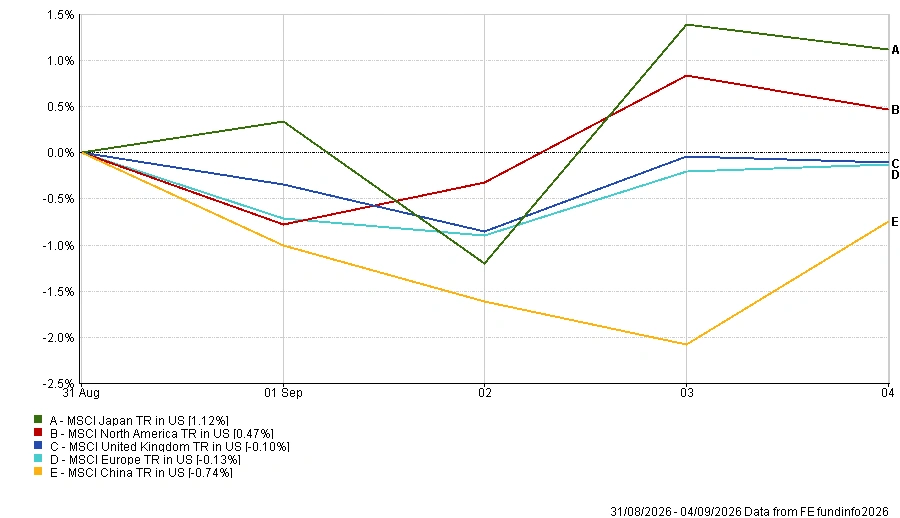
Source: FE Analytics. All indices total return in USD. Past performance is not a reliable indicator of future performance. Data as of 4 September 2026.
Currency Markets
Currency markets reflected shifting interest rate expectations, with the yen strengthening considerably against both the US dollar and sterling.
EUR/USD moved from an opening level of 1.1585 on 31 August to close at 1.1614 on 4 September, leaving the euro slightly stronger against the dollar. Higher euro area inflation reinforced expectations that the European Central Bank would raise interest rates at its September meeting.
GBP/USD moved from 1.3531 at Monday’s open to 1.3523 at Friday’s close, leaving sterling almost unchanged but marginally weaker against the US dollar.
The yen was the clearest outperformer. USD/JPY declined from 160.15 to 156.25 as investors increased expectations for further Bank of Japan tightening and Japanese government bond yields rose. GBP/JPY similarly fell from 216.73 to 211.28, confirming that the yen’s strength extended beyond its movement against the dollar.
Overall, the yen was the strongest of the currencies covered, while sterling was the weakest as it declined against both the US dollar and the Japanese yen.
Outlook: The Week Ahead
Attention now turns to inflation data as investors assess whether persistent price pressures will lead to further interest rate rises.
The US Producer Price Index is scheduled for Thursday, followed by the Consumer Price Index on Friday. Following the stronger employment report and the increase in oil prices, the releases will be important for expectations surrounding the Federal Reserve’s 15-16 September meeting. Evidence that inflation is broadening could reinforce expectations for a rate rise, while softer readings could strengthen the case for holding policy steady.
In Europe, the European Central Bank will announce its latest interest rate decision on Thursday. Markets expect the ECB to raise its deposit rate by 0.25 percentage points to 2.50%. Investors will focus on the updated economic projections and whether policymakers indicate that further tightening may be required.
Oracle is also scheduled to report quarterly results, providing another indication of demand for artificial intelligence infrastructure following recent updates from Nvidia and Broadcom.
For now, markets remain caught between resilient economic activity and renewed inflation risks, leaving incoming price data, central bank decisions and geopolitical developments as the main influences on sentiment.