














Sticky US Inflation Tests Markets Despite Nvidia Strength | Weekly Recap: 24-28 August 2026


Sticky US inflation and Nvidia’s strong earnings pulled markets in opposite directions during the final week of August. Technology stocks benefited from another strong signal on AI demand, while persistent US price pressures and a more hawkish message from Federal Reserve Chair Kevin Warsh strengthened expectations that interest rates could rise again.
US equities ultimately finished higher, led by technology, while the dollar strengthened and oil prices retreated. The result was another selective week as investors balanced resilient corporate earnings against the prospect of tighter monetary policy.
Economic Overview
US inflation and monetary policy dominated the macroeconomic picture as investors assessed whether persistent price pressures could prompt the Federal Reserve to tighten policy further.
July’s PCE Price Index rose 0.2% month-on-month and 3.7% year-on-year, while core PCE increased 0.2% on the month and 3.3% from a year earlier. Personal income rose 0.4%, while nominal consumer spending increased 0.2%, although real spending was broadly unchanged after adjusting for inflation. With both headline and core inflation remaining well above the Federal Reserve’s 2% target, expectations for a possible September rate increase strengthened.
The second estimate of US second-quarter GDP confirmed annualised growth of 1.5%, down from 2.1% in the first quarter. Consumer confidence also weakened, with the Conference Board index falling to 89.4 in August from a revised 90.2 in July.
Federal Reserve Chair Kevin Warsh reinforced the central bank’s commitment to returning inflation to 2% during his Jackson Hole speech on Friday, indicating that policymakers could have more work to do if inflation failed to improve sufficiently. His comments further strengthened expectations that monetary policy could tighten in September.
Elsewhere, Germany’s economy expanded 0.3% quarter-on-quarter in the second quarter, while the Ifo Business Climate Index rose to 88.8 in August. Tokyo core inflation accelerated to 1.8% year-on-year, keeping expectations for further Bank of Japan tightening in focus.
Overall, the week’s data highlighted an uneven global backdrop: US growth remained positive, but persistent inflation kept the prospect of tighter monetary policy firmly in focus.
Equities, Bonds and Commodities
Equities
Global equity markets were mixed as strong technology earnings supported risk appetite, while persistent inflation and renewed expectations for higher US interest rates limited gains later in the week.
In the United States, Nvidia provided the week’s main corporate catalyst. Second-quarter revenue more than doubled to US$96.22 billion, exceeding market expectations, while the company’s outlook reinforced confidence in continued demand for artificial intelligence infrastructure. US equities rallied following the results before giving back some gains on Friday after Warsh’s comments. The S&P 500 gained 0.49%, the Nasdaq Composite rose 0.85% and the Dow Jones Industrial Average advanced 0.53% over the week.
European markets were more subdued. The STOXX Europe 600 recorded a modest weekly gain, while concerns around French public finances and weaker French growth weighed on sentiment. UK equities ended Friday higher, with the FTSE 100 closing at 10,824.26, but remained nearly unchanged over the full week.
Bonds
Government bond markets reflected the shift towards tighter US rate expectations. Shorter-dated Treasury yields rose following the PCE release and again after Warsh’s Jackson Hole remarks as investors increased expectations for a September rate increase. The move contrasted with the previous week’s pressure at the longer end of the Treasury curve, shifting attention back towards the expected path of Federal Reserve policy.
Commodities
Brent crude fell more than 5% over the week to US$89.31 per barrel as markets assessed recovering flows through the Strait of Hormuz and the prospect of improved shipping access.
Gold reached a more than three-month high earlier in the week before falling around 3% on Friday, as stronger US rate expectations and a firmer dollar weighed on precious metals.
Sector Performance
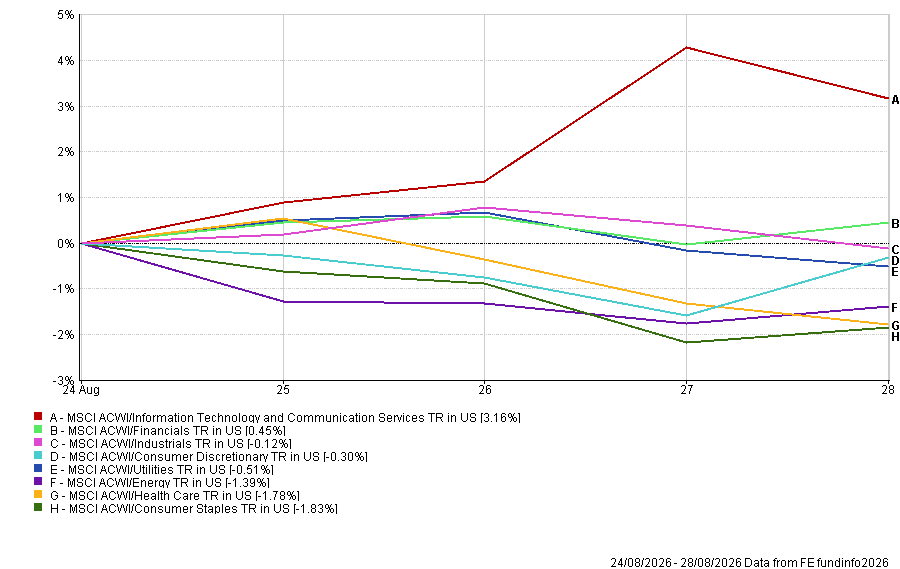
The FE Analytics sector data showed a clear concentration of strength in technology-related companies during the week.
Information Technology and Communication Services delivered the strongest return, rising 3.16%, consistent with renewed enthusiasm around artificial intelligence following NVIDIA’s results. Financials were the only other sector to finish higher, gaining 0.45%.
Industrials declined 0.12% and Consumer Discretionary fell 0.30%, while Utilities lost 0.51%. Energy declined 1.39% as crude oil prices fell over the week. Healthcare dropped 1.78%, while Consumer Staples was the weakest performing sector, falling 1.83%.
The overall pattern showed investors favouring technology exposure while several defensive and commodity-sensitive areas lagged.
Sector Performance: August 24-28 2026
Source: FE Analytics. All indices total return in USD. Past performance is not a reliable indicator of future performance. Data as of 28 August 2026.
Regional Markets
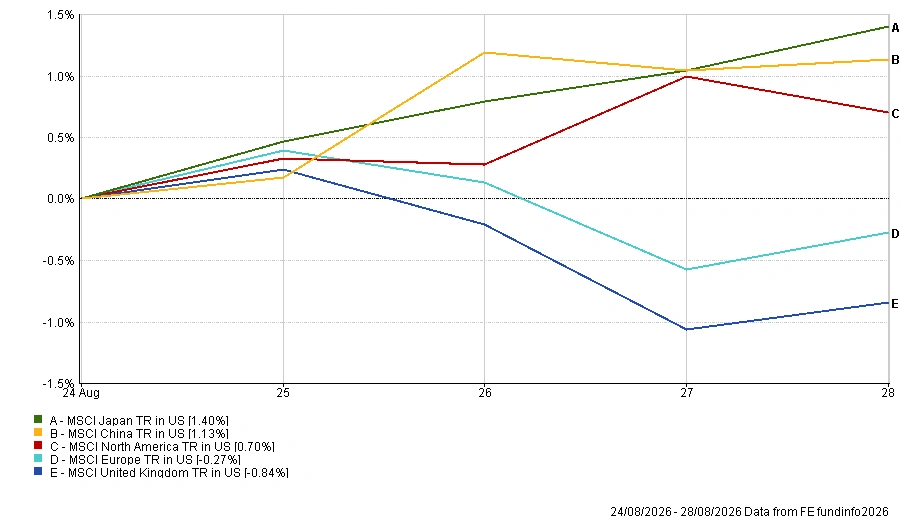
Regional performance was mixed, with Asia outperforming Europe and the United Kingdom.
Japan delivered the strongest return, gaining 1.40%, while China rose 1.13%. North America advanced 0.70%, supported by gains in US equities and the strong response to Nvidia’s earnings.
Europe declined 0.27% and the United Kingdom was the weakest region, falling 0.84%. Both the euro and sterling weakened against the US dollar over the measurement period, reducing translated returns in the FE Analytics US dollar-based series. This helps explain why the regional figures were weaker than some local-currency benchmarks, with the STOXX Europe 600 posting a modest weekly gain and the FTSE 100 finishing nearly unchanged in local terms.
Japan’s weaker yen similarly reduced the currency translation contribution to its US dollar return, indicating that underlying local-market performance was stronger than the headline FE Analytics figure suggests.
Regional Performance: August 24-28 2026
Source: Source: FE Analytics. All indices total return in USD. Past performance is not a reliable indicator of future performance. Data as of 28 August 2026.
Currency Markets
Currency markets reflected stronger US interest-rate expectations and renewed demand for the dollar.
- EUR/USD fell from 1.1679 to 1.1585, as persistent US inflation and shifting Fed expectations supported the dollar.
- GBP/USD declined from 1.3626 to 1.3535, while USD/JPY rose from 158.96 to 160.07 despite Tokyo inflation keeping expectations for further Bank of Japan tightening alive.
- GBP/JPY was comparatively stable, moving from 216.79 to 216.66.
Overall, the US dollar was the clearest outperformer as persistent inflation and Warsh’s emphasis on returning inflation to the Federal Reserve’s 2% target strengthened expectations for tighter US monetary policy.
Outlook and The Week Ahead
Attention now turns from inflation to the US labour market, which could become the next major test for Federal Reserve rate expectations.
The July Job Openings and Labor Turnover Survey is scheduled for Tuesday, followed by the August employment report on Friday. After payroll employment unexpectedly declined in July, the latest jobs data will be closely watched for evidence of whether labour-market conditions are weakening enough to complicate the case for tighter monetary policy.
In Europe, the flash estimate of August euro area inflation is also due Tuesday. With July inflation at 2.9%, the release will provide another indication of whether price pressures remain strong enough to keep the European Central Bank cautious.
Corporate earnings remain in focus, with Broadcom providing another test of demand for artificial intelligence infrastructure following Nvidia’s strong results.
For now, markets remain caught between resilient corporate earnings and persistent inflation. With expectations for a September Fed rate increase back in focus, labour-market data could determine whether that tension intensifies or begins to ease.