














Why Can a Stock Fall After Good Earnings?


A company reports rising revenue, stronger profits and earnings above analyst forecasts. On the surface, the announcement appears positive. Yet instead of rising, its share price falls sharply. This reaction can seem confusing when the headline figures suggest that the business is performing well.
A stock can fall after good earnings because markets react to results relative to expectations, not simply whether the numbers are positive. Stock prices are forward looking and may already reflect expectations for revenue, earnings, growth and guidance before results are announced. If the company fails to exceed those expectations, its share price can fall even after an earnings beat.
Why Earnings Expectations Matter
Published consensus estimates provide a useful benchmark, but they do not always capture the full level of optimism embedded in a share price.
Investors may privately expect a company to beat the official forecast by a wider margin. These unofficial expectations are sometimes called “whisper numbers”. They are not formal forecasts, but they can influence how investors position themselves before an announcement.
Suppose analysts expect earnings per share of £1.00 and the company reports £1.05. That is technically an earnings beat. However, if investors had informally expected £1.10, the result may still be viewed as disappointing.
This is particularly important when a company’s shares have risen strongly before the announcement. The increase may indicate that investors have already priced in rapid growth, improving margins or stronger guidance. When the report arrives, merely beating the published estimate may therefore not be enough to meet the expectations already reflected in the stock price.
How Stock Valuation Affects the Reaction to Earnings
The same earnings report can produce different reactions depending on the expectations reflected in each company’s valuation.
A company’s valuation reflects assumptions about its future growth, profitability and risk. When investors are willing to pay a high multiple of earnings or revenue, they are placing greater confidence in the company’s ability to deliver future growth. This can create a higher hurdle when earnings are announced.
Consider two simplified companies:
- Company A is priced for very strong growth after its shares have risen substantially. It reports higher revenue and profit, but its growth rate begins to slow. Although the results are good, they may not be strong enough to justify the valuation.
- Company B is priced for weak growth because investors expect difficult trading conditions. It reports only modest improvement, but the results are slightly better than feared. Its shares may rise because the announcement improves the outlook that was previously reflected in the price.
The difference is therefore not simply how well each business performed. It is the relationship between fundamental performance, valuation and market expectations.
What Should Investors Look for in an Earnings Report?
Headline revenue and earnings per share provide only part of the picture. Fundamental analysis looks deeper into how those results were generated and whether the company’s financial performance appears sustainable.
Investors may consider:
Revenue Growth: Is the company continuing to expand, and is its growth rate accelerating or slowing?
Profit Margins: Is the company generating more or less profit from its revenue?
Earnings Quality: Are profits being driven by underlying operations or influenced by one-off factors?
Cash Flow: Are reported earnings translating into cash generated by the business?
Management Guidance: Has the company raised, maintained or lowered its expectations for future revenue and earnings?
A company can therefore beat headline earnings estimates while other parts of its financial results point towards slower future growth.
Western Digital: Why the Stock Fell After Strong Earnings
Western Digital provided a clear example in August 2026. On 5 August, the company reported fiscal fourth quarter revenue of $3.747 billion, an increase of 44% from the previous year. Non-GAAP earnings were $3.56 per share, while free cash flow reached $1.28 billion. Revenue exceeded the approximately $3.70 billion analyst forecast, while adjusted earnings surpassed the $3.31 estimate, according to Western Digital’s official results and The Wall Street Journal.
The company also forecast fiscal first quarter revenue of $4.1 billion, plus or minus $100 million, and non-GAAP earnings of $4.00 per share, plus or minus $0.15.
Despite these strong figures, Western Digital shares fell approximately 10% in after-hours trading following the announcement. The following day, the shares fell 13.03% to close at $451.52 during regular trading, after dropping to an intraday low of $407.48.
The issue was not that Western Digital had reported weak results. Instead, the market reaction reflected the gap between the company’s performance and the expectations already embedded in its valuation. Western Digital’s shares had already more than tripled during 2026 as investors anticipated strong demand linked to artificial intelligence and data centre investment. Its revenue outlook exceeded the formal analyst consensus but fell short of the more optimistic expectations embedded in the share price. Concerns that price increases and growth could begin to normalise also influenced sentiment, according to Reuters.
Western Digital vs S&P 500 Around Q4 2026 Earnings
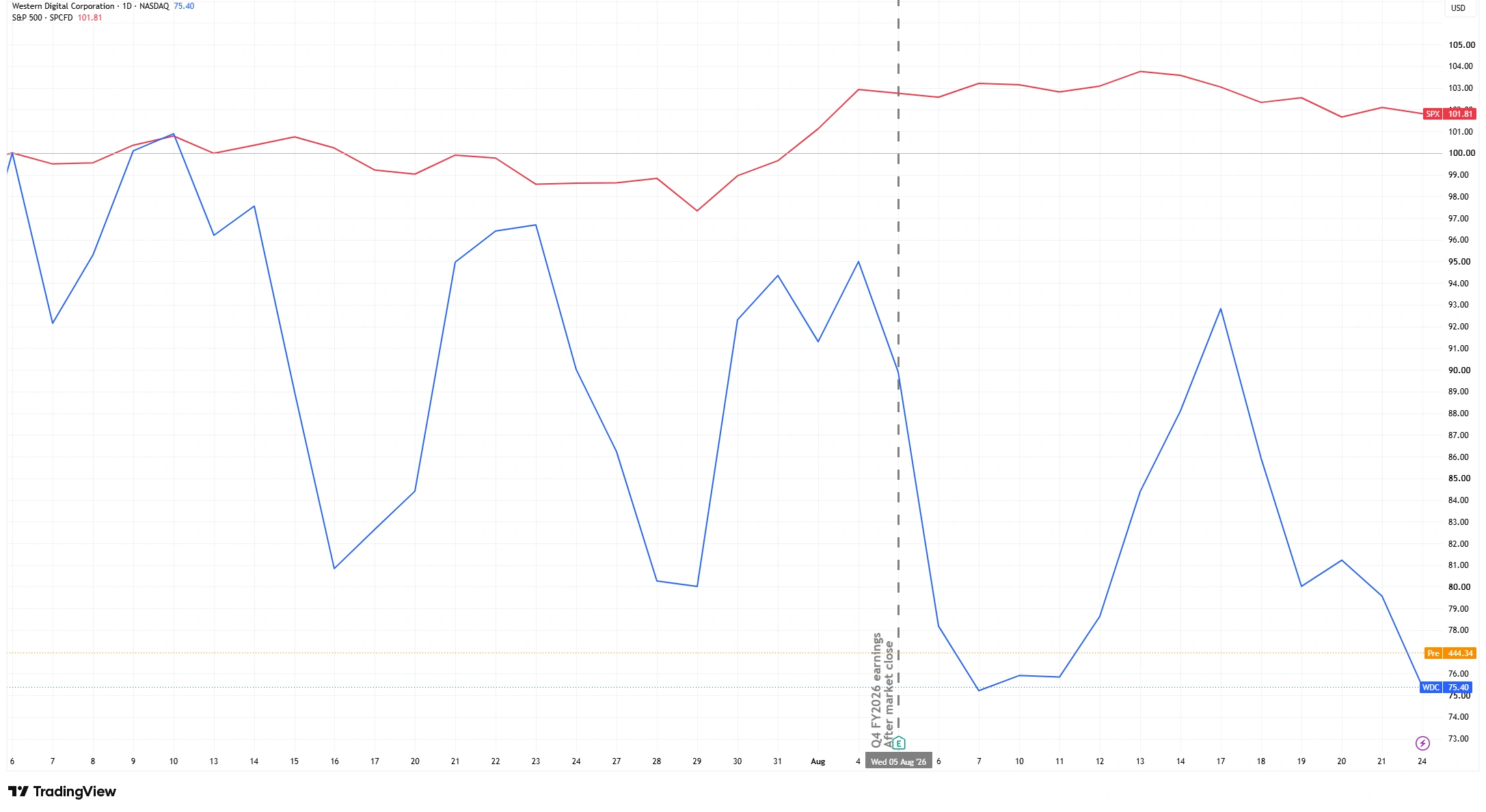
Source & Methodology: TradingView. The chart compares Western Digital’s share price performance with the S&P 500 from 6 July to 24 August 2026, with both series indexed to 100 at the beginning of the selected period. Daily closing prices are used, and the release of Western Digital’s earnings after the US market close on 5 August 2026 is marked on the chart. Past performance is not a reliable indicator of future performance. Data as of 24 August 2026.
Western Digital shares fell sharply following the earnings announcement even though revenue and adjusted earnings exceeded analysts’ forecasts. The reaction reflected the high expectations created by the stock’s earlier rally and concerns that future growth and pricing improvements might begin to normalise. The comparison with the S&P 500 helps separate part of the company specific reaction from wider market movements, although the announcement was not necessarily the only factor influencing the shares.
Bottom Line
A strong earnings report does not automatically mean a company’s share price will rise. Fundamental analysis requires investors to look beyond whether revenue or earnings simply beat analyst forecasts.
Growth rates, margins, cash flow, earnings quality, valuation and management guidance can provide a more complete picture of how the business is performing and what that performance may mean for the future.
Expectations provide the final piece of the puzzle. If strong growth is already reflected in a company’s valuation, even impressive results may not be enough to push the share price higher.
The key question is therefore not simply whether a company performed well, but whether its fundamentals support the expectations already reflected in its valuation.