



AI Optimism Lifts Markets as Strong US Data Pushes Yields Higher | Weekly Recap: 21-25 September 2026


Global markets navigated competing forces last week as stronger economic data pushed bond yields higher while renewed enthusiasm around artificial intelligence supported technology shares.
US business activity and labour-market data reinforced the picture of a resilient economy, keeping expectations for restrictive monetary policy firmly in place. The US dollar strengthened and Treasury yields climbed, but technology shares continued to advance, helping the Nasdaq outperform broader equity markets.
Economic Overview
US business activity accelerated sharply in September, reinforcing evidence of continued economic resilience. The S&P Global Flash US Composite PMI rose to 58.4 from 56.0 in August, its highest level since July 2021. Employment growth also accelerated, while input-cost pressures reached their strongest in almost four years, adding to concerns that inflation could remain elevated. Initial jobless claims remained low at 197,000, reinforcing evidence of a resilient labour market.
Housing data were also stronger. New home sales increased 6.4% in August to an annualised rate of 684,000, while durable goods orders were broadly unchanged. Orders excluding transportation increased, pointing to continued underlying business investment.
Federal Reserve officials maintained a cautious stance following September’s rate increase. Firm activity data and persistent price pressures increased expectations that another rise could be considered, pushing longer dated Treasury yields higher.
In Europe, the euro area composite PMI rose to 53.1 in September from 52.0, its highest since April 2023, while elevated energy and input costs kept further ECB tightening in focus. UK activity expanded more slowly, with the services PMI falling to 51.7 from 52.5 amid intensifying cost pressures.
The US-China summit produced limited progress but helped contain concerns about an immediate escalation in trade tensions. The existing trade truce was extended, tariff reductions were announced for selected goods and the countries agreed to establish a channel for artificial intelligence related incidents. Structural disagreements over technology, advanced semiconductors and critical minerals remained unresolved.
Overall, stronger activity data reinforced the view that major economies, particularly the United States, remain resilient enough to withstand restrictive monetary policy. However, persistent price pressures and elevated energy costs continued to complicate the outlook for interest rates.
Equities, Bonds and Commodities
US equities advanced as enthusiasm surrounding artificial intelligence outweighed pressure from rising bond yields. The Nasdaq Composite gained 2.1%, outperforming the S&P 500 at +1.2% and the Dow Jones Industrial Average at +0.3%.
Technology shares led the gains. Meta Platforms rallied following a positive reception for its Muse artificial intelligence assistant, while semiconductor companies benefited from expectations of continued investment in data centres and computing infrastructure. Broader market performance was less convincing as financial and interest rate sensitive shares faced pressure from higher borrowing costs.
European equities also recovered. The STOXX Europe 600 gained 0.5%, ending three consecutive weeks of losses, while the FTSE 100 rose 0.3%. Falling oil prices early in the week supported sentiment, although higher government bond yields and uncertainty surrounding the Middle East limited the advance.
Bond markets weakened as stronger economic data pushed investors to reassess the outlook for interest rates. The US 10-year Treasury yield ended the week near 5.18%, after reaching its highest level since 2007.
Euro area government bond yields also rose as higher energy costs kept further ECB tightening in focus. UK gilt yields remained elevated, while Japanese government bond yields climbed to fresh multi-year highs.
Brent crude settled at US$104.32 per barrel on Friday, approximately 0.5% lower over the week. Prices were volatile as markets weighed continuing Middle East supply risks against reports of negotiations involving a phased reopening of the Strait of Hormuz.
Gold declined by more than 2% over the week to approximately US$4,284 per ounce. A stronger dollar, rising Treasury yields and expectations that US interest rates could remain elevated reduced demand for the non-yielding metal.
Sector Performance
Sector performance reflected the impact of higher yields, with technology continuing to outperform while rate-sensitive areas came under pressure.
Information Technology and Communication Services was the strongest sector, gaining 0.93%, as investor demand remained concentrated in artificial intelligence, semiconductor and data centre related companies. Healthcare advanced 0.43%, while Consumer Staples rose 0.10%.
Industrials declined 0.17% and Energy fell 0.39%. Consumer Discretionary lost 1.62%, Financials declined 1.77% and Utilities was the weakest sector, falling 2.32%. Higher bond yields weighed particularly heavily on defensive, income sensitive sectors, while technology benefited from renewed artificial intelligence optimism.
Sector Performance September 21-25 2026
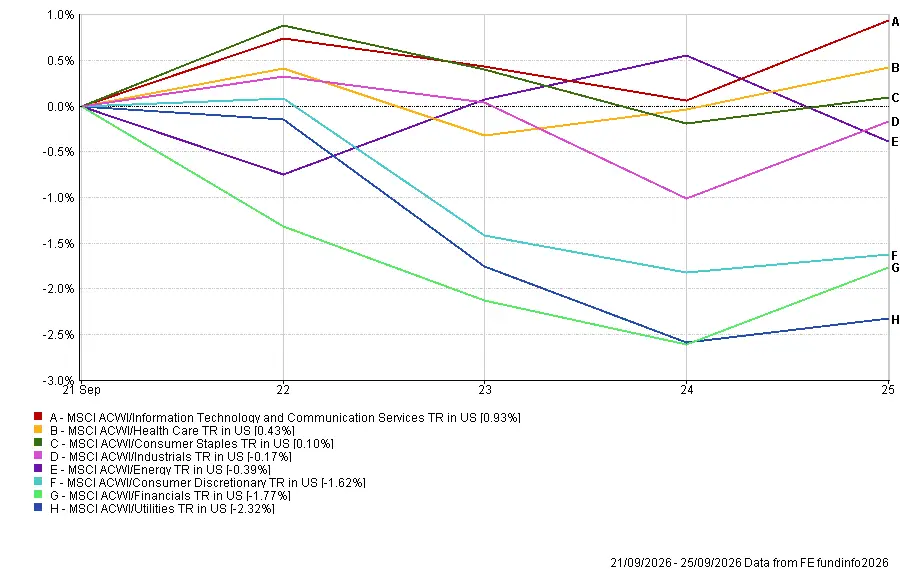
Source: FE Analytics. All indices total return in USD. Past performance is not a reliable indicator of future performance. Data as of 25 September 2026.
Regional Markets
The MSCI Japan TR in US dollars was the strongest regional index, gaining 1.17%. Japanese equities benefited from technology exposure and the improved global risk backdrop, although movements in the yen influenced the US dollar return.
The MSCI North America TR in US dollars declined 0.34% according to FE Analytics. Performance within the broader regional index was weaker than the gains recorded by the headline US equity benchmarks, reflecting differences in index composition and measurement.
The MSCI Europe TR in US dollars fell 1.01%, while the MSCI United Kingdom TR in US dollars declined 1.37%. The MSCI China TR in US dollars was the weakest regional index, falling 2.04%, as concerns surrounding domestic consumption and investment continued. The US-China summit reduced the risk of an immediate escalation but did not resolve longer-term disagreements surrounding trade, technology and critical minerals.
The stronger US dollar reduced translated returns from Europe, the United Kingdom and China. The yen’s movement was more limited, helping Japan outperform the other regions in US dollar terms.
Regional Performance September 21-25 2026
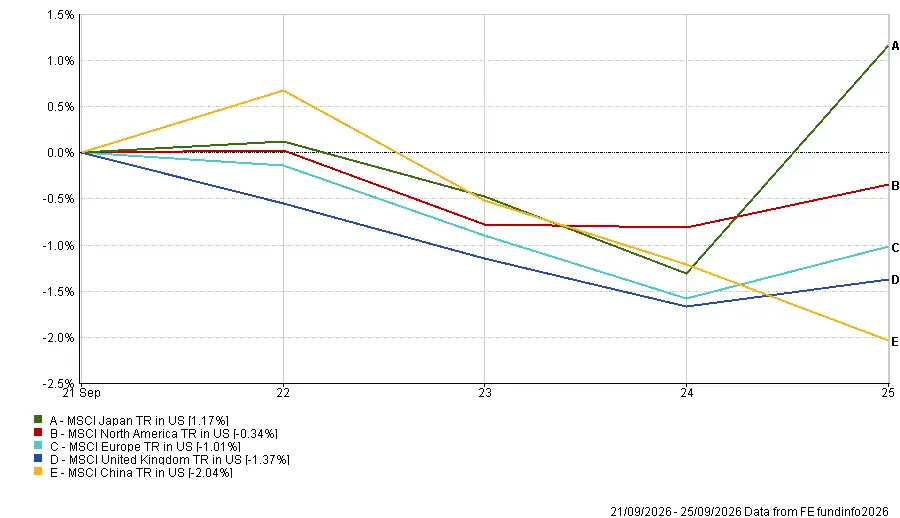
Source: FE Analytics. All indices total return in USD. Past performance is not a reliable indicator of future performance. Data as of 25 September 2026.
Currency Markets
The US dollar strengthened against the euro and sterling as resilient US data and higher Treasury yields supported expectations that the Federal Reserve could tighten policy again.
The US dollar strengthened broadly as resilient economic data and rising Treasury yields reinforced expectations that Federal Reserve policy could remain restrictive.
EUR/USD fell from 1.1487 to 1.1391, despite stronger euro area business activity, while GBP/USD declined from 1.3388 to 1.3253 as UK services growth slowed.
USD/JPY rose from 156.81 to 157.28, leaving the yen modestly weaker over the week despite recovering some ground on Friday. GBP/JPY fell from 210.04 to 208.44, meaning sterling weakened against the yen even as both currencies declined against the US dollar.
Overall, currency markets reflected the widening gap between resilient US economic data and softer activity elsewhere.
Outlook and The Week Ahead
Attention now turns to US inflation and employment data, which could play an important role in shaping expectations for the Federal Reserve’s next policy decision.
August PCE inflation, the Fed’s preferred inflation measure, is due Wednesday alongside personal income, consumer spending and the third estimate of second-quarter US GDP. The release will be closely watched for evidence of whether underlying price pressures remain persistent following September’s rate increase.
The September US employment report follows on Friday, with investors focused on nonfarm payrolls, unemployment and average hourly earnings for further evidence of labour-market resilience and wage pressures.
Other releases include JOLTS job openings and the ISM manufacturing survey. Elsewhere, euro area inflation will help shape expectations for the ECB, while the Reserve Bank of Australia delivers its latest rate decision. Chinese PMIs and the Bank of Japan’s Tankan survey will provide further signals on economic conditions across Asia.
Oil prices and developments in the Middle East will remain important, alongside any further developments in US-China relations. With markets increasingly questioning how long restrictive policy can coexist with resilient growth, this week’s inflation and employment data could prove critical for the next move in interest-rate expectations.