














Oil Falls Below $100 as Supply Fears Ease and Markets Reassess Inflation Risk


Brent crude extended its decline below $100 a barrel on Wednesday as signs of improving Gulf supply and hopes for progress in US Iran diplomatic efforts eased some of the pressure that had driven oil sharply higher in recent weeks. Brent futures fell 1.1% to around $98.16 a barrel in early trading, while West Texas Intermediate dropped 1.7% to $89.01. Both benchmarks have now fallen for six consecutive sessions and are trading around two-week lows.
The move marks a notable shift after renewed disruption in the Middle East pushed energy prices higher and intensified concerns about global supply. Brent closed below $100 on Tuesday for the first time since 8 September, as markets began to place more weight on the possibility that some of the region’s disrupted supply routes could improve.
Gulf Supply Outlook Begins to Improve
One factor has been Iran’s latest position on the Strait of Hormuz. A senior Iranian official said Tehran would be prepared to reopen the Strait within a week if the United States reduced military pressure and lifted its blockade of Iranian ports. Iran has also indicated a willingness to pursue diplomacy, although no agreement with the US has been reached and Washington’s position remains firm.
That distinction is important. Shipping conditions through Hormuz remain severely disrupted. Preliminary data showed only two commodity vessels crossed the Strait on Monday, compared with an average of around 125 large commercial vessels a day before the conflict escalated in February. Historically, the route has carried around 20% of global petroleum liquids consumption, making any improvement in traffic significant for the global supply outlook.
Saudi Arabia has provided another source of relief. Operations have restarted at the kingdom’s East-West Pipeline after a drone attack forced it offline earlier this month. The route carries crude from eastern Saudi Arabia to the Red Sea port of Yanbu, allowing exports to bypass Hormuz. Around 4 million barrels per day had been moving through the pipeline before the shutdown, equivalent to roughly 4% of global supply. Operations have resumed at a reduced rate, with full capacity potentially taking six to eight weeks to restore.
Brent Crude Falls Below $100 as Supply Concerns Ease
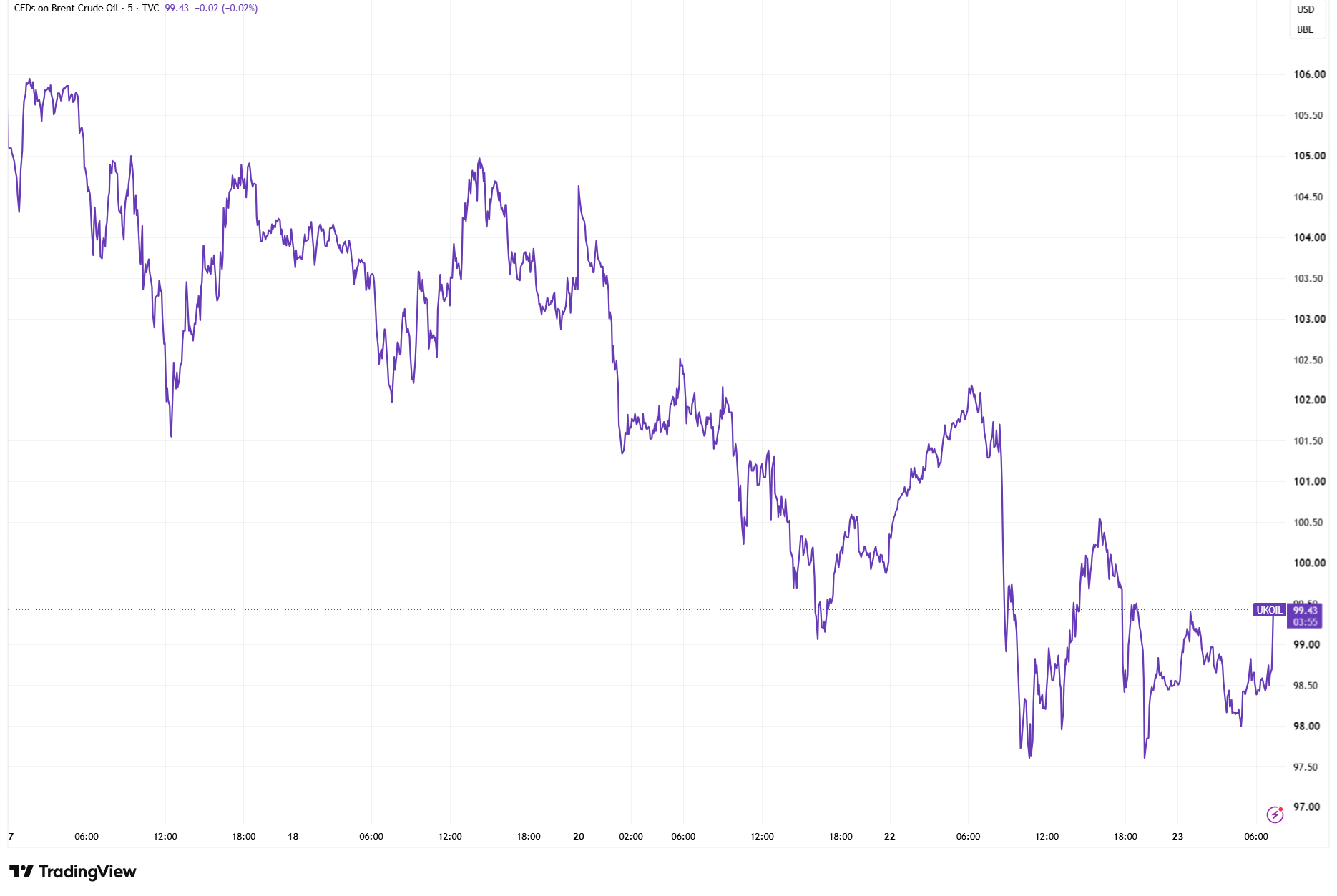
Source: TradingView. Past performance is not a reliable indicator of future performance. Data as of 23 September 2026.
Brent crude has fallen below $100 a barrel after trading above $105 earlier in the period. The decline comes as improving Gulf supply prospects and hopes for progress in US Iran diplomatic efforts ease some of the immediate concerns around global oil supply.
Falling Oil Eases Some Inflation Pressure
The decline matters beyond the oil market. Higher energy prices can feed through to transport, production and consumer costs, which is why the recent surge in crude has complicated the inflation outlook for central banks. Falling oil prices may reduce some of that immediate pressure, but several sessions of declines do not necessarily mean the inflation risk has disappeared.
That is particularly relevant in the US. The Federal Reserve raised its target range by 25 basis points to 3.75% to 4.00% last week, with policymakers continuing to emphasise inflation risks. Markets are still pricing around a 90% probability of another increase in December, according to CME FedWatch, suggesting expectations for restrictive monetary policy remain firmly in place.
Bond markets have also responded to the retreat in energy prices. The US 10-year Treasury yield fell to around 4.93% on Tuesday as Brent moved back below $100, after having climbed above 5% during the recent oil rally. Lower crude prices can reduce concerns about future inflation, although Fed policy will continue to depend on a much broader range of economic data.
Gold traded around $4,325 an ounce on Tuesday as expectations for higher US rates continued to limit demand for the non-yielding metal. Equity markets were mixed, although the Nasdaq reached another record as enthusiasm around technology shares provided support.
What Markets Watch Next
The next stage of the oil move is likely to depend heavily on whether improving supply expectations translate into actual barrels reaching global markets. Developments involving Iran and the US, traffic through the Strait of Hormuz and the recovery of Saudi exports through Yanbu will therefore remain important. For now, crude’s retreat reflects an improvement in expectations around supply rather than confirmation that the geopolitical risks facing global energy markets have disappeared.