













Gold Falls Below $4,300 as Oil Rally Lifts Fed Rate Hike Expectations


Gold prices fell to their lowest level in more than three weeks on Wednesday as rising oil prices intensified inflation concerns and lifted expectations of a Federal Reserve rate hike this month. Spot gold was trading around $4,327 an ounce at the time of writing, having fallen below $4,300 earlier in the session to its lowest level since 7 August. The metal was heading for a fourth consecutive session of declines.
The decline comes despite renewed tensions in the Middle East, which would normally be expected to support demand for safe haven assets such as gold. This time, however, the impact on energy markets is creating a competing force. Brent crude climbed above $95 a barrel on Wednesday as renewed US Iran hostilities raised concerns about potential disruption to oil supplies.
Higher oil prices can add to inflation through rising energy, transport and production costs. That matters for the Federal Reserve, with inflation still above its 2% target. If higher energy costs make price pressures more persistent, policymakers may have less room to keep rates unchanged.
Markets have responded by increasing expectations for another rate hike. Traders are now pricing roughly a 70% probability of an increase at the Fed’s September meeting, according to CME FedWatch. That represents a sharp change from around 40% a week earlier. Fed Governor Michael Barr has also indicated that rates may need to rise if inflation does not cool quickly, while Fed Chair Kevin Warsh signalled at Jackson Hole last week that further tightening could be necessary.
The shift in rate expectations has created an additional headwind for gold. Unlike bonds or cash, gold does not pay interest, meaning higher yields can reduce its relative appeal. The benchmark US 10-year Treasury yield was around 4.8% on Wednesday, while the US Dollar Index was trading near 99.7. A firmer dollar can also make gold more expensive for buyers using other currencies.
Gold Falls to Three Week Low as Rate Expectations Shift
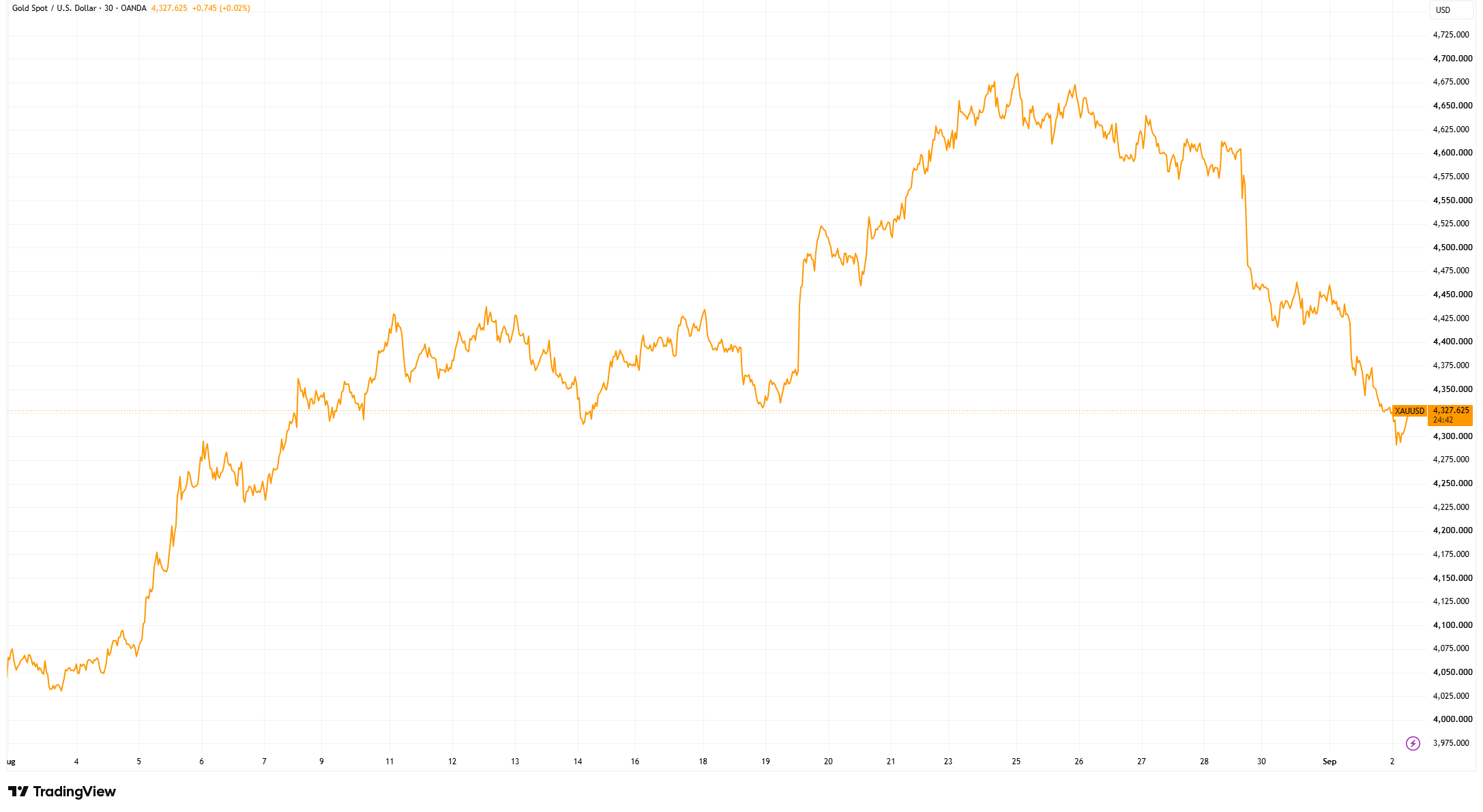
Source: TradingView. Past performance is not a reliable indicator of future performance. Data as of 2 September 2026.
Gold has fallen sharply from its late August highs, trading around $4,327 an ounce as rising oil prices add to inflation concerns and markets increase expectations of another Federal Reserve rate hike.
The latest move follows a sharp reversal from gold’s late August highs. The chart shows the scale of gold’s reversal from its late-August highs near $4,700 an ounce. Despite heightened geopolitical uncertainty, the metal has fallen sharply into September as rising yields, a firmer dollar and shifting Fed expectations outweigh some of the traditional safe-haven demand.
Attention now turns to the US labour market. The ADP employment report is due later on Wednesday, followed by the more closely watched nonfarm payrolls report on Friday. The jobs report is expected to show that US employers added around 56,000 positions in August, according to a Reuters poll, after employment unexpectedly declined by 23,000 in July.
The employment figures could influence whether the recent shift in Fed expectations continues. Stronger data could reinforce the view that the economy can withstand higher interest rates, potentially maintaining pressure on gold. Softer figures could reduce some of those expectations and provide the metal with support.
Gold therefore remains caught between competing forces. Geopolitical uncertainty may support safe-haven demand, while higher oil prices, rising yields and expectations of tighter monetary policy continue to weigh on the metal. Attention now turns to US employment data and whether it strengthens or challenges the case for a September Fed rate hike.