
The Evolution of Trading Technology: From Trading Floors to the EC Markets App


Table of Contents
- From Trading Floors to Electronic Markets
- The Desktop Trading Revolution
- When Trading Moved Into Your Pocket
- The Modern Trading App: Built Around the Trader
- 1. Superior Charting: Market Analysis Beyond the Desktop
- 2. Personalised Alerts: Stay Informed Without Watching the Charts
- 3. Watchlists: Keep Your Markets in Focus
- 4. EC Insights: Turning Market Information Into Market Context
- 5. Multi-Account Management: One App, Multiple Accounts
- 6. Funding and Withdrawals: Manage Your Funds on the Move
- What Comes Next for Trading Technology?
- How to Get Started
- The Bottom Line
From handwritten orders and ticker tapes to real-time market intelligence in your pocket, trading technology has changed dramatically. But what does that evolution mean for today’s traders?
Imagine trying to trade today’s markets using yesterday’s technology.
No live charts. No instant price alerts. No mobile access. Market information travelling by telegraph, orders handled over the telephone, and prices sometimes arriving long after the trades had taken place.
For much of financial history, this was the reality.
Today, a trader can monitor global markets, analyse price movements, manage accounts and receive important updates from a device that fits in their pocket.
The transformation didn’t happen overnight. It took centuries of innovation, from the first stock exchanges and electronic quotation systems to the internet, smartphones and increasingly sophisticated market intelligence tools.
And throughout that evolution, one thing has remained constant: traders need timely information, reliable access and the tools to make informed decisions.
So how did we get here, and how is EC Markets adapting to the needs of today’s increasingly connected trader?
From Trading Floors to Electronic Markets
Long before trading platforms and mobile applications, financial markets operated through physical exchanges, brokers and handwritten orders.
On trading floors, brokers communicated through shouted instructions and hand signals, a system known as open outcry. Information travelled through newspapers, messengers and, eventually, telegraph networks.
The introduction of the stock ticker in the nineteenth century was a major breakthrough. For the first time, market prices could be transmitted electronically rather than delivered entirely through physical communication.
But information still had limitations. Prices could be delayed, access was restricted, and placing a trade often required direct communication with a broker.
The next major transformation came with electronic markets.
The launch of Nasdaq in 1971 marked an important milestone in electronic securities quotations. Over the following decades, computerised systems increasingly replaced manual processes, helping reshape how market information was distributed and how trades were executed.
By the 1990s, the expansion of the internet was opening another door: individuals could increasingly access financial markets through personal computers.
The Evolution of Trading Technology
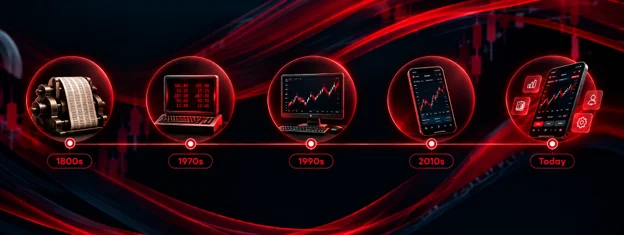
1800s – Ticker Tape: Market prices begin travelling electronically.
1970s – Electronic Markets: Computerised systems transform market information.
1990s – Online Trading: Retail traders gain access through personal computers.
2010s – Mobile Trading: Smartphones bring market access beyond the desktop.
Today – Connected Technology: Trading, market intelligence and account management come together.
The Desktop Trading Revolution
For retail traders, online trading represented a fundamental change.
Instead of relying entirely on telephone conversations with brokers, traders could increasingly view prices, study charts, monitor positions and submit orders electronically. Desktop trading platforms also made technical analysis more accessible.
Indicators, historical price data, multiple chart timeframes and increasingly sophisticated order-management tools became part of the everyday trading environment.
But there was still a limitation.
Trading was becoming more accessible, yet the experience remained largely tied to a computer.
That was about to change.
When Trading Moved Into Your Pocket
The arrival of modern smartphones in the late 2000s, alongside faster mobile internet connections, changed how people interacted with digital services.
Financial markets were no exception.
Trading applications began extending desktop functionality to mobile devices, allowing users to monitor prices, check positions and manage trades without remaining at their desks. As mobile technology developed, so did the applications themselves.
More advanced charts, economic calendars, push notifications and account-management tools gradually became part of the mobile trading experience.
The change was significant. Mobile technology gave traders greater flexibility over when and where they could access market information.
But it also introduced a new challenge.
With more data, more notifications and more ways to interact with markets, access alone was no longer enough.
Traders increasingly needed technology that could help them organise information, identify relevant developments and manage their trading activity without unnecessary complexity.
That shift is helping shape the next generation of trading applications.
The Modern Trading App: Built Around the Trader
The evolution of trading technology has changed more than how orders are placed.
It has changed what traders expect from the entire experience.
Today, traders may want to analyse a market before work, monitor an existing position during the day, receive a price notification while travelling and review account activity later that evening.
The technology supporting those activities needs to be accessible, organised and practical.
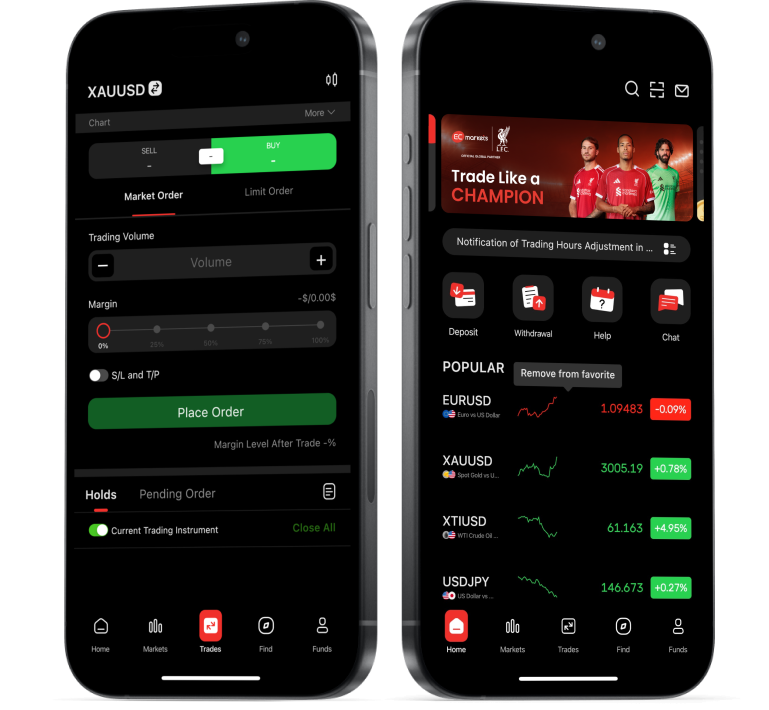
This is the thinking behind the EC Markets App and the wider Always Connected campaign: bringing key parts of the trading experience together within one intuitive mobile environment.
From technical analysis and market intelligence to account management and funding, the app is designed to support traders as they move between different activities throughout the day.
See How Trading Has Evolved with the EC Markets App
From market analysis and personalised alerts to account management and funding, discover how the EC Markets App brings essential trading tools together in one connected experience.
Here’s how its features reflect the wider evolution of trading technology.
1. Superior Charting: Market Analysis Beyond the Desktop
Technical analysis has evolved from manually plotted charts to interactive platforms offering real-time price data, technical indicators and multiple timeframes. What once required specialist equipment or a desktop terminal can now be accessed from a smartphone. As markets move throughout the day, traders need the flexibility to review their analysis wherever they are.
The EC Markets App brings charting functionality to mobile, allowing traders to analyse price movements, monitor trends and identify potential support and resistance levels without being tied to a desktop.
2. Personalised Alerts: Stay Informed Without Watching the Charts
Keeping track of market movements once meant watching ticker tapes or remaining close to a trading terminal. Digital platforms made prices easier to monitor, while mobile technology introduced notifications triggered by selected market conditions. Today, traders need to stay informed about relevant price movements without constantly checking their screens.
Personalised alerts allow traders to monitor selected price movements and trading levels, receiving notifications when specified conditions are met without constantly watching the charts.
3. Watchlists: Keep Your Markets in Focus
As online trading expanded access to global financial markets, traders gained more instruments to monitor and analyse. But greater choice also meant more information to navigate. Watchlists emerged as a practical way to organise selected instruments, helping traders focus on the markets relevant to their strategies.
Customisable watchlists keep preferred currency pairs, commodities and indices organised and easily accessible, making it simpler to focus on relevant markets without searching through the full range of available instruments.
4. EC Insights: Turning Market Information Into Market Context
Trading technology has evolved from delivering market prices and news to using artificial intelligence (AI) and machine learning to analyse vast amounts of information. AI-powered tools can process financial news, identify patterns, assess market sentiment and highlight developments that might otherwise be overlooked. As the volume of market information grows, the challenge for traders is no longer just accessing data, but turning it into meaningful insights.
Access EC Insights, powered by Acuity Trading, bringing AI-powered market intelligence tools into one mobile experience.
- Event Intelligence: Explore key economic events and their potential market impact.
- Trade Ideas: Discover potential trading scenarios and market setups for further analysis.
- Sentiment Analysis: Understand market sentiment and how it may be changing.
- Market Companion: Access relevant market news, analysis and insights in one place.
Together, these tools help traders filter market noise, understand what may be driving price movements and identify developments worth exploring further.
5. Multi-Account Management: One App, Multiple Accounts
As trading platforms developed, traders gained greater flexibility in how they structured their trading activity. Multiple accounts made it possible to separate strategies, instruments or trading preferences, but managing them could involve switching between different platforms or account interfaces. Today, traders increasingly expect a simpler way to manage multiple accounts.
Multiple trading accounts can be accessed and managed within one mobile environment, keeping account activity organised without switching between separate services.
6. Funding and Withdrawals: Manage Your Funds on the Move
The evolution of trading technology extends beyond charts and order execution. Funding and withdrawals have also moved from traditional banking processes towards digital payment systems and online account management. As financial services become increasingly mobile, traders expect greater convenience when managing funds alongside their trading activity.
Deposit and withdrawal functionality is accessible directly from a mobile device, allowing traders to manage funds alongside their trading activity.
What Comes Next for Trading Technology?
Artificial intelligence, automation and increasingly sophisticated data analytics are shaping the next phase of trading technology.
AI-powered tools can already process financial news, analyse market sentiment and identify patterns across large datasets. Further developments are likely to focus on more personalised market intelligence, automated monitoring and better integration between trading platforms and account-management systems.
However, greater automation also brings challenges. Data quality, algorithmic accuracy, cybersecurity and system reliability will remain critical as traders become increasingly dependent on digital tools.
For brokers, the priority is to balance innovation with reliability, security and usability. New technology needs to solve practical problems for traders rather than simply introduce more features.
How to Get Started
From downloading the app to placing your first trade, see how easy it is to get started.
The Bottom Line
Trading technology has progressed from manual order execution and delayed market data to real-time analysis, mobile trading and AI-powered market intelligence.
Each development has improved access to information and expanded the tools available to traders. However, technology cannot eliminate market risk or replace sound trading judgement.
The next stage of innovation will depend on how effectively brokers combine analytical capabilities, reliable execution, account management and usability.
Through the EC Markets App, we’re continuing to develop these capabilities within a single mobile experience, reflecting the changing requirements of modern traders.