

Q3 2026 Market Review: Oil, Inflation and Higher Rates Reshape Global Markets



Our Q3 2026 Market Review examines a quarter shaped by renewed inflation pressure. Surging oil prices and rising bond yields persisted. Major equity markets remained surprisingly resilient.
The third quarter of 2026 tested the resilience that markets had regained during Q2. After falling energy prices and moderating inflation helped restore confidence earlier in the year, Q3 brought a sharp reversal. Oil prices surged as conflict in the Middle East disrupted energy markets. Inflation concerns returned, and global bond yields moved sharply higher.
Despite these pressures, equity markets proved remarkably resilient. Strong corporate earnings, continued investment in artificial intelligence and robust economic activity helped offset the impact of tighter financial conditions. However, market leadership shifted once again, with energy returning to the forefront while several cyclical and defensive sectors struggled.
The result was a quarter defined less by broad-based risk appetite and more by selectivity across markets and sectors. Equities remained positive across several major markets, but rising borrowing costs and renewed inflation risks created a more challenging backdrop for fixed income and interest rate sensitive assets.
Macroeconomic Landscape
Economic conditions diverged across regions during Q3 as higher energy prices, renewed inflation pressure and shifting monetary policy expectations shaped the global outlook.
United States
The US economy remained resilient during Q3, supported by consumer spending, strong business investment and continued capital expenditure linked to artificial intelligence. The labour market remained relatively stable, while economic activity continued to expand at a solid pace. However, the sharp rise in energy prices complicated the inflation outlook, reversing some of the progress seen during Q2.
The Federal Reserve held rates steady in July before raising the federal funds target range by 25 basis points to 3.75%-4.00% in September as inflation remained above target. Although some inflation measures showed signs of moderation towards quarter end, policymakers continued to balance persistent price pressures against a labour market that remained broadly healthy. The shift towards tighter policy expectations contributed to a significant rise in Treasury yields during the quarter.
Europe
Europe faced a more challenging combination of higher energy prices and subdued growth. The renewed increase in oil and energy costs placed pressure on businesses and households, while inflation accelerated across several major euro area economies towards the end of the quarter.
The European Central Bank responded by raising its key interest rates by 25 basis points in September, citing persistent inflation pressures associated with the Middle East conflict. Despite these headwinds, the euro area economy remained more resilient than expected, supported by improving manufacturing activity, infrastructure and defence spending, and continued investment in technology. Nevertheless, higher borrowing costs and renewed inflation concerns weighed on European financial markets.
Asia & Emerging Markets
Performance across Asia remained mixed, although Japan and China both improved during the quarter. Japan continued to benefit from corporate reform, improving earnings and stronger investor interest, while expectations for further monetary policy normalisation supported the Japanese Yen.
China showed tentative signs of stabilisation after a prolonged period of weakness. Policymakers introduced additional support for infrastructure, technology investment and the property market, while manufacturing activity improved towards the end of the quarter. However, weak domestic consumption and continued property sector challenges meant that the broader recovery remained uneven. Emerging markets more generally faced pressure from rising global yields and higher energy costs.
Global Equities Remain Resilient Despite Rising Rates
Global equities remained surprisingly resilient during Q3 despite a significant increase in oil prices and borrowing costs.
United States
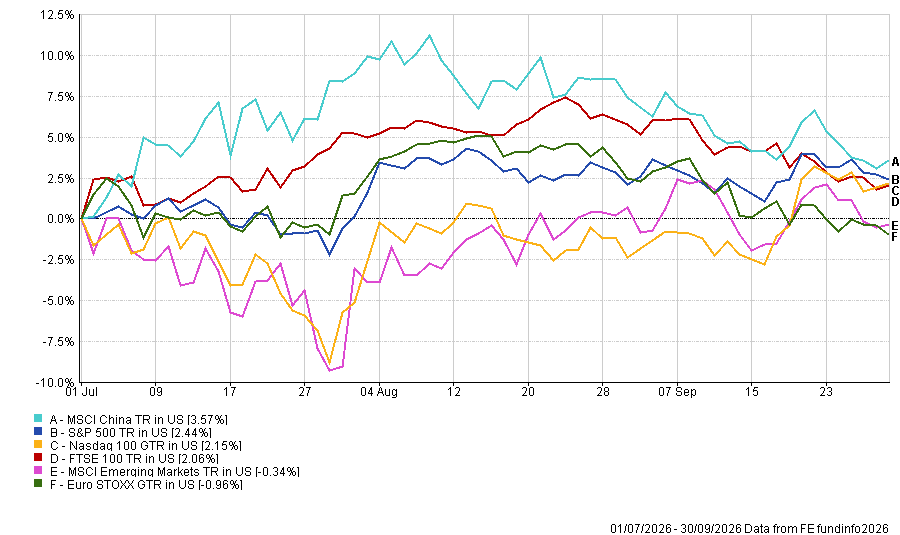
US equities extended their recovery, although gains were considerably more moderate than in Q2. The S&P 500 advanced 2.44%, while the Nasdaq 100 gained 2.15%. Continued enthusiasm around artificial intelligence and strong corporate earnings helped offset the impact of rising Treasury yields and tighter monetary policy.
Europe
European markets struggled as higher energy costs and renewed inflation pressures weighed on sentiment. The Euro STOXX declined 0.96%, while the FTSE 100 gained 2.06%, supported by its greater exposure to energy and commodity related companies.
Asia & Emerging Markets
Asia delivered a more positive picture. MSCI China gained 3.57%, reversing some of its Q2 weakness as policy support and improving manufacturing data helped sentiment. Japan was the strongest major region, returning 5.46%. The broader MSCI Emerging Markets Index slipped 0.34%, reflecting the pressure from higher global borrowing costs and significant divergence between individual markets.
Q3 2026 Global Equity Market Performance
Sector Rotation and Market Themes
Beneath the headline equity performance, sector returns diverged considerably as higher energy prices and bond yields reshaped market leadership.
Energy Returns to the Forefront
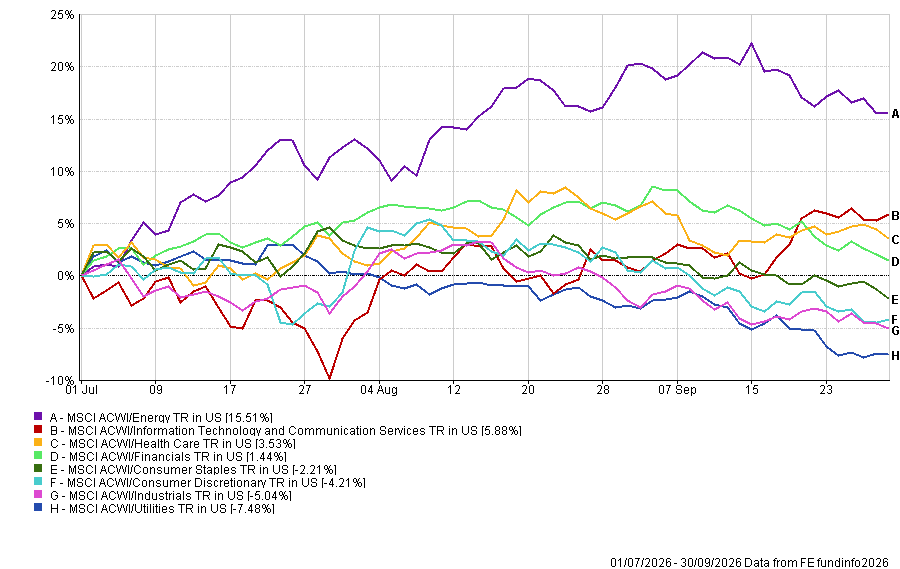
Energy regained market leadership during Q3, rising 15.51% as oil prices surged. The sharp reversal from Q2 reflected renewed geopolitical risk and disruption to Middle Eastern energy flows, which pushed crude prices significantly higher and improved the earnings outlook for energy producers.
Technology Remains Resilient
Information Technology and Communication Services gained 5.88%, demonstrating that enthusiasm surrounding artificial intelligence remained intact despite rising bond yields. Continued spending on AI infrastructure, semiconductors and data centres supported the sector, although returns were considerably more measured following Q2’s exceptional rally.
Rate Sensitive Sectors Struggle
Higher bond yields created a more difficult environment elsewhere. Utilities fell 7.48%, making them the weakest performing sector, while industrials declined 5.04% and consumer discretionary fell 4.21%. Consumer staples also declined 2.21%. Healthcare and financials proved more resilient, gaining 3.53% and 1.44% respectively.
Q3 2026 Global Sector Performance
Fixed Income Under Pressure as Bond Yields Rise
Bond markets faced a difficult quarter as rising energy prices revived inflation concerns and investors reassessed the outlook for global monetary policy. Government bond yields moved sharply higher, reversing much of the more constructive environment seen during Q2.
Euro government bonds declined 4.4%, while inflation linked bonds fell 3.7% and US investment grade credit declined 3.3%. Emerging market debt returned -2.8%, while Euro investment grade bonds and US Treasuries fell 2.5% and 2.4% respectively.
High yield proved relatively more resilient, with Euro and US high yield declining 1.8% and 1.9%. The relative strength reflected continued confidence in corporate fundamentals, but the broader trend reflected renewed inflation risk and expectations that interest rates could remain higher for longer once again placed pressure on duration sensitive assets.
Q3 2026 Fixed Income Performance
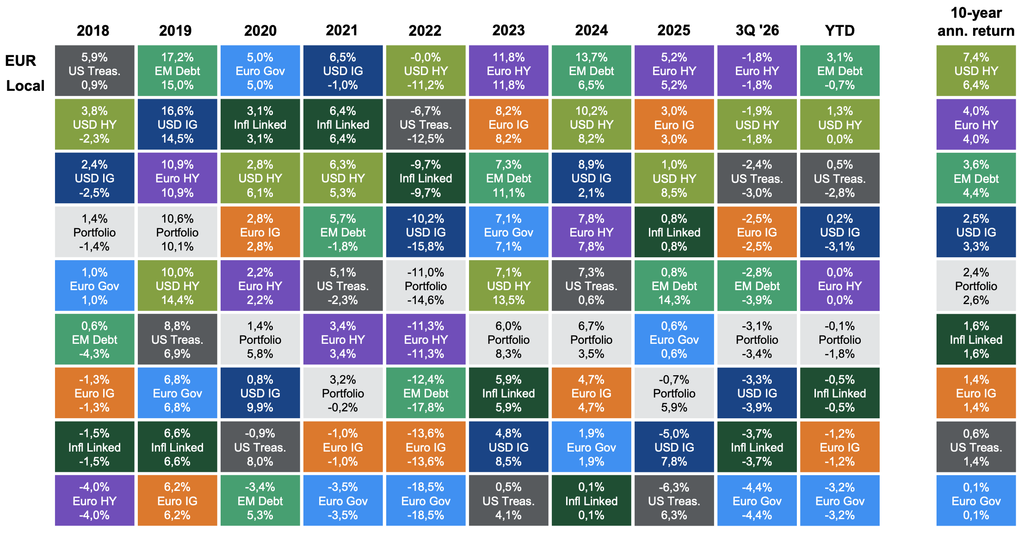
The document also notes UK Gilts Bloomberg Sterling Gilts; US Treasuries Bloomberg US Agg. Gov. – Treasury; Infl Linked ICE BofA UK Gilt Inflation-Linked Government. Hypothetical portfolio (illustrative only): 20% UK Gilts; 15% US Treasuries; 10% Linkers; 15% US IG; 10% GBP IG; 10% US HY; 5% EUR HY; 15% EM Debt. Returns are unhedged in euros and local currencies. Past performance is not a reliable indicator of future results. Guide to the Markets – EMEA. Data as of 30 September 2026. Drop files to upload.
Commodities and Currencies: Energy Reverses Course
Commodity markets reflected many of the forces shaping the wider Q3 backdrop, with energy recording the most significant move of the quarter.
Oil Surges
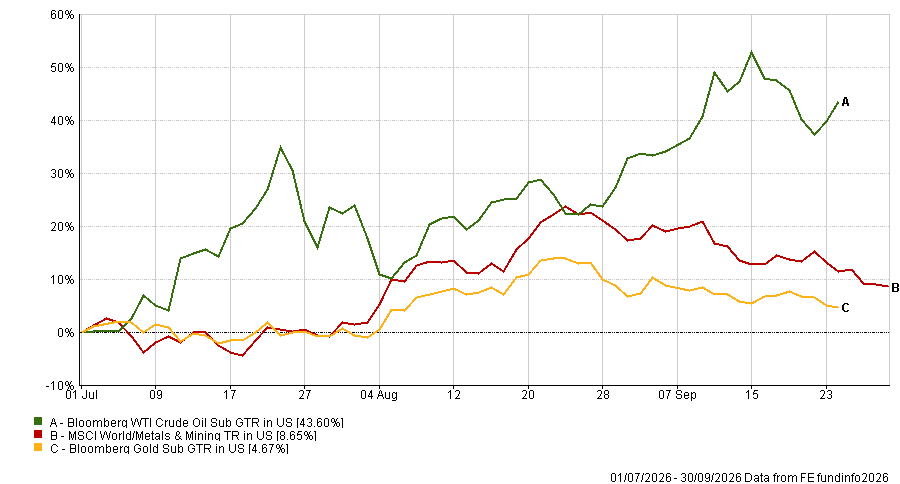
The most significant market move of Q3 came from energy. WTI crude surged 43.60%, reversing its sharp Q2 decline as the Middle East conflict disrupted regional energy flows and increased concerns around global supply. Oil moved back above $100 per barrel during the quarter, contributing directly to renewed inflation concerns and the repricing of global interest rate expectations.
Gold and Metals Advance
Gold gained 4.67%, supported by geopolitical uncertainty and demand for defensive assets despite rising bond yields. The MSCI World Metals & Mining Index rose 8.65%, supported by infrastructure investment, strategic demand for industrial commodities and continued spending associated with technology and AI infrastructure.
Q3 2026 Commodity Performance
Currency Markets
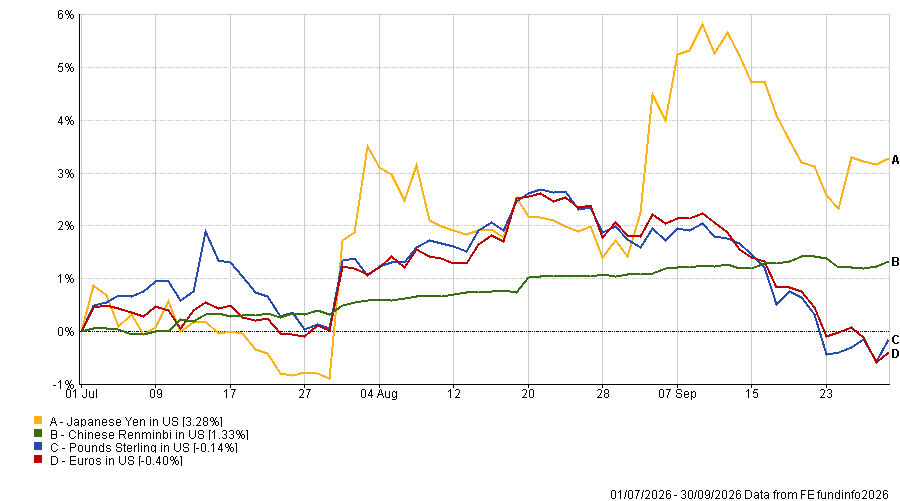
Currency movements remained relatively contained, although the Japanese Yen strengthened 3.28% as expectations for further Bank of Japan policy normalisation increased. The Chinese Renminbi gained 1.33%, while Sterling declined 0.14% and the Euro fell 0.40% against the US dollar.
Q3 2026 Currency Performance
Q4 2026 Market Outlook
As markets enter the final quarter of 2026, the outlook has become more complex. Economic growth remains resilient and corporate earnings continue to provide support for equities, but the return of inflationary pressure has challenged expectations for easier monetary policy.
Energy prices are likely to remain an important driver of both inflation and market sentiment. Continued disruption in the Middle East could keep oil prices elevated, placing pressure on consumers and businesses while limiting the ability of central banks to ease monetary policy. At the same time, strong investment in artificial intelligence and digital infrastructure continues to provide a structural source of growth.
Within equities, the sharp rotations seen throughout 2026 highlight how significantly market leadership has shifted between sectors. Energy has regained leadership, while technology continues to benefit from long term structural investment despite higher yields. Fixed income yields have moved higher, while persistent inflation and fiscal concerns continue to shape the outlook for duration-sensitive assets.
The interaction between growth, energy prices, inflation and monetary policy is therefore likely to remain central to the market outlook through the final quarter of 2026.
Looking Ahead
Q3 demonstrated the resilience of global equity markets despite a sharp rise in oil prices, renewed inflation pressure and a difficult quarter for fixed income. Market leadership shifted towards energy, while technology remained supported by continued investment in artificial intelligence and digital infrastructure.
Attention now turns to whether higher energy prices continue to feed through to inflation and how central banks respond. The path of bond yields, monetary policy and corporate earnings will be important in determining whether equity resilience can continue through the final quarter of 2026.
With market leadership continuing to shift, Q4 begins against a backdrop of resilient economic activity, tighter financial conditions and renewed uncertainty around inflation.
Want to stay up to date? Explore our latest Market Analysis or learn more with our Education Guides.