













US Inflation in Focus as Markets Weigh Fed Rate Outlook


US inflation is expected to accelerate in September, putting renewed attention on the Federal Reserve’s interest rate outlook as investors assess whether policymakers can afford to pause later this month. Forecasts point to a 0.6% monthly increase in the Consumer Price Index (CPI), potentially taking annual inflation to around 3.6%, compared with 3.4% previously. Despite expectations for stronger price pressures, interest rate futures suggest that markets still favor borrowing costs unchanged at the Federal Reserve’s October meeting.
The September inflation report is scheduled for release on 14 October and comes at a time when the Federal Reserve is balancing persistent inflation against signs of softer economic activity. US employment increased by just 29,000 in September, while the unemployment rate stood at 4.2%, suggesting that the labor market may be losing momentum. These developments have made the outlook for further interest rate increases less straightforward.
The Federal Reserve raised its benchmark interest rate by 25 basis points in September, bringing the target range to 3.75% to 4.00%. However, investors increasingly expect policymakers to leave rates unchanged at their 27 to 28 October meeting. According to CME FedWatch, interest rate futures suggest roughly an 80% probability of no change, reflecting expectations that the Fed may wait for further economic evidence before making another adjustment.
Recent comments from Federal Reserve officials have reinforced this cautious approach. New York Fed President John Williams has indicated that another rate increase could still be appropriate this year, but that there is no immediate urgency to tighten policy further. His comments highlight the distinction between keeping interest rates restrictive to control inflation and raising them again before the economic outlook becomes clearer.
Energy prices remain an important part of the inflation picture. Higher petrol and fuel costs can push headline CPI upwards, even when price pressures elsewhere in the economy are more moderate. In August, headline inflation rose by 0.4% over the month, while core CPI, which excludes food and energy, increased by 0.3%. Annual core inflation stood at 2.4%, below the headline rate of 3.4%, illustrating how energy costs have contributed to the difference between the two measures.
US Dollar Pulls Back from Recent High Ahead of Inflation Data
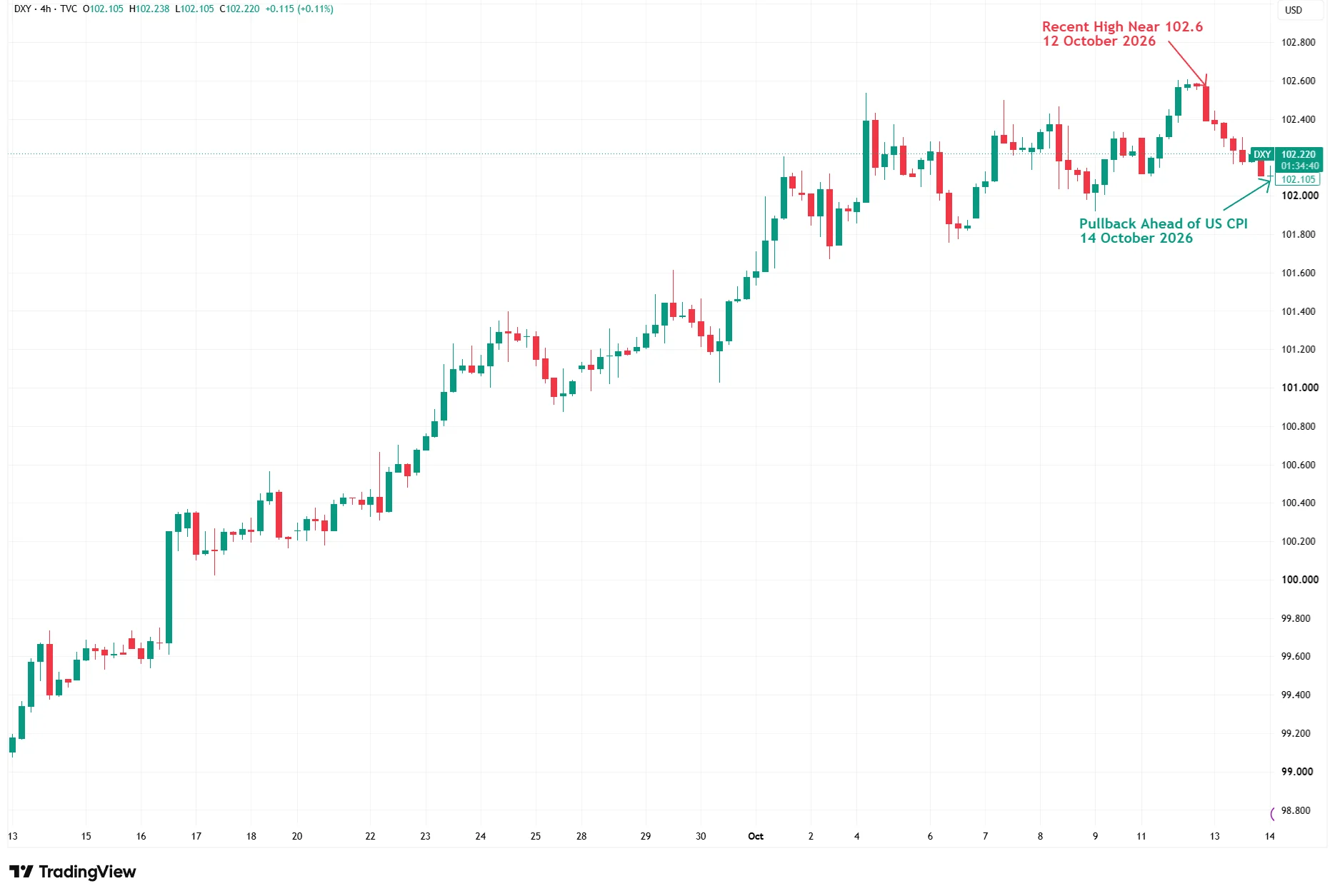
Source: TradingView. Past performance is not a reliable indicator of future performance. Data as of 14 October 2026.
The US Dollar Index strengthened over the past month, reaching approximately 102.6 before easing towards 102.2 ahead of the September US inflation report. Despite the recent pullback, the index remains above its mid-September levels, highlighting the broader strength of the dollar as investors reassess Federal Reserve interest rate expectations.
The recent movement of the dollar reflects the uncertainty surrounding the next stage of US monetary policy. While the index has pulled back from its October high, its broader rise suggests that investors have continued to favor the currency over recent weeks. US Treasury yields have also eased, with the 10-year yield moving towards 5.20%. Changes in expected interest rates can influence both Treasury yields and currency valuations, although other economic and international developments also play a role.
For equity markets, the implications are similarly mixed. Higher inflation could strengthen expectations that interest rates will remain elevated, increasing borrowing costs for businesses and potentially weighing on valuations. However, evidence of slower underlying inflation could give policymakers more flexibility, particularly if employment growth continues to weaken.
Investors will also monitor the September Producer Price Index, scheduled for 15 October, alongside further Federal Reserve commentary ahead of the October policy meeting. Together, these developments could provide a clearer picture of whether inflation pressures are becoming more persistent or gradually easing.
For now, the market is weighing the risk of renewed inflation against signs of a cooling economy. The September CPI report could influence expectations for the timing of the next interest rate move, but the Federal Reserve’s decisions will continue to depend on the broader balance between inflation, employment and economic growth.