














US Inflation Cools as Geopolitical Risks Rise | Weekly Recap: 10-14 August 2026


Global markets navigated a week of competing signals as softer US inflation strengthened expectations that interest rates could remain unchanged in September, while weaker consumer spending and renewed geopolitical tensions complicated the outlook.
US equities reached fresh record highs, oil and gold remained sensitive to developments in the Middle East, and performance across sectors and regions diverged as investors assessed what the latest economic data could mean for growth and monetary policy.
Economic Overview
Investors focused on inflation, consumer demand and the outlook for interest rates as a relatively calm start to the week gave way to renewed geopolitical concerns. In the United States, July consumer prices rose 0.1% month-on-month and 3.4% year-on-year, while core inflation eased to 2.5%. The softer readings reduced market expectations that the Federal Reserve would raise interest rates again in September.
Producer prices reinforced that message. July PPI was unchanged on the month, below expectations for a 0.2% increase, while the annual rate slowed to 4.7% from 5.5% in June. However, Friday’s retail sales report showed a different challenge, with sales falling 0.6% in July, the first decline in nine months, raising questions about household demand.
Elsewhere, the UK economy expanded 0.4% in the second quarter, supported by a 0.3% rise in June output. In Japan, producer prices rose 7.2% year-on-year in July, keeping expectations for further Bank of Japan tightening in focus. China’s credit data remained weak, with new yuan loans contracting by 340 billion yuan in July.
Overall, the week strengthened the case for caution among central banks: US inflation moderated, but growth and price pressures remained uneven across major economies.
Equities, Bonds and Commodities
Equities
Global equity markets were mixed as softer US inflation supported risk appetite, while weaker consumer data and renewed Middle East tensions limited gains later in the week.
In the United States, the S&P 500 and Nasdaq Composite reached record highs during the week as investors welcomed the CPI and PPI reports and continued to respond to resilient corporate earnings. Friday brought a modest pullback, particularly across semiconductor stocks, after weaker retail sales and renewed concerns around technology valuations. The S&P 500 nevertheless gained around 0.4% over the week, while the Nasdaq rose about 0.1%.
European equities were less buoyant. The STOXX Europe 600 fell 0.3% over the week, ending a four-week winning streak, as strong earnings were offset by geopolitical uncertainty and weakness in parts of the health care sector. UK equities also softened, with the FTSE 100 recording its first weekly decline in five weeks despite stronger domestic growth.
Bonds
Government bond markets reflected changing expectations for US monetary policy. Treasury yields initially eased following the softer inflation releases, but the US 10-year yield ended Friday at around 4.69% as markets continued to balance weaker demand against persistent inflation risks.
Commodities
Commodity markets remained sensitive to developments in the Middle East. Brent crude settled at US$88.52 per barrel on Friday as uncertainty surrounding US-Iran negotiations and disruption risks around the Strait of Hormuz remained in focus. Gold ended Friday around US$4,374 per ounce after reaching a two-month high during the week, supported by softer US inflation and shifting interest rate expectations.
Sector Performance
FE Analytics data showed gains across most sectors, although performance varied considerably.
Information Technology and Communication Services delivered the strongest return, rising 2.33%, as earnings and continued investment in artificial intelligence supported technology-related companies despite some late-week weakness in semiconductor shares. Energy followed with a gain of 2.00%, consistent with renewed support for oil prices as geopolitical risks remained elevated.
Utilities advanced 1.18% and Industrials gained 1.06%, while Financials rose 0.69% and Consumer Staples returned 0.37%.
Healthcare declined 1.22%, while Consumer Discretionary was the weakest-performing sector, falling 2.01%. The backdrop was less supportive for discretionary companies as weaker US retail sales and concerns around consumer demand weighed on sentiment.
Sector Performance August 10-14 2026
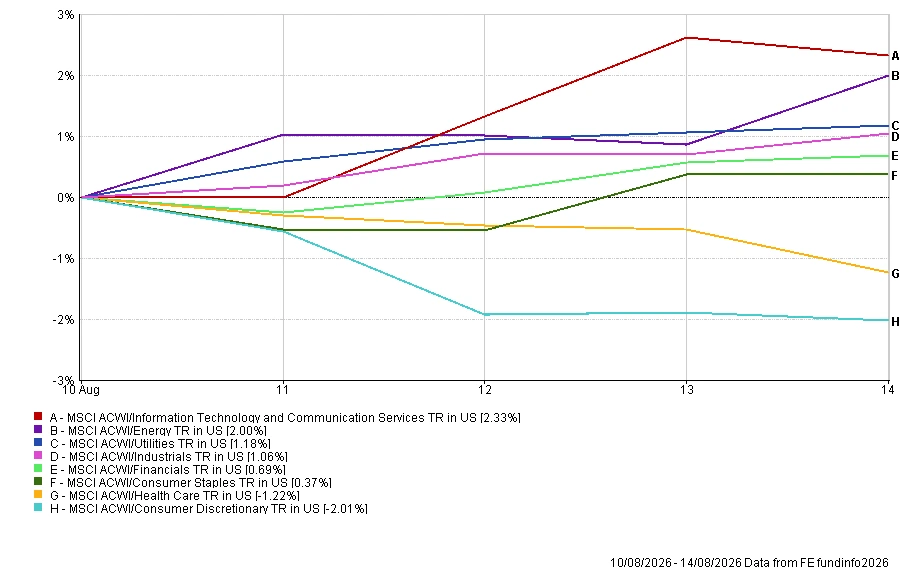
Information Technology and Communication Services led sector performance during the week, while Consumer Discretionary recorded the weakest return.
Regional Markets
Regional performance diverged sharply during the week.
Japan delivered the strongest return, gaining 2.43%. Improved business sentiment and strength in technology-related companies supported equities, while a weaker yen helped exporters. Because the FE Analytics return is measured in US dollars, however, the weaker yen reduced the currency translation contribution to dollar-based returns, indicating that underlying local equity performance was stronger than the USD return alone suggests.
North America gained 0.46%, supported by softer inflation and resilient earnings. Europe was broadly unchanged at 0.02%, while the United Kingdom declined 0.54% despite stronger domestic GDP data.
China was the weakest region, falling 4.06%, as weak credit growth and continued signs of subdued household demand outweighed expectations for further policy support.
Regional Performance August 10-14 2026
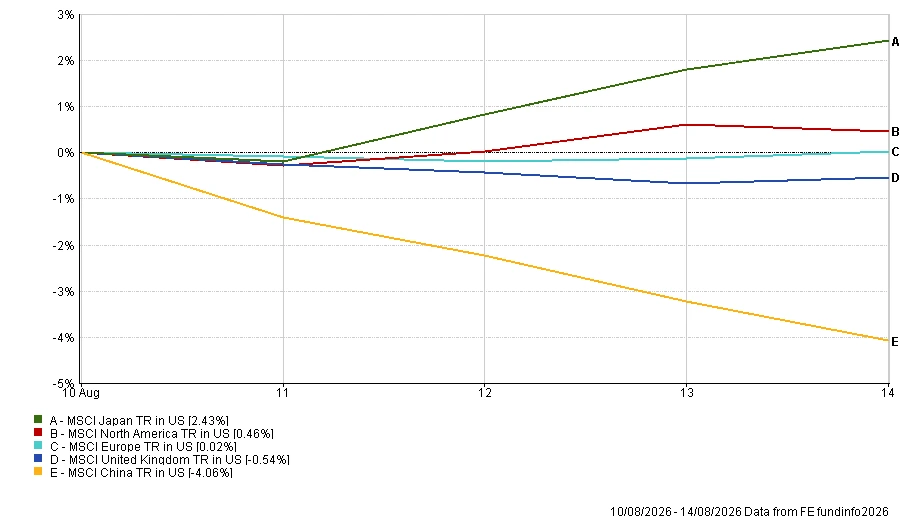
Japan led regional equity performance during the week, while China recorded the weakest return amid subdued credit demand.
Currency Markets
Currency markets reflected softer US inflation, stronger UK growth and continued pressure on the Japanese yen.
EUR/USD moved from an opening level of 1.1559 on 10 August to close at 1.1570 on 14 August, leaving the euro modestly stronger against the dollar.
GBP/USD rose from 1.3491 to 1.3535, with sterling supported by stronger-than-expected UK second-quarter growth. UK GDP expanded 0.4% during the quarter, while June output rose 0.3%.
The yen weakened over the full period. USD/JPY increased from 157.78 at Monday’s open to 159.32 at Friday’s close, while GBP/JPY rose from 212.88 to 215.63. The move reflected the still-wide gap between US and Japanese bond yields, even as expectations for another Bank of Japan rate increase strengthened later in the week.
Overall, the dollar was little changed against the euro and softer against sterling, while the yen remained the clearest underperformer.
The yen remained weaker over the full week despite growing expectations later in the period that the Bank of Japan could raise interest rates again.
Outlook and the Week Ahead
Attention now turns to another busy week of economic data and central bank communication.
Japan will publish preliminary second-quarter GDP at the start of the week, followed by machinery orders and July consumer inflation. The releases will be closely watched for evidence on economic momentum and underlying price pressures as investors assess the prospect of further Bank of Japan tightening.
In the UK, labour market data will be followed by July inflation and retail sales. The releases will help investors assess whether stronger economic growth is being accompanied by renewed price pressures and what that could mean for Bank of England policy.
In the United States, industrial production is scheduled for Tuesday, while the Federal Reserve will publish minutes from its July meeting on Wednesday, offering further detail on the 9–3 decision to keep rates unchanged.
Corporate earnings will also remain important, particularly across technology and consumer-facing businesses, as investors look for further evidence on the durability of earnings growth.
For now, markets remain sensitive to the balance between moderating US inflation, uneven global growth and geopolitical risks, particularly where they affect energy prices and interest rate expectations.