














Soft US Labour Market Data Supports Global Markets | Weekly Market Recap: 3-7 August 2026


Softer-than-expected US labour market data and another strong week of corporate earnings helped global equity markets rally to record highs during the first week of August. July’s surprise decline in nonfarm payrolls prompted investors to reduce expectations of further Federal Reserve tightening, while resilient technology earnings continued supporting risk appetite.
Economic Overview
Markets navigated another busy week of economic data and corporate earnings, with attention firmly centred on the US labour market and the outlook for monetary policy.
The week’s defining event came from the US employment report. July nonfarm payrolls unexpectedly fell by 23,000, compared with expectations for an increase of around 80,000 jobs, while payrolls for May and June were revised lower by a combined 103,000 jobs. Although the unemployment rate edged down to 4.1%, the weaker labour market data strengthened expectations that the Federal Reserve could adopt a more cautious approach to interest rates. Treasury yields declined as markets reduced expectations for further near-term policy tightening.
Elsewhere, economic data remained broadly supportive. The ISM Services PMI edged up to 54.1 in July from 54.0, indicating continued expansion across the US services sector. In Europe, euro area inflation increased to 2.9%, reinforcing expectations that the European Central Bank will maintain a cautious approach to future policy decisions. In Asia, China’s Caixin Manufacturing PMI eased to 50.9 from 51.7, signalling slower but still expanding manufacturing activity.
Overall, economic data painted a mixed picture. Growth remained relatively resilient, but softer US labour market conditions shifted investor attention towards the possibility of a less restrictive monetary policy outlook.
Equities, Bonds and Commodities
Equities
Global equity markets delivered their strongest weekly gains in months as weaker-than-expected US employment data and another solid earnings season boosted investor confidence.
In the United States, the S&P 500 climbed 3.6% to a record close of 7,757.64, while the Nasdaq Composite advanced 5.2% as technology and AI-related companies led gains following another strong earnings season. The Dow Jones Industrial Average gained 3.0%, reflecting broad-based strength across US equities as investors reduced expectations for further Federal Reserve tightening.
European markets also advanced, supported by resilient corporate earnings and continued strength in technology shares. The STOXX Europe 600 recorded another record close, while UK equities finished the week higher as investors responded positively to improving market sentiment.
Bonds
Bond markets reflected shifting expectations for monetary policy. The US 10-year Treasury yield declined following the weaker-than-expected employment report, ending the week at around 4.65%. European government bond yields remained comparatively firm as investors continued to assess elevated inflation pressures.
Commodities
Commodity markets reflected diverging investor sentiment during the week. Gold rallied approximately 6.6%, climbing above US$4,300 per ounce to its highest level in seven weeks as falling Treasury yields and reduced expectations for further Federal Reserve tightening increased demand for defensive assets.
Brent crude settled at US$83.55 per barrel, while West Texas Intermediate (WTI) closed at US$77.08 per barrel, as easing concerns over potential supply disruptions through the Strait of Hormuz weighed on oil prices.
Sector Performance
The FE Analytics sector data highlighted a clear preference for growth-oriented areas of the market during the week.
Information Technology and Communication Services delivered the strongest return, rising 4.69%, as strong corporate earnings and continued enthusiasm around artificial intelligence supported technology-related companies.
Healthcare followed with a gain of 2.70%, while Industrials advanced 1.73%. Consumer Staples rose 0.52% and Financials gained 0.50%, while Consumer Discretionary recorded a more modest increase of 0.33%.
Utilities declined 1.08%, while Energy was the weakest-performing sector, falling 2.35% as oil prices retreated during the week.
Sector Performance August 3-7th, 2026
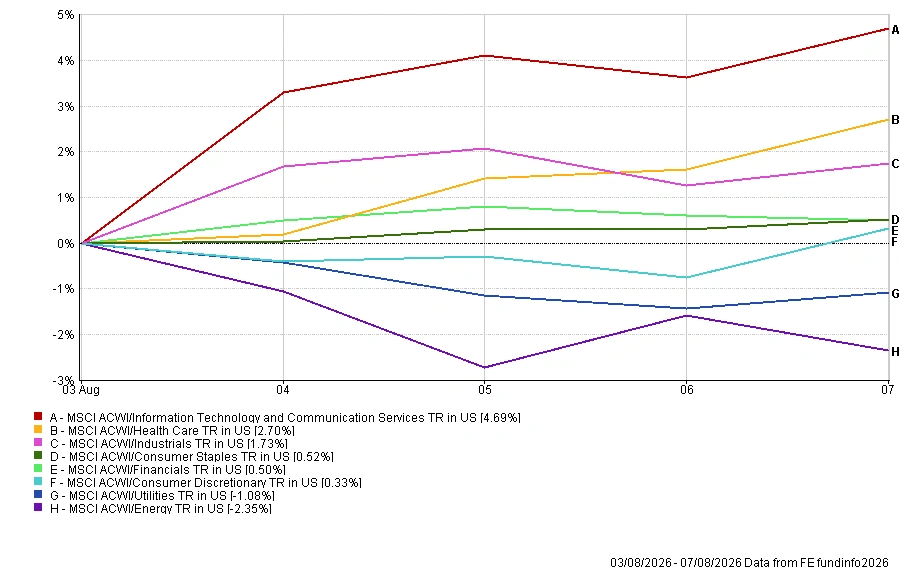
Source: FE Analytics. All indices total return in USD. Past performance is not a reliable indicator of future performance. Data as of 7 August 2026.
Regional Markets
Regional performance was positive across all five markets tracked by FE Analytics.
North America delivered the strongest return, rising 2.22% as softer US labour market data and resilient technology earnings lifted investor confidence.
Japan followed with a gain of 2.01%, while Europe advanced 1.63% on the back of strong corporate earnings and improving market sentiment.
The United Kingdom gained 0.99%, supported by internationally focused companies and mining stocks.
China recorded the smallest advance, rising 0.19%, as ongoing policy support was balanced against continued concerns surrounding domestic demand.
Overall, regional performance reflected improving global risk appetite, led by North American technology stocks following the weaker US payroll report.
Regional Performance August 3-7th, 2026
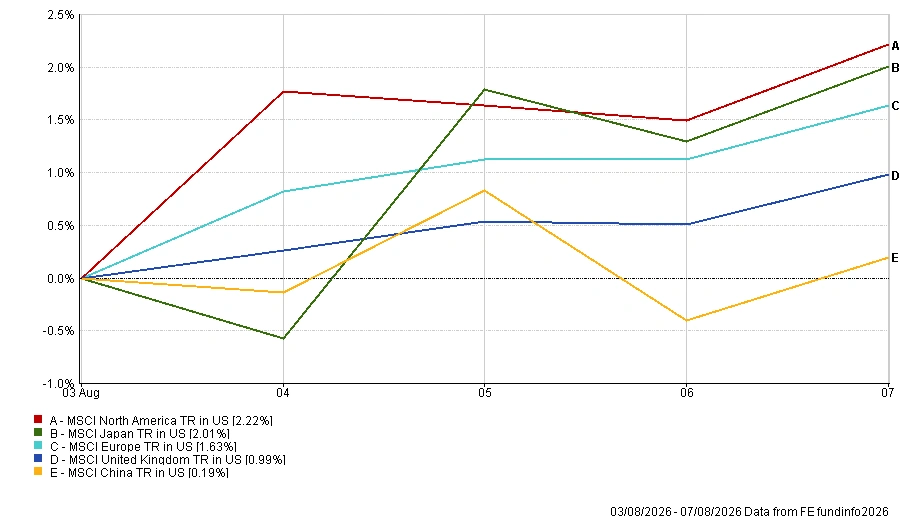
Source: FE Analytics. All indices total return in USD. Past performance is not a reliable indicator of future performance. Data as of 7 August 2026.
Currency Markets
Currency markets reflected changing expectations for US monetary policy following the weaker-than-expected employment report.
EUR/USD strengthened from 1.1540 to 1.1559 as expectations for additional Federal Reserve tightening eased.
GBP/USD edged higher from 1.3487 to 1.3492, supported by broad US dollar weakness.
USD/JPY rose modestly from 157.25 to 157.81, indicating slight weakness in the Japanese yen against the US dollar over the week.
GBP/JPY advanced from 211.99 to 212.91, reflecting sterling’s modest gains against the Japanese currency.
Overall, foreign exchange markets reflected softer expectations for US interest rates, although currency moves remained relatively measured compared with equities and bonds.
Outlook and The Week Ahead
Attention now turns towards the next round of US inflation data as investors assess whether easing labour market conditions will be accompanied by further progress on inflation.
US consumer price inflation will be closely watched for evidence of whether price pressures are moderating sufficiently to influence the Federal Reserve’s policy outlook. Following the weaker July employment report, markets are likely to remain particularly sensitive to data that changes expectations for the future path of US interest rates.
Developments in Europe will also remain in focus as investors assess the implications of elevated inflation for European Central Bank policy. Meanwhile, Chinese economic releases will provide further insight into the strength of domestic demand and the effectiveness of policy support.
Geopolitical developments and energy markets remain another important source of uncertainty. The sharp movement in oil prices over recent weeks has highlighted the potential for developments in the Middle East to influence inflation expectations and market sentiment.
Corporate earnings will continue to play an important role, particularly as investors assess whether strong earnings growth can justify elevated valuations across parts of the technology sector.
For now, markets appear likely to remain sensitive to incoming economic data, earnings and changes in interest rate expectations, with investors continuing to favour companies demonstrating resilient profitability and sustainable earnings growth.