













Why Falling Inflation Does Not Always Mean Lower Interest Rates


Table of Contents
- Falling Inflation Is Not the Same as Deflation
- Headline vs Core Inflation: Why the Difference Matters
- Why Services Inflation Matters
- Why Central Banks Need Inflation to Return Sustainably to Target
- Why Central Banks May Wait Before Cutting
- Bank of England Case Study: Why Rates Stayed High as Inflation Fell
- Bottom Line
Inflation begins to fall, yet the central bank keeps interest rates unchanged and warns that borrowing costs may remain elevated. This can appear contradictory. If price pressures are easing, it may seem reasonable to expect policymakers to begin reducing rates.
However, central banks consider more than the direction of headline inflation. They assess whether inflation is returning sustainably towards target. Headline inflation may fall because energy or food prices have declined, while underlying pressures linked to wages and services remain persistent.
Falling Inflation Is Not the Same as Deflation
When economists talk about falling inflation, they usually mean disinflation rather than deflation.
Disinflation occurs when prices continue rising, but at a slower rate. If inflation declines from 6% to 3%, the general price level is still increasing. Deflation occurs when the overall price level falls.
A lower inflation rate therefore does not normally mean prices have returned to where they were before inflation increased. It means they are rising more slowly than they were previously.
Headline vs Core Inflation: Why the Difference Matters
Headline inflation measures price changes across the full consumer basket, including food and energy. Core inflation excludes selected volatile components of the consumer price basket, typically including food and energy, to provide another view of underlying price pressures.
Headline inflation can decline quickly when oil, gas or food prices fall. It can also be affected by a base effect, which occurs when a large price increase from the previous year drops out of the annual comparison.
These developments may reduce headline inflation without removing broader domestic price pressures. Core inflation may remain elevated if prices continue rising across a wider range of goods and services.
Central banks monitor both measures. Food and energy costs matter greatly to households, but policymakers must also determine whether inflation is likely to remain elevated after temporary price movements have passed.
Why Services Inflation Matters
Services inflation can be more persistent than goods inflation.
Goods prices may respond relatively quickly when commodity prices fall or supply chains improve. Services such as hospitality, transport, insurance and personal care often depend more heavily on domestic labour, rents and other costs that adjust gradually.
Wage growth is therefore an important part of the inflation outlook. Higher wages support household incomes and spending, but they can also increase business costs. Companies may pass some of these costs on to customers when demand remains resilient.
This does not mean wage growth automatically creates inflation. Higher pay may be supported by stronger productivity, allowing businesses to raise wages without increasing prices by the same amount.
Central banks consequently examine unemployment, job vacancies and hiring activity alongside wage data. These indicators help policymakers assess whether labour market conditions could sustain wage and services inflation.
Why Central Banks Need Inflation to Return Sustainably to Target
One favourable inflation report is rarely enough to establish a lasting trend. Monthly figures can be volatile, while different measures may provide conflicting signals.
Policymakers may wait for evidence that headline inflation, underlying inflation, wage growth and inflation expectations are moving in a direction consistent with lasting price stability.
Inflation expectations matter because households and businesses make decisions about wages, prices and contracts partly on the basis of what they believe inflation will be in the future. If those expectations remain elevated, price pressures may become more persistent.
Monetary policy can also become more restrictive as inflation falls, even if the central bank does not raise its policy rate. If the nominal interest rate remains unchanged while inflation declines, the inflation adjusted, or real, interest rate increases.
Why Central Banks May Wait Before Cutting
Reducing interest rates can lower borrowing costs and support spending and investment. If rates are cut before inflation is under control, stronger demand could slow the decline in inflation or cause price pressures to return.
However, keeping rates high for too long also carries risks. Restrictive borrowing costs can weaken economic activity, employment and corporate earnings.
Central banks must balance these competing risks. Being data-dependent means their decisions evolve as new information changes the economic outlook rather than following a predetermined timetable.
Bank of England Case Study: Why Rates Stayed High as Inflation Fell
The UK provided a clear example in early 2024. Annual Consumer Prices Index inflation had fallen from 11.1% in October 2022 to 4.0% in December 2023. However, core inflation remained at 5.1%, while services inflation stood at 6.4%, according to the Office for National Statistics.
On 1 February 2024, the Bank of England maintained Bank Rate at 5.25%. Its Monetary Policy Committee voted by six to three to hold the rate, with two members preferring an increase and one favouring a reduction.
By March, headline inflation had declined further to 3.2%. Nevertheless, the Bank kept Bank Rate at 5.25% in May. Services inflation remained at 6.0%, while annual private sector regular wage growth was also 6.0% in the three months to February. The Bank said these indicators continued to signal elevated domestic inflationary pressures, although both had started to ease.
The decision demonstrated why a substantial decline in headline inflation was not sufficient by itself to produce an immediate rate reduction. Policymakers were also considering whether wage and services inflation were moderating enough for inflation to return sustainably to the 2% target.
UK Inflation, Services Inflation and Bank Rate: 2021-2026
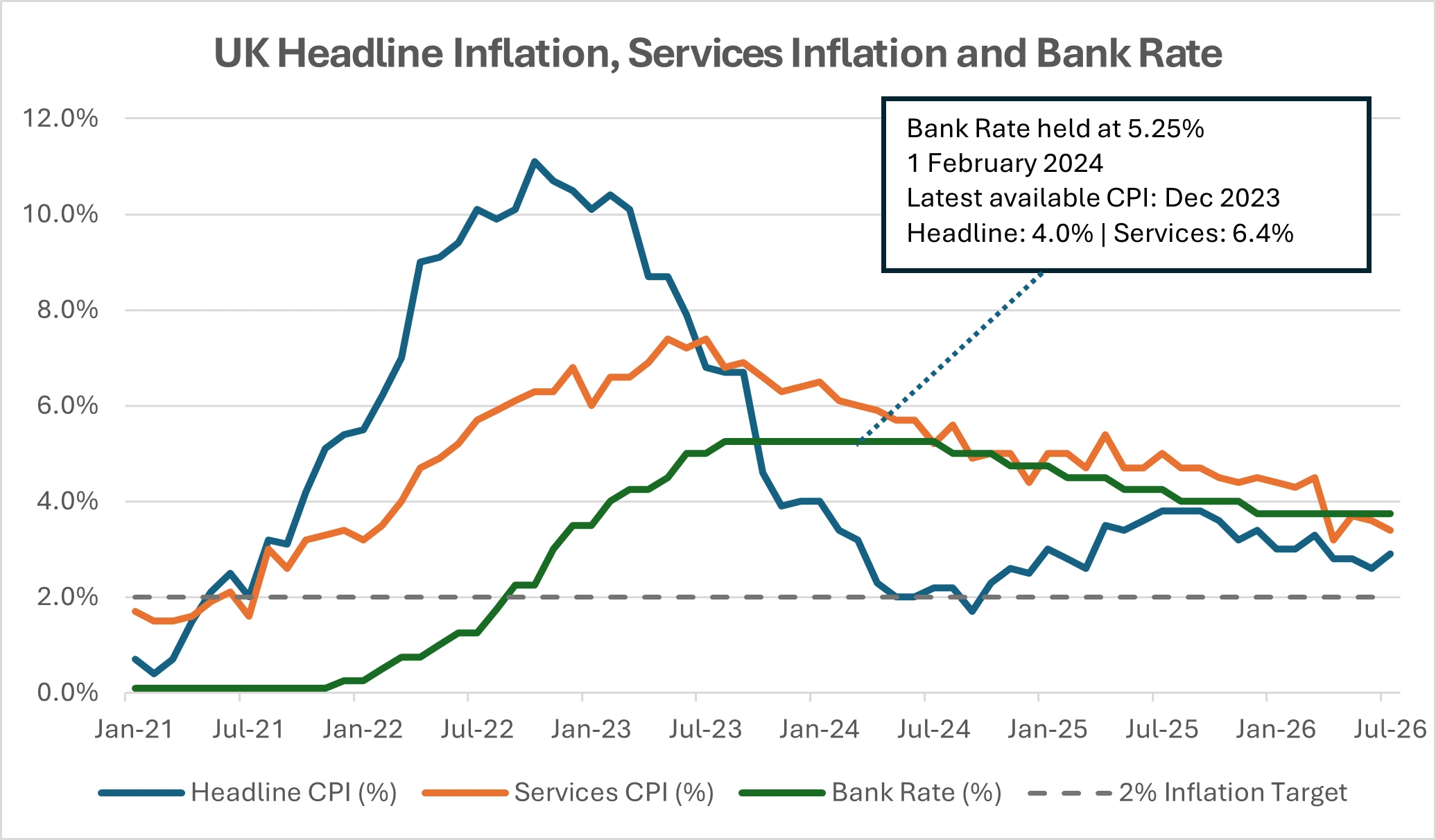
Source & Methodology: Office for National Statistics and Bank of England. The chart compares the annual rate of UK headline Consumer Prices Index inflation with CPI services inflation and Bank Rate from January 2021 to July 2026. Inflation observations are aligned with the months to which the data relate rather than their subsequent publication dates. Bank Rate represents the rate applicable at the end of each month. The dashed line indicates the Bank of England’s 2% inflation target. All series are shown in their original percentage terms and have not been indexed. Data as of 19 August 2026.
Headline inflation declined substantially after reaching its October 2022 peak, but services inflation eased more gradually. This divergence helped explain why the Bank of England kept Bank Rate at 5.25% during the first half of 2024 despite the improvement in the headline measure. The chart also shows that inflation and interest rates do not move together mechanically, as policymakers consider the composition, persistence and likely future direction of price pressures.
Bottom Line
Falling inflation can represent meaningful progress, but it does not automatically mean interest rates will decline immediately.
Central banks consider whether inflation remains above target and whether underlying price pressures, wage growth and expectations support a lasting return to price stability. They must also balance the risks of cutting too soon against those of keeping monetary policy restrictive for too long.
The direction of inflation matters, but its composition, persistence and distance from the central bank’s target matter as well.