














Higher Bond Yields and Oil Prices Weigh on Global Markets | Weekly Market Recap: 17-21 August 2026


Global markets turned more cautious as rising government bond yields, renewed tensions surrounding Iran and higher oil prices weighed on risk appetite. US equities finished the week lower, while oil, precious metals and cryptocurrencies recorded strong gains.
Economic data presented a mixed picture. US services activity strengthened, China’s domestic economy lost momentum and Japanese inflation accelerated. Together, the data reinforced an increasingly uneven global outlook as investors assessed the implications for growth, inflation and interest rates.
Economic Overview
Economic data highlighted increasingly divergent conditions across the world’s major economies.
In the United States, August business activity remained resilient. The Services PMI rose to 56.8, comfortably above expectations of 54.0 and signalling the strongest expansion in almost two years. Manufacturing PMI came in at 53.2, below expectations of 53.9 but still above the 50 level separating expansion from contraction.
Europe also showed signs of improving activity. The euro area Composite PMI increased to 52.1, supported by stronger manufacturing activity, particularly in Germany. Services remained comparatively weaker, however, highlighting an uneven recovery across the region.
China’s economy lost further momentum. Industrial production increased 4.5% year-on-year in July, slowing from 5.3% and missing expectations of 4.8%. Retail sales grew just 0.6%, well below expectations of 1.5%, while fixed-asset investment contracted 6.7% during the first seven months of the year. The figures reinforced concerns surrounding weak domestic demand.
In Japan, core consumer prices excluding fresh food increased 1.8% year-on-year in July, up from 1.6% in June. Inflation excluding both fresh food and energy rose 1.9%, strengthening expectations that the Bank of Japan could continue normalising monetary policy.
Overall, resilient US and European business activity contrasted with weaker Chinese demand and renewed inflation pressures in Japan.
Equities, Bonds and Commodities
Equities
US equities recovered on Friday but finished the week lower as volatile Treasury yields and geopolitical uncertainty weighed on sentiment.
The S&P 500 fell 1.43% over the week to close at 7,674.37, while the Nasdaq Composite declined 2.05% to 26,180.46. Both snapped three-week winning streaks. The Dow Jones fell 0.85% for its second consecutive weekly decline, despite gaining almost 1% on Friday to close at 53,277.01.
Technology stocks remained particularly sensitive to changes in long-term borrowing costs as investors reassessed valuations following the sector’s strong gains earlier in the year.
European markets also faced pressure, although improving economic data helped support Friday’s recovery. Asian markets were mixed, with Japanese equities particularly affected by Middle East uncertainty and changing expectations for Bank of Japan policy.
Bonds
Government bond markets remained central to investor sentiment.
The US 30-year Treasury yield briefly reached 5.34%, its highest level since 2007, before ending the week around 5.28%, while the 10-year finished near 4.74%.
The Treasury’s decision to expand its bond buyback programme briefly eased pressure but yields subsequently moved higher again.
Commodities
Energy and precious metals advanced as geopolitical and fiscal uncertainty increased.
Brent crude gained 6.39% to US$94.39 per barrel, while WTI rose 5.66% to US$87.06. Continued disruption to shipping through the Strait of Hormuz and the prospect of tighter sanctions on Iran kept supply concerns elevated.
Gold gained more than 5%, reaching a three-month high and ending Friday at approximately US$4,624 per ounce. While silver also rallied strongly (+7%), ending the week around US$69.62 per ounce. A weaker US dollar, concerns surrounding US debt and the Treasury market, and stronger demand for defensive assets supported precious metals.
Sector Performance
FE Analytics data showed a clear rotation away from technology and industrial stocks towards Healthcare, Energy and more defensive areas of the market.
Healthcare led with a 4.11% gain, followed by Energy at +2.15% as oil prices rose sharply. Consumer Staples advanced 0.82%, while Consumer Discretionary gained 0.71%.
Performance was weaker elsewhere. Financials declined 0.61%, Utilities fell 1.47% and Industrials dropped 2.59%. Information Technology & Communication Services was the weakest-performing sector, falling 2.66%, as higher Treasury yields placed renewed pressure on growth valuations.
Sector Performance: 17-21 August 2026
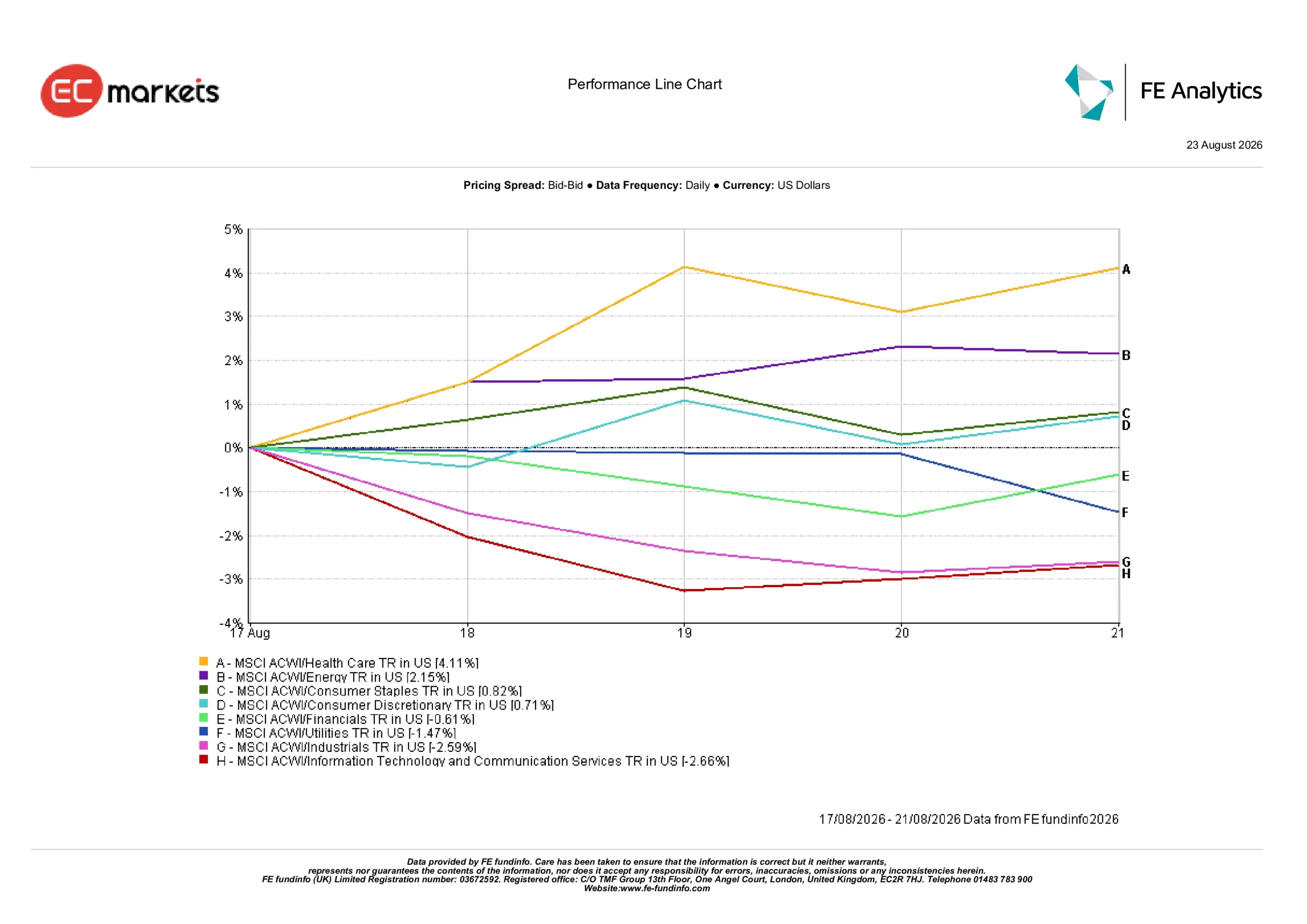
Source: FE Analytics. All indices total return in USD. Past performance is not a reliable indicator of future performance. Data as of 21 August 2026.
Regional Markets
Regional performance diverged as sector composition, currency movements and exposure to technology influenced returns.
The United Kingdom led with a 1.50% gain in US dollar terms, followed by China at +1.37%, supported by expectations of additional policy measures.
Europe gained 0.41%, with improving business activity helping offset concerns surrounding energy prices and borrowing costs.
By contrast, North America declined 0.85% as technology and other interest-rate-sensitive stocks came under pressure. Japan was the weakest-performing region, falling 3.11% amid equity-market weakness and renewed policy uncertainty.
Regional Performance: 17-21 August 2026
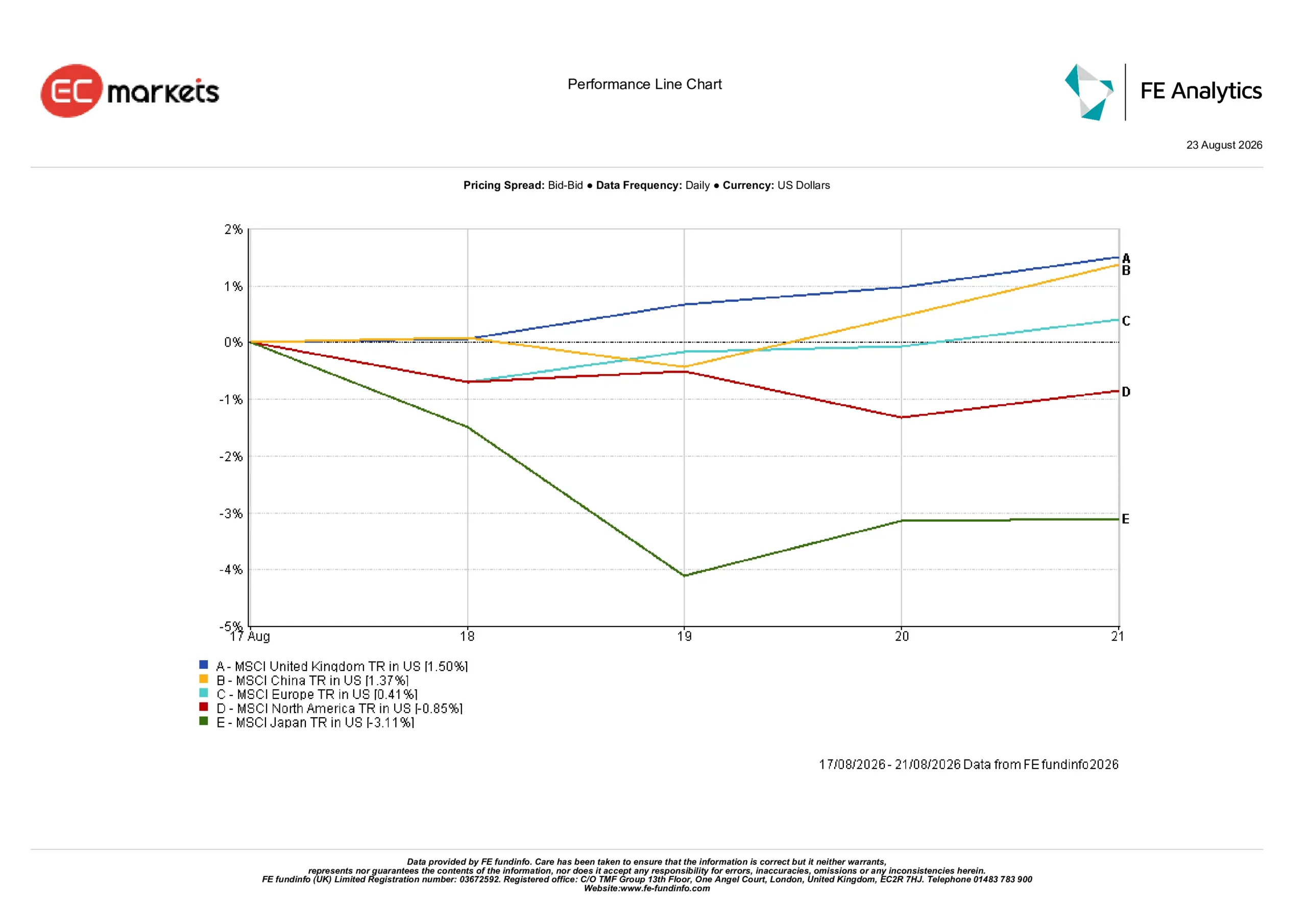
Source: FE Analytics. All indices total return in USD. Past performance is not a reliable indicator of future performance. Data as of 21 August 2026.
Currency Markets
Currency markets reflected broad US dollar weakness alongside shifting monetary-policy expectations.
EUR/USD rose from 1.1570 to 1.1677, gaining approximately 1.26%, as the euro benefited from broader dollar weakness and improving Eurozone business activity.
GBP/USD advanced from 1.3535 to 1.3644, gaining around 1.14%, while USD/JPY declined from 159.32 to 158.93, leaving the yen modestly stronger as Japanese inflation reinforced expectations for further Bank of Japan policy normalisation.
GBP/JPY remained comparatively resilient as sterling strength offset some of the yen’s recovery.
Overall, the US dollar weakened as concerns around the US fiscal outlook and elevated government borrowing weighed on sentiment, while stronger Japanese inflation supported expectations for further BoJ normalisation.
Digital Assets
Digital assets were among the week’s strongest performers.
Bitcoin surged approximately 22% to above US$77,000, reaching its highest level since May and recording its strongest weekly gain since 2024.
Ethereum also advanced to around US$2,440, while the broader cryptocurrency rally supported strong gains across crypto-related equities.
Outlook and The Week Ahead
Attention now turns to US inflation, central bank guidance and another important round of technology earnings. The Personal Consumption Expenditures (PCE) Price Index, the Federal Reserve’s preferred inflation measure, will be closely watched for signs that underlying price pressures are moderating, particularly following the recent rise in energy costs.
Investors will also focus on Federal Reserve Chair Kevin Warsh’s speech at the Jackson Hole Economic Policy Symposium. With long-term Treasury yields near multi-year highs, any guidance on inflation, interest rates and the wider policy outlook could influence sentiment across equities, bonds and currencies.
Corporate earnings will remain firmly in focus, led by Nvidia. After semiconductor stocks came under pressure last week, its results will provide an important test of whether AI-related earnings growth can continue supporting elevated technology valuations.
Geopolitical developments remain another source of uncertainty. Further disruption to oil supplies or escalation in tensions surrounding Iran could push energy prices higher, adding to inflation concerns and keeping pressure on government bond yields.
For now, markets remain caught between resilient economic activity and tighter financial conditions. With bond yields elevated and oil prices rising, investors are likely to remain selective while awaiting clearer signals from PCE inflation, Jackson Hole and Nvidia earnings.