



AI Financing Concerns Hit US Tech as Defensive Stocks Gain | Weekly Recap: 12-16 October 2026


This week’s Weekly Market Recap examines a sharp divide across global markets as AI financing concerns and hotter US inflation challenged investor confidence.
While technology-heavy US indices declined, defensive and value-oriented stocks held up better, and European equities outperformed as investors reassessed their exposure to AI-related companies.
Meanwhile, stronger US consumer and producer inflation complicated the outlook for interest rates, even as Treasury yields declined amid increased demand for safer assets.
Together, these developments highlighted how investors were balancing resilient economic activity against higher financing costs, technology valuations and persistent inflation.
Economic Overview
US inflation accelerated in September, complicating the outlook for interest rates even as economic activity remained resilient.
The Consumer Price Index rose 0.6% month on month, up from 0.4% in August, while annual inflation increased to 3.7% from 3.4%. Gasoline prices jumped 9.1%, accounting for more than half the monthly increase. Core inflation rose 0.3% on the month and 2.6% year on year.
Producer prices showed even stronger pressure. The Producer Price Index increased 1.3% month on month, its largest monthly rise since March 2022, and 6.3% year on year. Goods prices climbed 2.6%, driven by a 10.8% increase in energy, while services prices advanced 0.8%.
Economic activity remained firm. US retail sales rose 0.8% in September, although higher fuel prices contributed to the increase. Excluding vehicles and gasoline, sales grew 0.2%. Industrial production advanced 0.7%, with capacity utilisation rising to 76.9%. Initial jobless claims increased by just 1,000 to 199,000, suggesting layoffs remained limited despite slower hiring.
The Federal Reserve’s Beige Book described labour market conditions as broadly unchanged, with employers remaining cautious about recruitment. Fed Chair Kevin Warsh offered no clear indication of his preferred decision for the 27–28 October meeting. Markets continued to expect rates to remain unchanged in October, with the probability of an increase declining further after his comments, although expectations of another increase in December remained.
Elsewhere, the UK economy expanded 0.1% month on month in August, supported by production and computer programming activity. The Bank of England continued to monitor the inflationary impact of energy costs, while markets expected at least one further rate increase before year-end.
In the euro area, September inflation was confirmed at 3.8%, keeping the possibility of further ECB tightening in focus. China’s consumer inflation edged up to 0.9%, while producer prices rose 5.0% year on year amid higher oil and commodity costs.
The combination of resilient activity and accelerating inflation left central banks facing a difficult balance between growth and price stability.
Equities, Bonds and Commodities
Equities
US equities diverged sharply as concerns over artificial intelligence financing triggered a sell-off in technology shares.
The S&P 500 fell 1.9% and the Nasdaq Composite declined 4.5%, marking their weakest weeks since June. In contrast, the Dow Jones Industrial Average gained 0.7%, supported by demand for defensive and value-oriented companies.
Investors increasingly questioned whether heavily indebted data centre operators could generate sufficient returns to justify large-scale AI investment. CoreWeave fell more than 20% over the week, while semiconductor and other technology companies also came under pressure.
Third-quarter earnings from major US banks presented a mixed picture. Investors focused on trading activity, lending margins, credit costs and the outlook for dealmaking as higher interest rates and volatile markets influenced performance.
European equities proved more resilient. The STOXX Europe 600 gained more than 2%, its strongest week since June, as encouraging company results helped offset weakness in global technology stocks. The FTSE 100 rose 3.1%, its best week in six months, supported by corporate earnings, lower exposure to the AI sell-off and an unexpected expansion in UK monthly GDP.
Bonds
Government bond yields declined over the week as concerns about artificial intelligence financing increased demand for safer assets. The US 10-year Treasury yield ended Friday at about 5.1%. UK gilt and German government bond yields also eased despite persistent inflation concerns.
Commodities
Brent crude settled at US$109.86 per barrel, gaining 4.9% over the week. Prices were supported by renewed concerns about Middle Eastern supplies and increased attacks near the Strait of Hormuz.
Spot gold declined approximately 0.7% over the week to around US$4,165 per ounce. Hotter consumer and producer inflation renewed expectations that US interest rates could remain restrictive for longer, reducing the appeal of the non-yielding metal.
Sector Performance
Global sector returns reflected a pronounced shift away from technology-related companies towards defensive areas of the market.
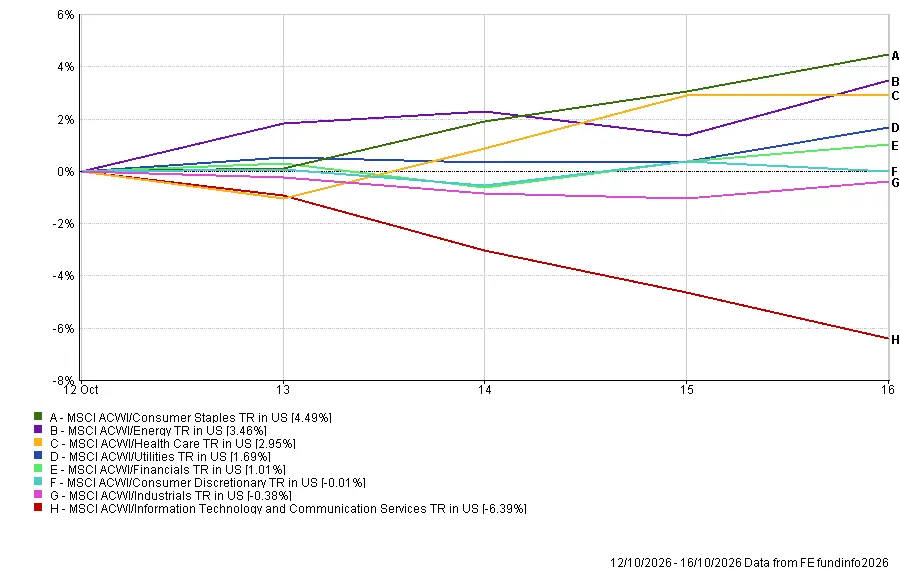
Consumer Staples was the strongest sector, gaining 4.49%, as investors favoured defensive companies during the technology sell-off. Energy advanced 3.46%, supported by higher oil prices, while Healthcare gained 2.95%.
Utilities rose 1.69% and Financials advanced 1.01%. Consumer Discretionary was nearly unchanged, declining 0.01%, while Industrials fell 0.38%.
Information Technology & Communication Services was the weakest sector, declining 6.39%, leaving a gap of 10.88 percentage points between the strongest and weakest performers as concerns over AI valuations and debt-funded data centre investment intensified.
Sector Performance October 12th-16th, 2026
Source: FE Analytics. All indices total return in USD. Past performance is not a reliable indicator of future performance. Data as of 16 October 2026.
Regional Markets
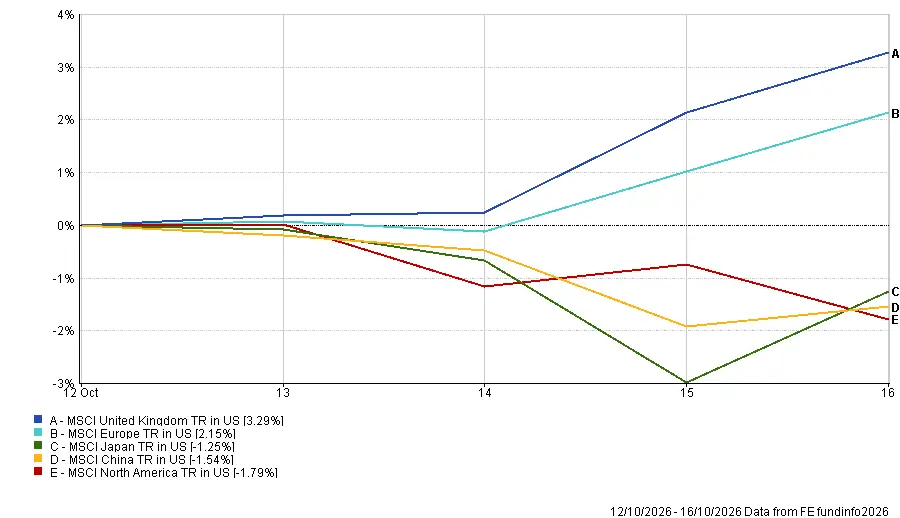
The MSCI United Kingdom TR was the strongest regional index, gaining 3.29%, supported by the FTSE 100’s defensive exposure and stronger sterling.
The MSCI Europe TR rose 2.15%, reflecting stronger corporate results and the euro’s appreciation against the dollar. The MSCI Japan TR declined 1.25%, while the MSCI China TR fell 1.54%.
The MSCI North America TR was the weakest regional index, declining 1.79%, as losses among technology and artificial intelligence-related companies outweighed gains in defensive sectors.
Currency movements influenced the US-dollar-based results. Sterling and the euro strengthened against the dollar, increasing translated UK and European returns. The yen also strengthened slightly, providing a modest positive currency contribution to Japan’s return, although this was insufficient to offset the decline in Japanese equities.
Regional Performance October 12th-16th, 2026
Source: FE Analytics. All indices total return in USD. Past performance is not a reliable indicator of future performance. Data as of 16 October 2026.
Currency Markets
The US dollar weakened against the euro and sterling as Treasury yields declined and expectations of an October Fed rate increase eased.
EUR/USD rose from 1.1200 to 1.1240, reflecting euro strength against the dollar.
GBP/USD advanced from 1.3236 to 1.3329, supported by the unexpected expansion in UK monthly GDP and broader dollar weakness.
USD/JPY declined from 158.25 to 158.01, indicating modest yen appreciation.
GBP/JPY climbed from 209.57 to 210.62, as sterling strengthened against the yen.
Overall, the dollar’s weakness contributed to stronger US-dollar-based returns for UK and European equities, reinforcing the regional performance differences seen during the week.
Outlook and The Week Ahead
Attention now turns to China’s third-quarter GDP, industrial production and retail sales on Monday, offering fresh insight into the balance between export growth and weak domestic demand.
In the UK, labour market data arrives Tuesday, followed by inflation on Wednesday and retail sales on Friday. Investors will assess whether wage growth and persistent price pressures strengthen the case for another Bank of England rate increase.
In the US, housing starts and building permits are due Tuesday, followed by weekly jobless claims on Thursday. Preliminary October purchasing managers’ indices and the final University of Michigan consumer sentiment reading arrive Friday, offering further insight into economic momentum and inflation expectations.
Federal Reserve officials have entered their blackout period ahead of the 27-28 October policy meeting, leaving economic data to shape market expectations.
Meanwhile, earnings season continues with Netflix, Tesla, IBM, Texas Instruments, Procter & Gamble and American Express. Investors will be watching for evidence of sustainable returns on AI investment, resilient consumer demand and companies’ ability to manage higher financing and energy costs.
The key question is whether corporate earnings can restore confidence in technology valuations as persistent inflation keeps interest-rate expectations elevated.