

High Dividend Yield: Why It Is Not Always a Good Sign


A high dividend yield can look attractive, but the percentage alone does not tell the full story. Here’s why a high yield can sometimes signal greater risk rather than stronger income potential.
For investors seeking regular income, dividend yield can be an important metric. However, the highest percentage does not necessarily represent the strongest opportunity or the most dependable payment.
A company’s dividend yield can rise because it has increased its dividend. It can also rise because its share price has fallen. In some cases, that falling price reflects concerns about the company’s earnings, cash flow or ability to continue paying dividends.
Understanding why the yield is high is therefore more important than looking at the percentage alone.
What Is Dividend Yield?
A dividend is a payment that a company makes to its shareholders, usually from the profits or cash generated by the business. However, companies are not required to pay dividends, and payments can be reduced or suspended.
The dividend yield compares a company’s annual dividend per share with its current share price.
Dividend yield = Annual dividend per share ÷ Share price × 100
Consider a company that pays an annual dividend of £1 per share while its shares trade at £20. Its dividend yield is 5%.
If the share price falls to £10 while the annual dividend remains £1, the displayed yield rises to 10%. The company has not increased the cash payment. The higher yield results entirely from the lower share price.
This relationship means that a rapidly rising dividend yield may sometimes reflect declining investor confidence rather than improving income prospects.
Why Can a High Dividend Yield Be a Warning Sign?
Share prices can fall when investors expect weaker earnings, deteriorating cash flow or greater financial pressure. If the dividend remains unchanged during the initial decline, its yield automatically rises.
The market may also anticipate that the company will eventually need to reduce or suspend the dividend. Share prices are forward looking, so they can respond to these concerns before management announces a formal change.
A dividend may come under pressure when earnings are falling, free cash flow is insufficient to support payments or debt and interest costs are increasing. Management may also need to preserve cash for investment, debt reduction or other business requirements.
However, a high dividend yield is not automatically evidence of financial distress. Mature businesses in certain industries may distribute a larger proportion of their earnings because they require less money for expansion. Dividend levels and payout practices also differ across sectors.
The important question is not simply whether the yield is high, but whether the underlying payment appears sustainable.
Dividend Yield vs Dividend Sustainability
Dividend yield measures the payment relative to the share price. It does not measure the company’s ability to continue making that payment.
The payout ratio compares dividends with company earnings. A persistently high ratio may leave the business with less flexibility if profits weaken or unexpected costs arise. If a company reports a net loss, the conventional earnings payout ratio becomes less meaningful because there are no positive earnings against which to compare the dividend. Investors may then place greater emphasis on free cash flow, balance sheet strength and future funding requirements. However, no single measure provides a complete assessment of dividend sustainability.
Free cash flow is important because dividends are paid in cash. A company can report an accounting profit while generating insufficient cash after paying for equipment, facilities and other investments.
Debt should be considered as well. Interest payments and debt repayments compete with dividends for the company’s available cash. When borrowing costs rise or substantial debt needs refinancing, management may prioritise the balance sheet over shareholder distributions.
A long dividend history can provide useful context, but it does not guarantee future payments. Management guidance concerning cash flow, investment and capital allocation can offer further information about the company’s priorities.
Intel: How Its Dividend Changed From 2022 to 2024
Intel provides a useful example of how dividend policies can change when a company needs greater financial flexibility.
In 2022, Intel declared a quarterly dividend of $0.365 per share, equivalent to an annualised rate of $1.46 per share.
On 22 February 2023, Intel announced that it was reducing its quarterly dividend to $0.125 per share, equivalent to an annualised rate of $0.50. The company said the change would improve its financial flexibility and support the investment required to execute its long term transformation strategy. Intel was also working to reduce costs and manage a period of unusually high investment.
On 1 August 2024, Intel announced that it would suspend the dividend beginning in the fourth quarter of 2024. The company explained that it was prioritising liquidity to support its strategy and planned investments. The announcement formed part of a broader programme that included reductions in operating expenses, capital expenditure and headcount.
These decisions did not occur in isolation. Intel was facing pressure on profitability, substantial investment requirements and the need to improve operating efficiency.
The example does not mean that the dividend changes alone determined Intel’s share price. Share prices respond to many factors, including financial results, business guidance, industry conditions, interest rates and changing investor expectations.
Intel Share Price and Dividend Announcements, 2022-2024
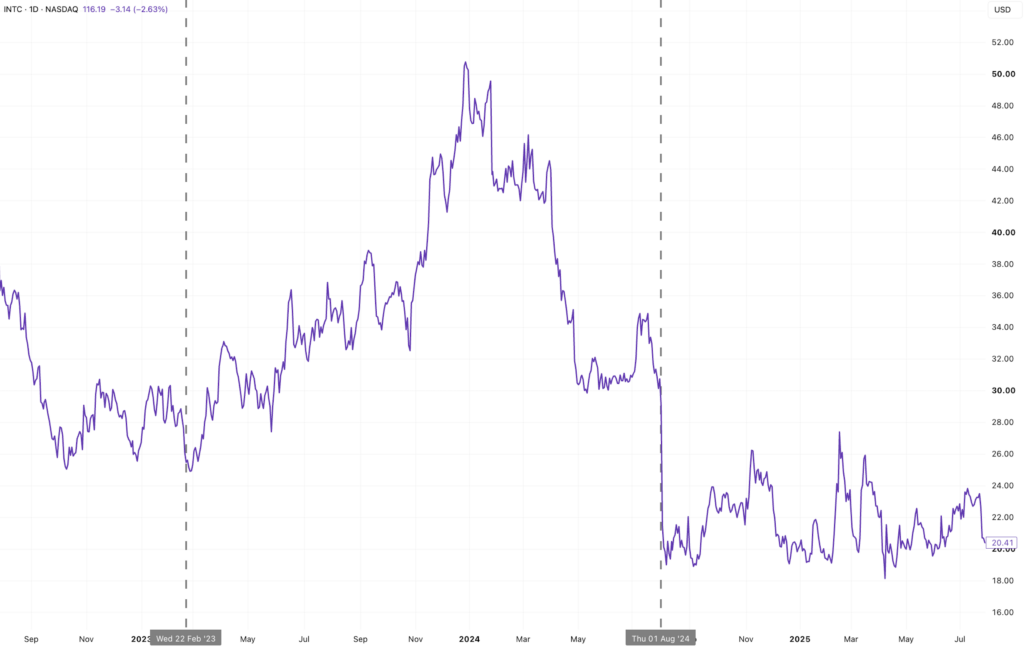
The announcements occurred during a period of changing earnings expectations, substantial investment requirements and pressure on Intel’s financial performance. The sharp decline following the August 2024 announcement also coincided with weaker financial results, a more challenging outlook and a cost reduction programme. The chart therefore provides context for the dividend decisions but does not establish that either announcement was solely responsible for subsequent share price movements.
What Should Investors Examine Alongside Dividend Yield?
Dividend yield can provide useful information about the income a share currently offers relative to its price, but it is more informative when considered alongside the company’s wider financial position.
Investors may also examine:
- Payout ratio: how much of the company’s earnings is being distributed as dividends.
- Free cash flow: whether the business is generating sufficient cash to support its dividend payments.
- Debt: whether interest costs and repayments could place pressure on available cash.
- Dividend history: how the company’s payments have changed over time.
- Earnings outlook: whether future profits are expected to support the current level of distributions.
No single measure can determine whether a dividend is sustainable, but considering these factors together can provide broader context for the headline yield.
Why Total Return Matters
Dividend income is only one part of an investor’s overall outcome. Total return includes both the income received and any change in the share price.
For example, an investor may receive a dividend yield of 8%, but the share price could decline by 20%. The dividend would not fully offset the capital decline.
This is a simplified illustration that excludes taxes, fees and the effect of reinvesting dividends. It nevertheless demonstrates why a high yield should not be assessed separately from movements in the value of the investment.
Bottom Line
A high dividend yield may provide attractive income, but it can also result from a falling share price or concerns about the sustainability of the payment.
Rather than judging a company by the percentage alone, investors can examine why the yield is high and whether the business generates sufficient earnings and cash flow to support future distributions.
Dividend yield is therefore most informative when considered alongside earnings, free cash flow, debt, dividend sustainability and the company’s wider financial outlook.