



How Commodity Prices Affect Company Profits


Commodity prices can have a significant impact on company profits, influencing everything from the revenue earned by energy producers to the costs faced by airlines, manufacturers and food companies.
Commodities are basic materials used throughout the economy, including oil, natural gas, metals and agricultural products such as wheat, coffee, cotton and sugar. Their prices fluctuate in response to supply and demand, weather, geopolitical events, production decisions, inventories and currency movements.
However, the financial impact depends on how a company uses or produces the commodity. A producer may benefit from higher selling prices, while a business purchasing the same commodity may face rising costs and pressure on its profit margins.
How Commodity Prices Affect Producers
Commodity producers earn revenue by selling the materials they extract, grow or process.
Consider a hypothetical oil producer selling 10 million barrels of oil. If the selling price rises from $70 to $90 per barrel while production remains unchanged, its revenue would increase as follows:
| At $70 per barrel | At $90 per barrel | |
| Oil production | 10 million barrels | 10 million barrels |
| Selling price | $70 | $90 |
| Total revenue | $700 million | $900 million |
| Revenue increase | — | $200 million |
This is a simplified hypothetical example for educational purposes only and does not represent an actual company.
However, the additional $200 million does not automatically become profit. The company must still pay wages, taxes, transportation costs, maintenance expenses and other production costs.
How Commodity Prices Affect Purchasers
Many businesses purchase commodities as part of their operations.
Airlines buy fuel, food companies purchase agricultural products and manufacturers use metals, energy and chemicals.
If commodity prices rise, the cost of producing goods or providing services may increase. Profit margins can weaken when a company lacks the pricing power to pass those additional costs on to customers.
A fall in commodity prices can have the opposite effect. It may weaken the revenue of producers while reducing costs for companies that purchase the commodity.
Why Volumes and Costs Still Matter
Commodity prices are only one part of a producer’s financial performance.
A company may receive a higher selling price but produce fewer units because of maintenance, operational problems, weather disruption or declining reserves.
Production costs can also rise because of higher wages, energy prices, equipment expenses or taxes. As a result, profits may fall even when the market price of the commodity increases.
Investors may therefore consider selling prices, production volumes, production costs, profit margins and cash flow.
How Hedging Can Reduce Commodity Price Risk
Commodity hedging involves using financial contracts or other arrangements to reduce exposure to future price movements.
A producer may agree in advance to sell part of its future production at a fixed price. A purchaser may similarly arrange to buy a commodity at a predetermined price.
This can make future revenue or costs more predictable. However, it can also reduce the immediate benefit of a favourable price movement.
The price reported in financial news may therefore differ from the price a company actually receives or pays.
Shell: How Commodity Prices Influence Company Profits
Shell provides a useful example because its results are influenced by oil and natural gas prices, production volumes, refining margins, chemical margins and energy trading conditions.
Shell’s financial performance between 2020 and 2022 illustrates how changing energy market conditions can influence revenue, profitability and cash flow.
Shell’s Reported Financial Performance, 2020-2022
Shell’s financial performance between 2020 and 2022 illustrates how changing energy market conditions can influence revenue, profitability and cash flow.
| Metric | 2020 | 2021 | 2022 |
| Average Brent crude oil price | ~$42/bbl | ~$71/bbl | ~$101/bbl |
| Revenue | $180.5bn | $261.5bn | $381.3bn |
| Income attributable to shareholders | −$21.7bn | $20.1bn | $42.3bn |
| Cash flow from operating activities | $34.1bn | $45.1bn | $68.4bn |
In 2020, the pandemic weakened energy demand and contributed to a sharp fall in oil prices. Shell reported a substantial loss attributable to shareholders, although lower commodity prices were not the only cause. Its results also reflected significant accounting charges, including impairments that reduced the recorded value of certain assets.
Conditions improved in 2021 as economic activity and energy demand recovered. Higher oil prices coincided with stronger revenue, profitability and operating cash flow.
The recovery became more pronounced in 2022 as global energy markets tightened. Brent crude oil prices rose further, while Shell reported substantially higher revenue, income attributable to shareholders and operating cash flow.
These results illustrate how higher commodity prices can support the financial performance of an energy producer. However, natural gas prices, production volumes, refining margins, trading activity, taxes, costs and accounting charges also influenced Shell’s results.
After 2022, Shell’s revenue and profit declined as energy prices moderated from their earlier highs. Income attributable to shareholders fell to $19.4 billion in 2023 and $16.1 billion in 2024 before increasing to $17.8 billion in 2025.
Shell said its 2025 results were affected by lower realised oil and liquefied natural gas prices, weaker trading and optimisation margins and lower chemicals margins. Higher sales volumes, lower operating expenses and favourable tax movements partly offset these pressures. This illustrates why commodity prices should not be treated as the sole explanation for changes in profit.
Shell Annual Revenue and Standardised Net Income, 2020-2025
The chart below provides a longer-term comparison of Shell’s annual revenue and standardised net income, showing how both measures changed between 2020 and 2025.
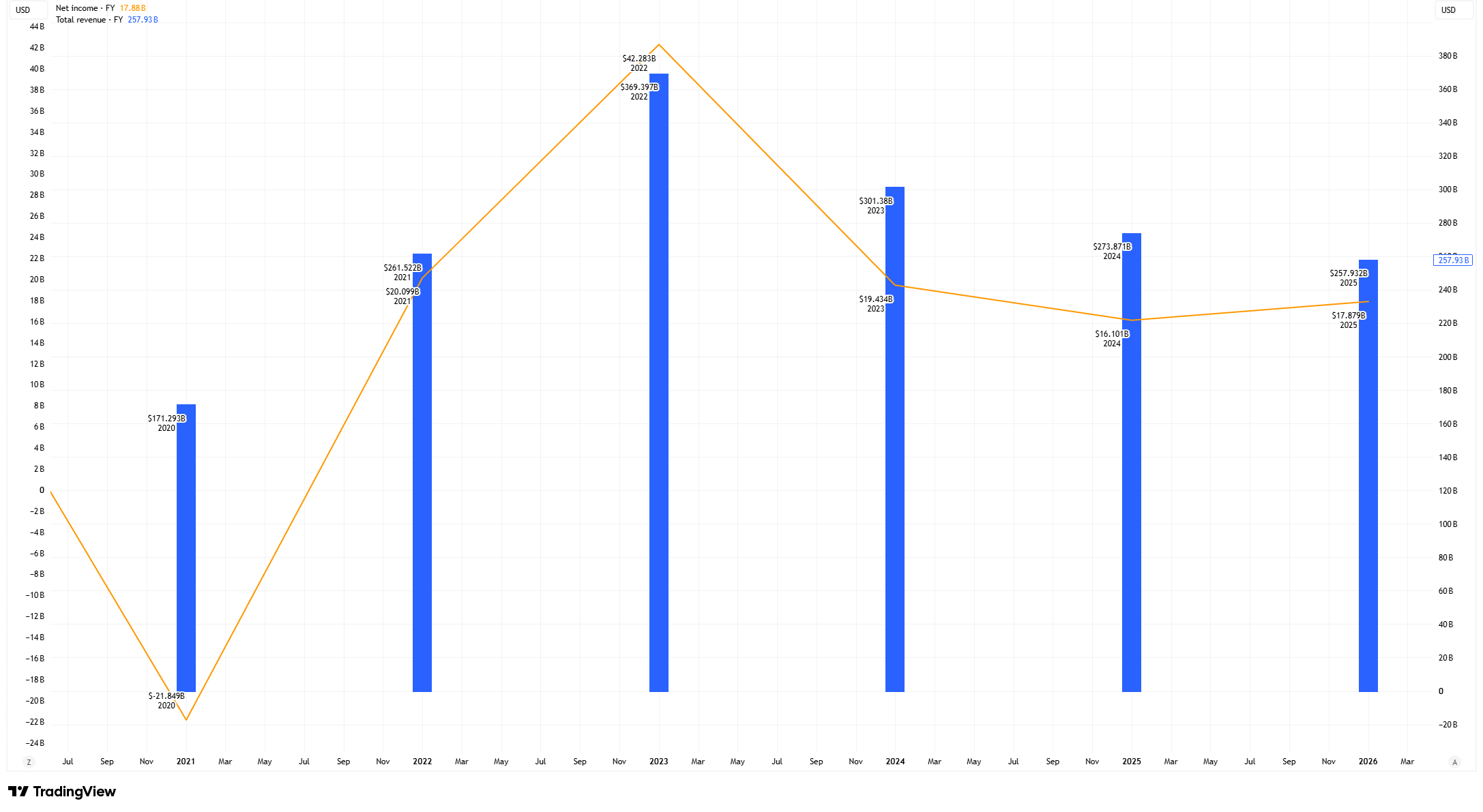
Source & Methodology: TradingView. The chart compares Shell’s annual total revenue and standardised net income for the financial years 2020 to 2025. Total revenue is shown in US dollars in billions as blue columns on the right axis. Standardised net income is shown in US dollars in billions using the orange line on the left axis. Annual figures are labelled by Shell’s financial year. Each observation is plotted at the end of its financial year, so the FY2025 observations appear above the 2026 label. TradingView’s standardised financial data may differ from figures reported directly in Shell’s filings because of provider methodology and classification. Historical figures may also be revised. Data as of 27 October 2026.
Shell’s standardised revenue increased from approximately $171.3 billion in 2020 to $369.4 billion in 2022, while standardised net income moved from a loss of approximately $21.8 billion to a profit of $42.3 billion. Both measures declined in 2023 and 2024 as energy market conditions moderated, although other business factors also influenced the results.
These standardised figures differ from the revenue Shell reported in its own financial statements, reflecting differences in data-provider methodology and classification.
Limitations of Commodity Price Analysis
Commodity prices are only one influence on company profitability. Changes in production volumes, operating costs, hedging arrangements, taxes, exchange rates and wider market conditions can all affect financial results.
A higher commodity price does not guarantee stronger profits for producers, just as lower input costs do not necessarily improve the margins of purchasers. Investors should also distinguish between reported financial results and standardised figures provided by financial data platforms.
Commodity price movements should therefore be assessed alongside company financial statements, operating performance and other relevant business factors.
Bottom Line
Commodity prices can significantly influence company revenue, costs and profitability, but their impact depends on the business model.
Producers may benefit from higher selling prices, while businesses that purchase commodities may face rising operating costs. However, production volumes, hedging arrangements, operating efficiency, taxes and other financial factors also affect the final result.
Understanding how commodity prices interact with these factors can help investors interpret company performance more accurately, without assuming that price movements alone determine future profits.