












Technical vs Fundamental Analysis: Understand the Difference
Anyone new to trading will, at some point in their journey, ask themselves 'how do I analyse the market?' Whether it is forex pairs, commodities or stocks/indices, there are two main types of analysis that traders use to try and understand where the market might be headed. Technical analysis reads price action, whereas fundamental analysis focuses on aspects beyond price, such as market sentiment and economic factors, that influence the value of an asset. 'Technical vs fundamental analysis' does not imply a battle of choosing between the two, but rather an understanding how each serves a separate but essential role when making trading decisions. This article compares technical vs fundamental analysis in depth, how to blend them together and common mistakes to avoid with both approaches.
What is Technical Analysis?
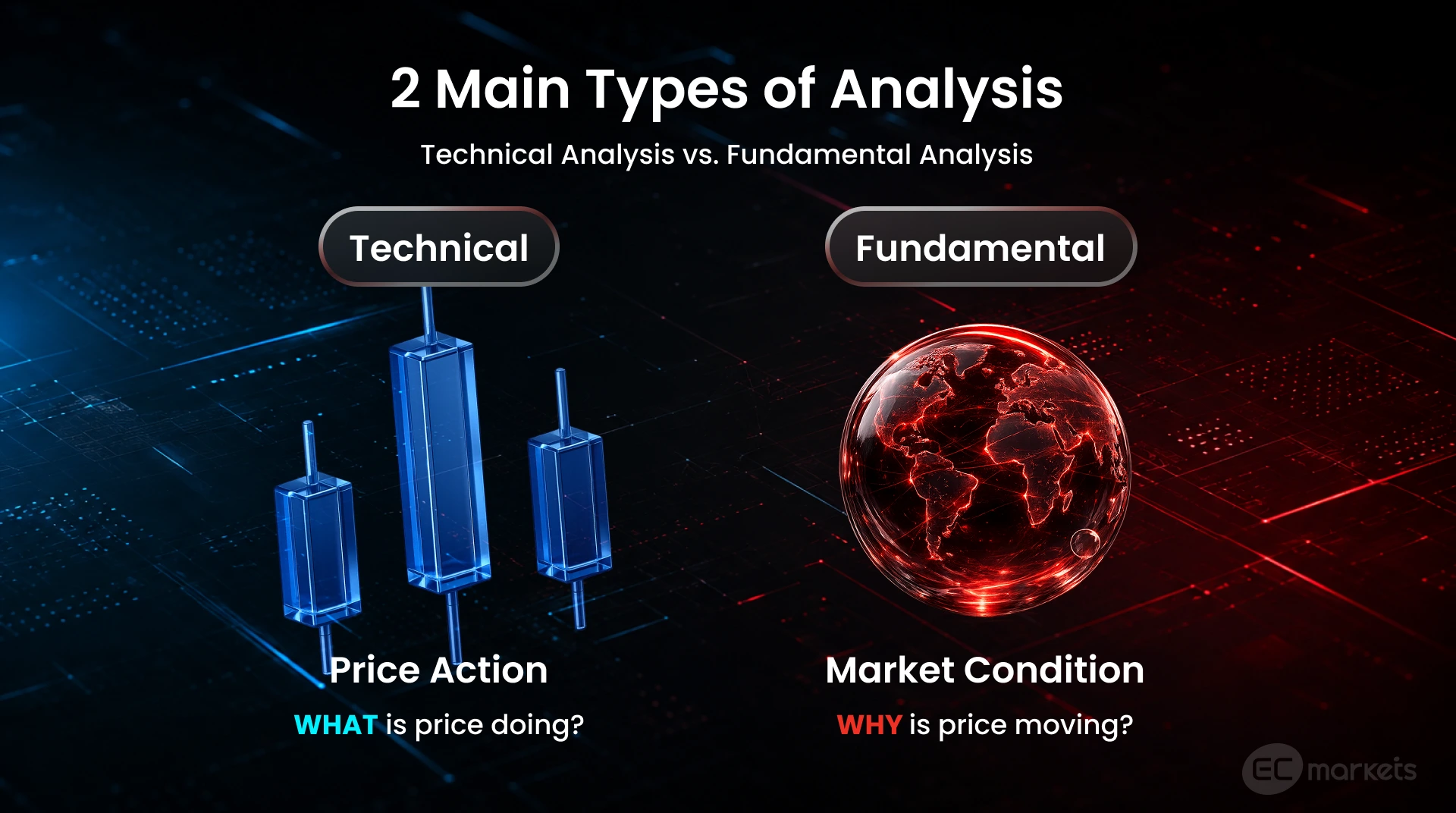
At its simplest, technical analysis is the study of price action. The process involves looking at a chart of historical prices and trying to find patterns, levels or signals that help with decisions about when to buy or sell. The underlying assumption behind technical analysis is that price already reflects everything the market collectively knows, such as economic data, news and trader expectations. So rather than trying to gather that information independently, a technical trader reads price action directly and responds accordingly.
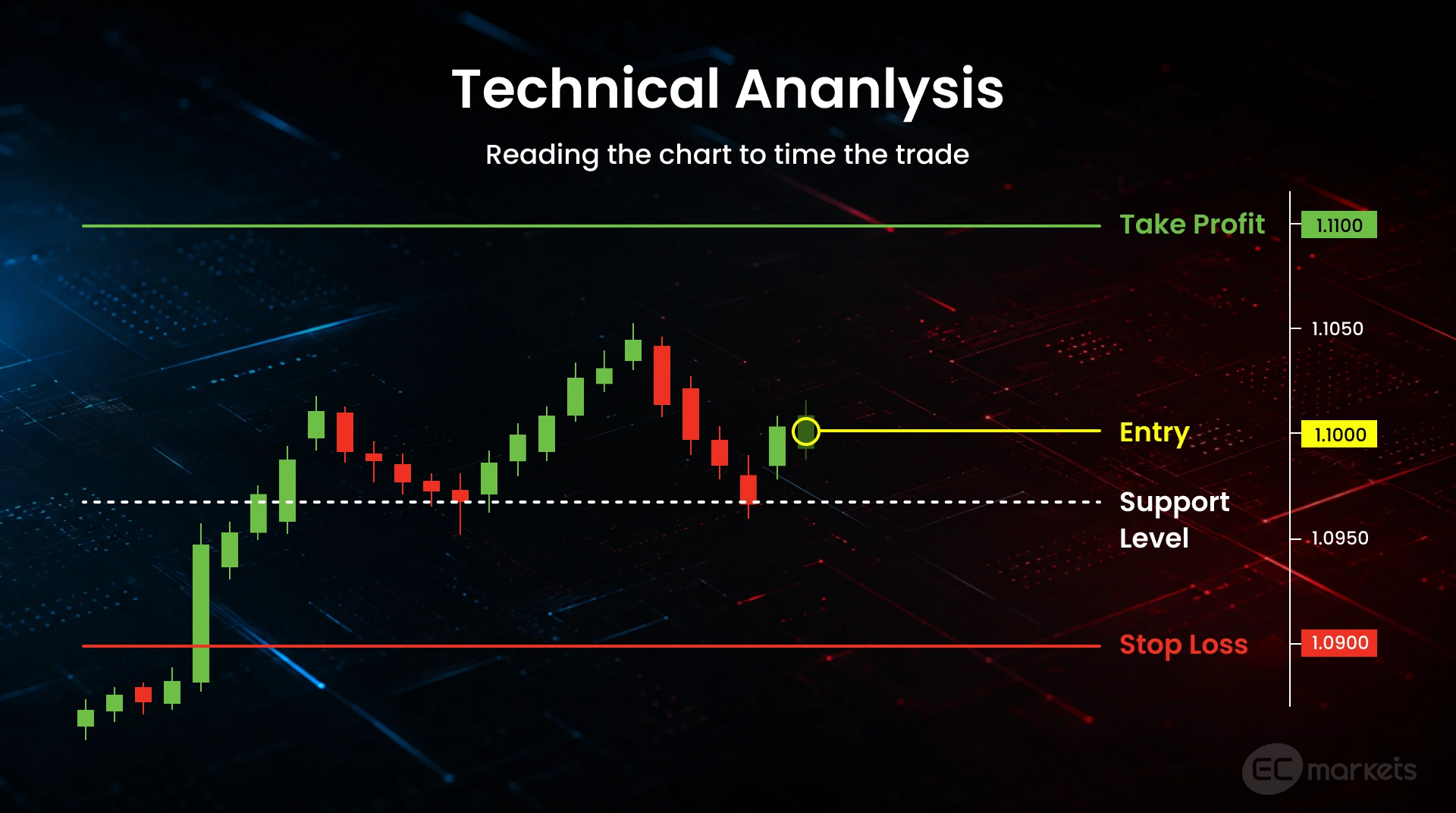
What does reading price action look like in practice? A trader might identify a price level where the market has repeatedly reversed — sometimes called support or resistance. Or they might look at whether prices are generally moving up, down or sideways over a given period. The goal of technical analysis is to find situations where the setup looks favourable, (where the potential gain justifies the risk) and act on those with a clear plan. The main thing technical analysis provides is structure: a defined entry point, a level that would prove the idea wrong, and a target. This combination takes some of the guesswork out of decisions that can otherwise feel hard to make.
What is Fundamental Analysis?
Fundamental analysis looks at the factors that drive the underlying value of an asset. It is less about what price is doing on a chart and more about the economic factors, political developments and broader market forces that might push it higher or lower over time.
In currency markets, the main economic factors tend to be central bank interest rate decisions, inflation data and employment figures. These affect whether a currency is attractive to hold. When a country's interest rates rise relative to others, it often draws in more investment, which tends to support the currency's value. When growth slows or inflation becomes unpredictable, that can have the opposite effect.
Something worth understanding early on is that markets often move based on what people expect to happen, not just what actually happens. If a central bank is expected to raise rates, traders might buy that currency well in advance. By the time the decision is announced, much of the move has already happened. This is why fundamental analysis involves paying attention to expectations and sentiment alongside economic factors — the raw data alone rarely tells the full story.
The main thing fundamental analysis provides is context. Rather than simply watching a price bounce around, a trader using fundamentals understands what is driving it and whether those conditions are likely to persist or change.
Combining the Two Methods
Understanding technical vs fundamental analysis is one thing — knowing how to combine them is another.
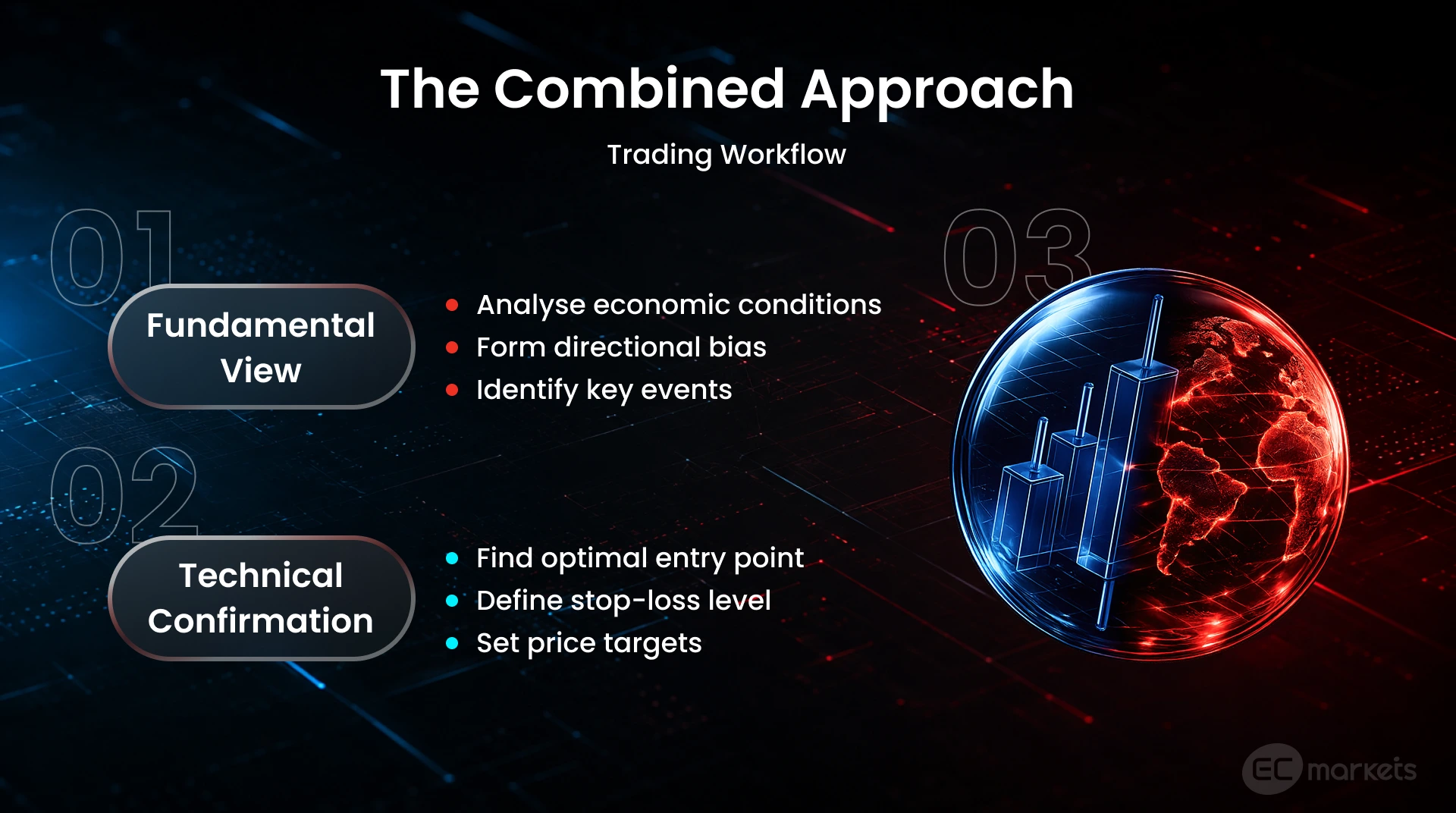
Fundamental analysis helps form a view. Is this market being pushed by conditions that are likely to continue? Are there upcoming events, such as an interest rate announcement, an inflation report or a political development, that could shift the economic factors at play? The goal is to understand the broader trading environment. Technical analysis then helps traders act on that view by reading price action to identify precise entry and exit points. Even when there is confidence that a market should move in a certain direction, there are still decisions to be made about where to enter, what level would prove the trade wrong and where to exit.
Combining technical and fundamental analysis matters for one practical reason: both approaches have blind spots. A trader using only fundamentals might be right about the overall trend but enter at a terrible price and get stopped out before the move happens. A trader using only technical analysis might take a setup that looks clean on the chart but walks straight into a major news event they were not tracking. Using both reduces those gaps.
When the chart and the fundamental backdrop are pointing the same way, there is more reason to act with confidence. A memorable way to think about technical vs fundamental analysis is this: fundamentals determine direction, technicals determine timing. When they conflict, such as if price is breaking higher but the underlying economic factors look weak, then that is often a reason to be cautious, or at least to wait until there is greater confluence between the two before acting.
Common Mistakes in Technical vs Fundamental Analysis
Mistakes in technical vs fundamental analysis are rarely about a lack of knowledge — they are about habits. Traders who struggle with one or both approaches typically do not misunderstand the method itself, but fall into behavioural patterns that undermine it. Most mistakes are avoidable with the right awareness, and many share a common thread: letting a single tool or data point do more work than it is designed to do. Here are some common mistakes to watch out for:
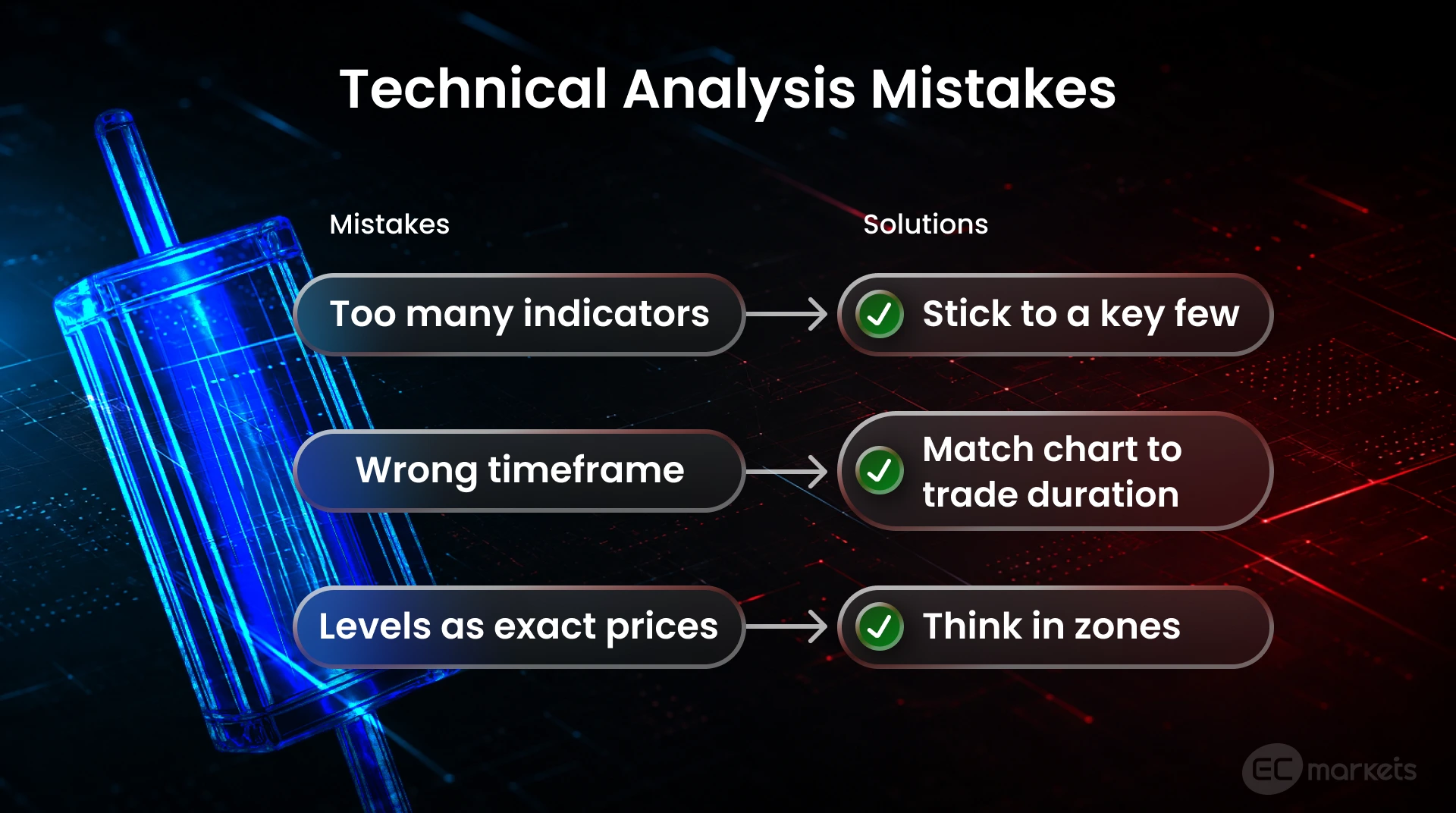
In technical analysis, traders should avoid...
- Adding too many indicators.
This is probably the most widespread habit among people who are newer to charts. The thinking is that more data means better decisions, but a lot of common indicators measure variations of the same thing — usually some form of momentum or rate of change. When several of them agree, it can feel like strong confirmation, when in actual fact, it often just means the same price action is being viewed from slightly different angles. A simpler chart is usually easier to trade from. - Using the wrong timeframe for the trade.
When a trade is intended to play out over several days, analysing it on a very short-term chart is going to create problems. Short-term charts are noisier. Small, normal fluctuations look significant, which can lead a trader to react to movements that do not actually matter for the trade in question. The timeframe used for analysis should roughly match the intended holding period. - Treating price levels as exact numbers.
Price action rarely repeats itself with precision — support and resistance are not exact lines but zones. The market does not always reverse at the exact same price twice. Treating these levels as specific numbers rather than approximate areas can lead to exiting too early when price briefly pushes through before reversing, or missing entries because price came close but did not reach the level exactly.
In fundamental analysis, traders should avoid...
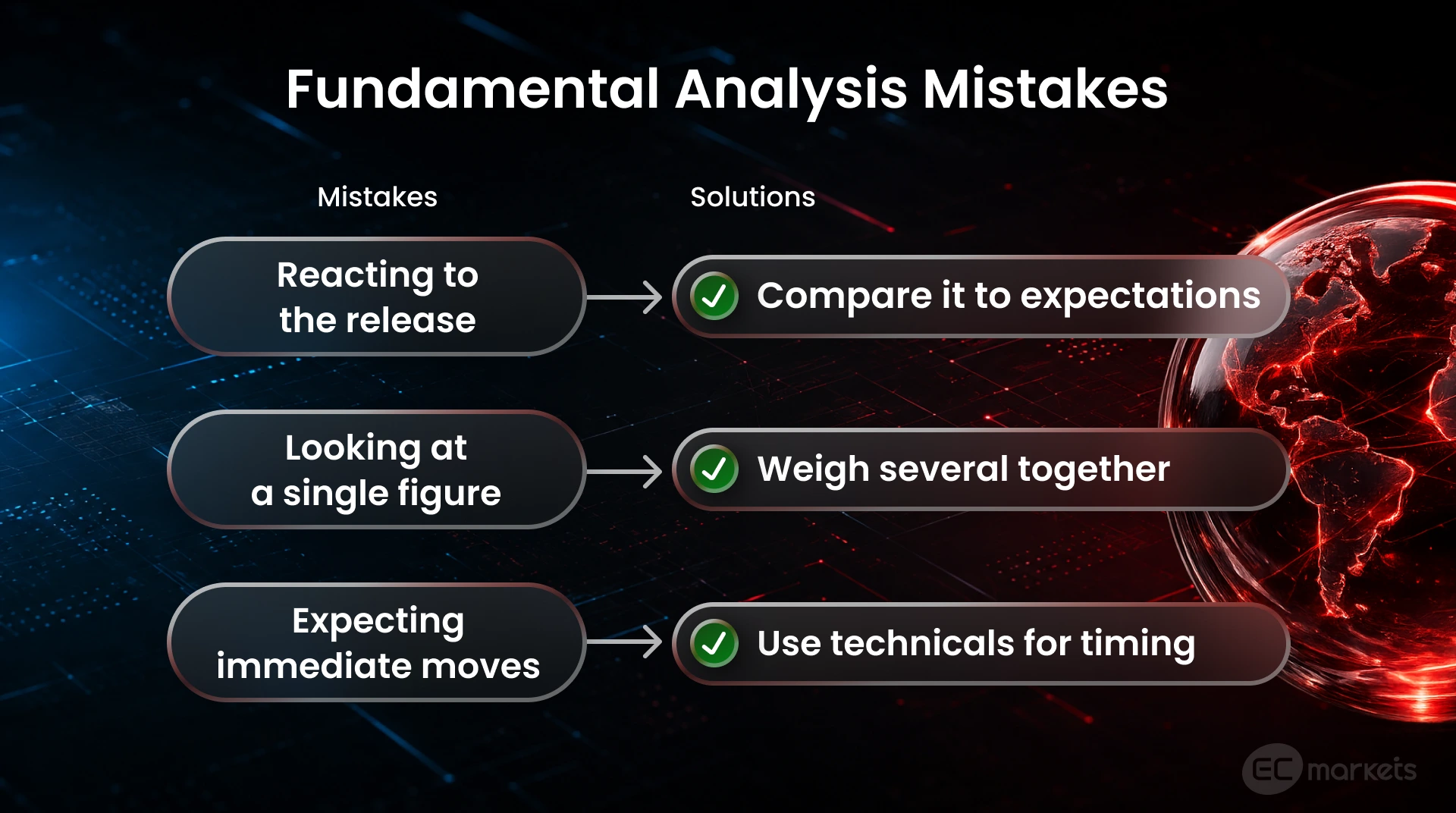
- Reacting to data without considering what was already expected.
Markets price in expectations ahead of time. If a central bank raises interest rates exactly as predicted, the currency might barely move — sometimes it even falls, as traders who bought the rumour sell the actual announcement. The data release matters less than whether it surprised people. A strong number that was already expected is not news to the market. - Looking at one data point in isolation.
No single economic figure provides the full picture. A strong jobs report might look straightforwardly positive for a currency, but if inflation is coming down sharply at the same time and the central bank has signalled it is done raising rates, the overall picture is more complicated. Fundamental analysis requires weighing several things together. - Expecting price to respond immediately.
Fundamental conditions play out over time — sometimes weeks or months. A currency can have genuinely supportive conditions and still trade sideways or drop in the short term, because other economic factors and market forces are affecting near-term price action. Using fundamentals alone to time precise entries tends to be frustrating for this reason. This is where technical analysis earns its place alongside the fundamentals.
Conclusion | Technical vs Fundamental Analysis Comparison
It is not a matter of deciding between technical vs fundamental analysis, but rather how to use each method in tandem to get a more complete picture. Fundamental analysis allows traders to assess an asset's intrinsic value by looking at aspects outside of price movements, such as market sentiment, political factors and economic factors. This provides the broader context for what price charts show. Price action is where technical analysis becomes useful for calculating entries, exits and risk levels, with the name of the game being precision in execution. Getting familiar with technical vs fundamental analysis early on saves a lot of trial and error down the line. While neither analysis truly eliminates uncertainty, the combination leads to more deliberate, better-informed trading decisions.
Note:
This content is for general information and educational purposes only and does not constitute investment advice or a personal recommendation. Any examples are for illustration only and should not be treated as a signal or invitation to trade. This material does not take into account your investment objectives, financial situation or needs. CFD trading is high-risk; losses may exceed deposits.