












Economic Indicators Explained: How to Trade the News
Whether it is forex pairs, stocks or gold, news releases can cause markets to move drastically. Capitalising on these movements by trading the news starts with understanding what economic indicators are and which ones actually matter. This forms the foundation of economic analysis, which is an essential part of fundamental analysis. This article will cover these basics as well as how they apply in a style of trading known as 'news trading'. By the end, navigating the economic calendar will feel less like noise and more like opportunity.
What are Economic Indicators?
Economic indicators, like GDP and Consumer Confidence, are data points released by governments, central banks or think tanks that measure the health of an economy. These releases are more than just calendar events. They are routine check-ins on the health of the economy that have impacts on interest rate expectations, growth expectations and capital flows, which affect exchange rates and asset prices. Economic analysis largely involves tracking changes in expectations, since these often prompt large institutions to reposition, which has a major effect on price movements in the market.
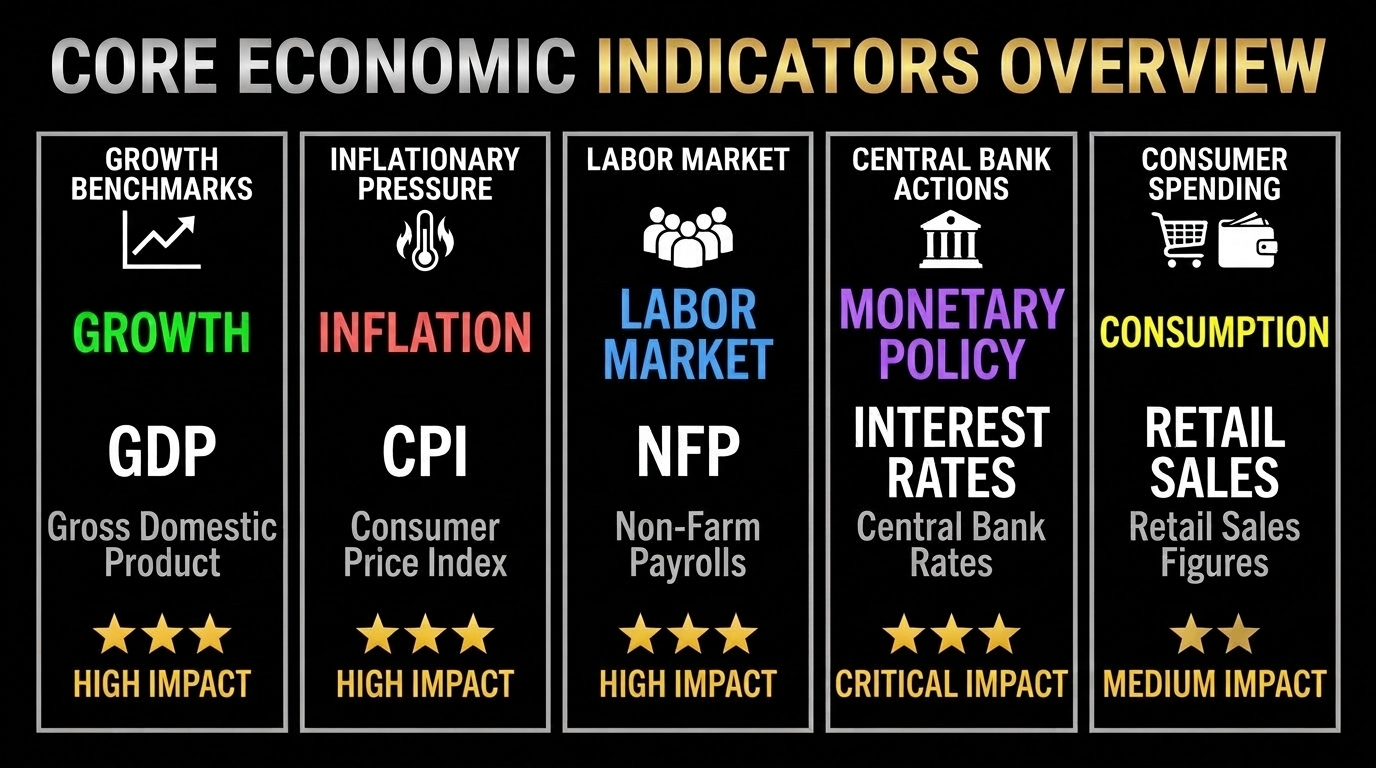
The economic calendar can be so information dense that it becomes difficult to choose what to focus on. For traders, only a handful of economic indicators significantly move financial markets and are worth paying attention to. Sound economic analysis starts by narrowing the field. Here are the releases traders watch most closely:
- GDP (Gross Domestic Product)
- Manufacturing PMI (Purchasing Managers’ Index)
- Consumer Confidence
- CPI (Consumer Price Index)
- PPI (Producer Price Index)
- Unemployment Rate
- Non-Farm Payroll
- Retail Sales
- Industrial Production
How to Read Economic Indicators
Good economic analysis is not about trying to read every release – it is about knowing what each one signals and why it moves price. Let’s take a closer look at each of these economic indicators by understanding what they measure and how they are useful to traders.
- GDP is one of the most useful economic indicators for confirming the broader economic picture – though as a lagging indicator that draws on historical data, it is slower to reflect current conditions than forward-looking measures like PMI and Consumer Confidence.
- Manufacturing PMI and Consumer Confidence are leading indicators – meaning they are forward-looking, using current sentiment and activity data to signal where the economy may be heading rather than confirming where it has been. Traders tend to focus more on these as they reflect current business and consumer decisions and often shift earlier – well before the lagging data (like GDP) catches up. A consistently weak PMI and confidence may not signal a crash but can hint at slower growth and smaller risk appetites – a cue for traders to focus on more defensive positioning until the data stabilises. Two other useful leading indicators are building permits (a forward signal for construction and credit-sensitive demand) and durable goods/new orders (a rough read on whether businesses are willing to invest in long-term projects).
- CPI and PPI are lagging economic indicators that measure an economy’s inflation. Inflation heavily influences expectations for future interest rate decisions made by the central bank. High inflation typically prompts the central bank to raise rates. Higher rates increase demand for that currency, strengthening it. The opposite is true when inflation is low: the central bank cuts rates, decreasing that currency’s demand and, therefore, its value. Take the US as an example: interest rate decisions by the Federal Reserve and its forward guidance can significantly reshape trends across USD pairs.
- Unemployment Rate and Non-Farm Payroll (lagging indicators) measure the labour market dynamics of an economy, giving traders a read on its growth. Strong labour data is indicative of strong economic growth, which means there is likely to be more consumer spending. Higher spending usually leads to elevated inflation, so the central bank (e.g. Federal Reserve) is likely to increase rates, which will increase the value of the currency (e.g. the dollar). The reverse is true, where weak labour data will often lead to a weaker currency.
- Retail Sales and Industrial Production are coincident indicators – tracking current economic conditions in real time rather than signalling what is ahead or confirming what has passed. They give ground-level reads on whether the economy is expanding or contracting by showing how the real sector is doing. The logic here is the same as the labour market data mentioned above: strong real sector activity can signal a stronger currency, and weak activity signals a weaker currency.
Sharpening economic analysis over time is what lets traders spot which releases genuinely matter. But knowing what the economic indicators are saying is just one part. The real edge is using them to anticipate how the market might respond. That response can arrive in two waves:
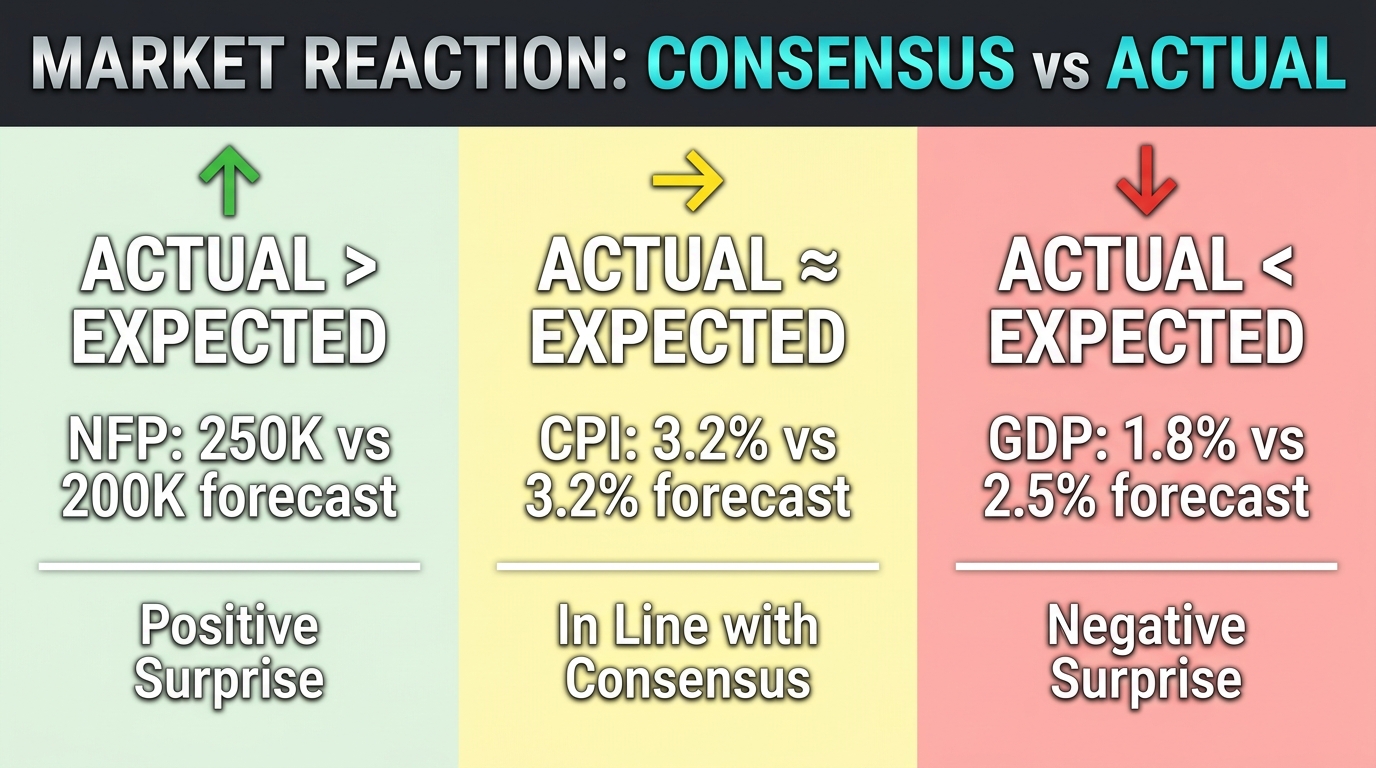
- The surprise. Markets move on the gap between the actual result and what was expected. A much stronger jobs report than forecast might lead traders to expect rates to stay higher for longer – supporting the currency. A disappointing number can quickly flip that expectation in the other direction.
- The ripple effect. A big data surprise rarely stays contained to one market. Weak growth or manufacturing data can drag on stocks, spike volatility and push traders toward safer assets. Within FX specifically, it can shift which currencies are being bought as "safe havens" and which are being sold.
What is News Trading?
News trading is where traders execute based on the market’s reaction to major economic reports, central bank announcements or unexpected global events. The key to news trading is preparation. Inexperienced traders can make the mistake of being reactive, but reactions require speed and nobody can compete with an algorithm on speed. This is why success in trading the news comes from using economic analysis to decide in advance what to do depending on what the data shows.
Here is how to approach news trading:
- Choose which news events to focus on. Not every event moves the market, which is why traders should focus on the ones that matter, and the events that matter are those that drive institutional flows. Using a reliable and up-to-date economic calendar when trading the news helps with staying on top of release times and forecasts.
- Compare expectations to actual results. Every trade built on economic analysis starts with one question – is this result a surprise, and in which direction? Markets, especially range-bound ones, do not react to the headline – they react to the difference between the result and the consensus forecast – a surprise. Surprises are what make markets move – the bigger the surprise, the bigger the potential move. If the actual figure lands close to the consensus, the move can be limited because the outcome was largely priced in already.
- Never trade the spike. When news surprises happen, price can be extremely jumpy – moving hundreds of pips in seconds. Spreads can widen dramatically and liquidity can dry up quickly, resulting in orders being filled at prices vastly different to their intended prices. Trading during this period is very risky, and traders could end up losing more than they initially planned for, especially on small accounts.
- Wait for the retest. Once volatility settles after a price spike, experienced traders often look for the retest of a key level, usually the one that was broken by the spike. By this point, conditions are stable and direction is clearer.
One important rule: traders tend to avoid tight stop-losses around news events. When spreads widen, tight stops get wiped out almost instantly. Instead, it is better to take a smaller position size and give the trade more breathing room.
News Trading Strategies: Conservative vs Aggressive
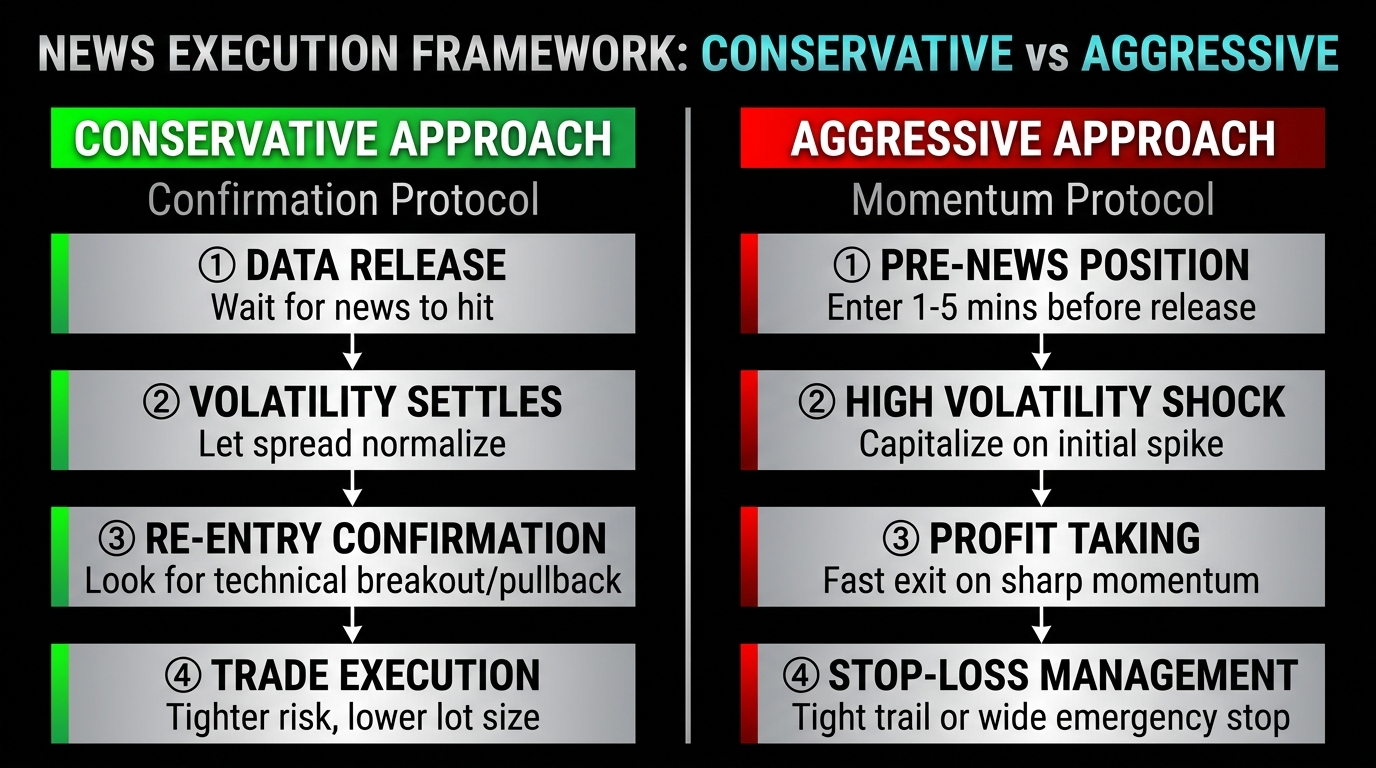
Trading the news is not about predicting what the data will say – it is about reading how the market reacts to a surprise. There are two main ways traders typically approach news trading:
- Conservative News Trading (wait and confirm)
No touching the buy or sell button until the data is out and the initial chaos has settled. Let the spread normalise, wait for a clear direction to emerge and enter when price pulls back to a key level. The first burst of movement gets missed, but the trade is based on confirmation rather than guesswork. - Aggressive News Trading (play both sides)
Rather than guessing the outcome, triggers are set up on both sides of the market before the release – if price breaks up, go long; if it breaks down, go short. This is high-stakes execution. Spread widening during the pre-release ‘quiet period’ can trigger stop-losses before the news even hits the wires. Also, if the actual number released comes in close to what was expected, the market will often whipsaw. Since there is no new information to start a real trend, the price simply jumps up and down rapidly as traders close their pre-news bets. In a thin market, even small orders can cause wild swings, which can end up triggering stop-losses on both sides before price eventually settles back down.
The honest truth? For most traders, the best approach around major news is to simply stay out until the dust settles. A five-minute spike can wipe out months of careful progress – it is rarely worth the risk.
Common Mistakes When Trading the News
Trading the news can create fast opportunities, but it also exposes mistakes that do not show up in quieter markets, such as poor planning, positions that are too large and unrealistic expectations about execution. The key to achieving positive results when trading the news is to avoid the errors that turn an acceptable loss into an unacceptable one. Below are the most common pitfalls that can occur in news trading:
- Ignoring the forecast
A common mistake beginner traders make in economic analysis is only focusing on the headline. Markets react to the gap between the actual number and what was expected. Without knowing the consensus forecast, there is no context for whether the result is a surprise or not. - Too much leverage
During major releases, spreads widen and slippage is common. High leverage leaves no room for that reality – a small gap in execution can quickly become a much larger loss than planned. - Trading every release
Trading the news does not mean trading every high-impact event. Not all of them are worth trading – many releases have no effect on the interest rate outlook and some just produce messy, short-lived spikes that go nowhere. The better approach is to focus only on releases that could genuinely shift expectations around central bank policy. - Misreading what actually moves markets
A common mistake in economic analysis is judging an indicator by whether it is leading or lagging. What matters when trading the news is whether the report is significant enough to shift rate expectations and force large institutions to reposition. For example, just because CPI and jobs data are backward-looking, it does not mean that they cannot move markets.
A simple rule for news trading: know the forecast, know what a surprise in either direction would mean and size positions for worst-case execution conditions.
Conclusion
Mastering economic indicators takes time and solid economic analysis grows from practice, not speed. The key idea is expectations vs reality: being aware of the consensus, then comparing it to the headline – not focusing on the headline alone. After all, it is the surprises that move markets. Reading the data, following the forecast and staying patient builds a steadier approach to trading the news. For most beginners, the smartest move is often to watch and wait – and skill in news trading comes from preparation above everything else.
Note:
This content is for general information and educational purposes only and does not constitute investment advice or a personal recommendation. Any examples are for illustration only and should not be treated as a signal or invitation to trade. This material does not take into account your investment objectives, financial situation or needs. CFD trading is high-risk; losses may exceed deposits.