

Discounted Cash Flow (DCF): How DCF Valuation Works


Analysts widely use Discounted Cash Flow (DCF) as a valuation method. DCF estimates a company’s value from the cash it will generate in the future.
Although the name may sound technical, the underlying principle of Discounted Cash Flow (DCF) is relatively straightforward. Moreover, the model bases a company’s value on the cash it will generate in the future. It adjusts for the lower value of future cash.
Understanding the basic principles of DCF analysis can help investors appreciate how analysts estimate the intrinsic value of a business and why a company’s market price may differ from estimates of that value.
What Is a Discounted Cash Flow (DCF) Model?
The Discounted Cash Flow model serves as a valuation method that estimates the present value of a company’s expected future cash flows. Rather than focusing only on today’s profits, the model attempts to estimate how much cash a business may generate over many years and then converts those future amounts into today’s value.
In this context, analysts often call this estimated value the company’s intrinsic value. Intrinsic value is an estimate of what a company may be worth based on its underlying business performance rather than its current share price.
Why Is Future Money Worth Less Today?
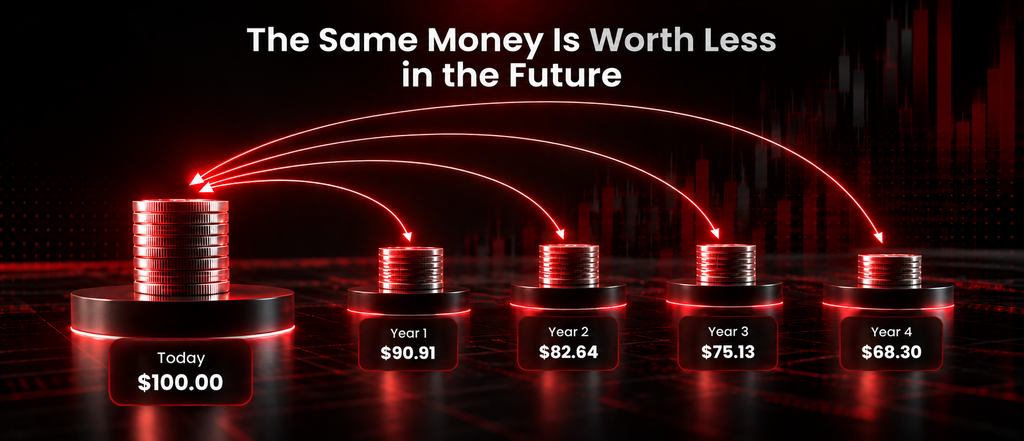
A key idea behind DCF analysis is the time value of money. Simply put, people value money available today more than the same amount you would receive in the future.
Investors can invest money available today to earn returns. They can use it for business activity, while future payments involve uncertainty and opportunity cost. We discount future cash flows when calculating today’s value for this reason.
What Is Free Cash Flow in a DCF Model?
Cash flow refers to the actual cash generated by a business after paying its operating expenses and making the investments needed to maintain and grow the business.
Additionally, many DCF models focus on free cash flow. This is an important metric because:
- It measures the cash remaining after a company has paid for the investments needed to maintain and grow its business.
- It focuses on the movement of real money rather than accounting profits.
- Investors may receive funds through dividends or share buybacks.
Because businesses ultimately create value by generating cash, many investors consider free cash flow an important measure of financial strength.
How Does a DCF Model Work?
Although professional DCF models can become highly detailed, the basic process follows four simple steps.
Step 1: Estimate Future Cash Flows
We expect Company A to generate the following free cash flows over the next four years.
| Year | Expected Free Cash Flow |
| 1 | $100 million |
| 2 | $110 million |
| 3 | $120 million |
| 4 | $130 million |
These estimates are based on assumptions about future sales, operating costs and business growth.
Step 2: Select a Discount Rate
Next, the analyst chooses an appropriate discount rate.
The discount rate converts future cash flows into today’s value. It reflects both the time value of money and the risks associated with the business.
Analysts assess companies with more uncertain future cash flows using higher discount rates than more stable businesses.
For this example, assume the analyst selects a discount rate of 10%.
Step 3: Convert Future Cash Flows into Today’s Value
We convert each future cash flow to its present value using the following formula:
Present Value = Future Cash Flow ÷ (1 + Discount Rate) number of years
Where:
PV = Present Value
FCF = Future Cash Flow
r = Discount Rate
n = Number of periods
Using the first year’s expected cash flow:
$100 million ÷ (1 + 10%) ¹
= $100 million ÷ 1.10
= $90.9 million
As a result, we apply the same calculation to each subsequent year.
| Year | Future Cash Flow | Present Value (10%) |
| 1 | $100.0 million | $90.9 million |
| 2 | $110.0 million | $90.9 million |
| 3 | $120.0 million | $90.2 million |
| 4 | $130.0 million | $88.8 million |
Although the company’s expected cash flows increase each year, their values in today’s money are lower because those cash flows are received further into the future.
Next, Step 4: Add the Present Values Together
Finally, the present values of the four forecast cash flows are added together.
$90.9m + $90.9m + $90.2m + $88.8m = $360.8 million
These four years of forecast cash flows therefore have an estimated present value of approximately $361 million. This is not the company’s complete intrinsic value because it excludes any cash flows generated after year four. A full DCF model would normally account for this additional value, often by including a terminal value.
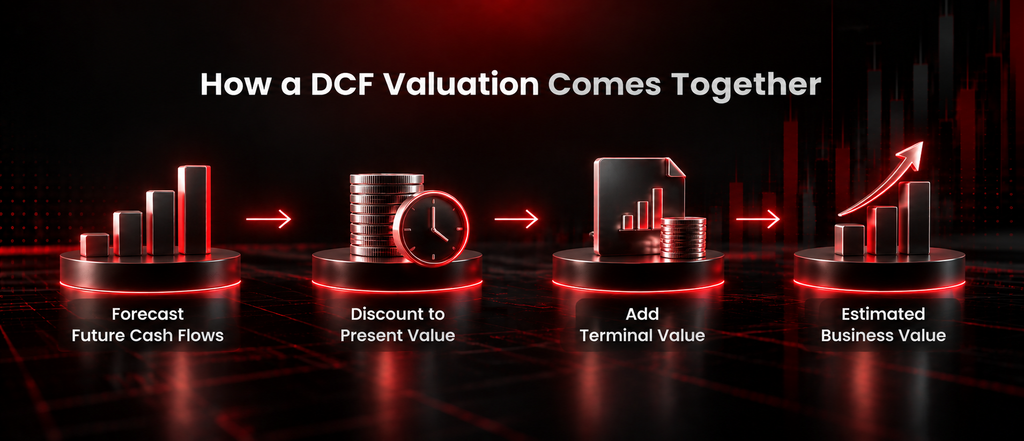
Additionally, Here is a Simplified Discounted Cash Flow Example.
| Step | Example |
| Estimate future cash flows | Forecast $100m, $110m, $120m and $130m over four years |
| Select a discount rate | 10% |
| Discount future cash flows | Convert future cash flows into today’s value |
| Calculate present value | Present value of four-year cash flows ≈ $361 million |
Examples shown are for educational purposes only and should not be interpreted as investment recommendations.
What Is Terminal Value in a DCF Model?
A DCF forecast usually covers a limited number of years, but companies may continue generating cash flows beyond that period. Terminal value is used to estimate the value of those future cash flows beyond the explicit forecast period.
Because terminal value can represent a significant part of a DCF valuation, the assumptions used to calculate it can have a substantial effect on the final estimate.
Why Can DCF Valuations Differ?
DCF analysis depends on assumptions about the future. Different analysts may have different expectations regarding:
- Future revenue growth
- Operating profit margins
- Long-term cash flow generation
- Interest rates
- Business risk
- Long term economic conditions
Even relatively small changes in these assumptions can produce noticeably different valuation estimates. For this reason, DCF analysis should be viewed as a valuation framework rather than an exact prediction.
Does a Higher DCF Valuation Mean a Stock Is Undervalued?
Not necessarily. If a DCF model produces an estimated intrinsic value above a company’s current market price, some investors may interpret the difference as a sign that the shares could be undervalued. If the estimated value is below the market price, the shares may appear expensive relative to that particular valuation.
However, the result depends on the assumptions used in the model. A DCF valuation is therefore only one part of the investment process. Investors may also consider factors such as competitive advantages, management, financial strength, industry conditions and broader economic trends.
Bottom Line
Discounted Cash Flow analysis is one of the most widely used valuation methods in finance because it is built around a straightforward principle: the value of a business can be estimated from the cash it is expected to generate in the future.
DCF models cannot predict the future with certainty. Their results depend heavily on assumptions about future cash flows, growth, risk and the discount rate, which is why different analysts can arrive at different valuations for the same company.
For investors, understanding DCF is less about building complex financial models and more about understanding how future cash generation, risk and time can influence estimates of business value.
Want to stay up to date? Read our latest market analysis or explore our education guides to keep learning.