














Why Rising Bond Yields Can Hurt Stocks: What Investors Are Really Pricing


Looking Beyond Company Fundamentals
Equity investors often focus on earnings, revenue growth, profit margins and company valuations. However, movements in government bond markets can also have a significant influence on how much investors are willing to pay for those earnings.
One of the most closely watched indicators is the US 10-Year Treasury yield. It acts as an important reference point for borrowing costs, asset valuations and the returns available from relatively lower risk government securities.
This raises an important question: why can rising bond yields place pressure on stock prices even when nothing has changed about a company’s underlying business?
What Is a Bond Yield?
A bond yield represents the return investors receive from holding a bond. The US 10-Year Treasury yield is particularly important because it is widely used as a benchmark across global financial markets.
Bond prices and yields move in opposite directions. When Treasury prices fall, their yields rise, and when prices rise, yields fall.
Movements in the US 10-Year Treasury yield can reflect changing expectations for economic growth, inflation, monetary policy and broader financial conditions. This means the reason behind a change in yields can be just as important as the direction of the move itself.
The Discount Rate Effect
One of the most important links between bond yields and stock valuations is the discount rate.
A company’s value depends partly on the cash flows investors expect it to generate in the future. Because money received many years from now is not worth the same as money received today, investors discount those future cash flows back to their present value.
Government bond yields form an important component of this calculation. When Treasury yields rise, the discount rate applied to future company earnings may also increase. All else being equal, this reduces the present value of those future cash flows and can lower the valuation investors are willing to pay for a company.
In simple terms, higher yields can make future profits worth less today.
Stocks Have to Compete with Bonds
Rising bond yields also change the opportunity cost of owning equities.
When government bonds offer very low yields, investors may be more willing to accept the additional uncertainty associated with shares in search of higher potential returns. When bond yields rise, relatively lower risk government securities begin offering more attractive returns.
Investors may therefore demand greater potential returns from equities to compensate for the additional risk they are taking. This can reduce the valuation multiples they are willing to pay for the same level of expected corporate earnings.
Why Growth Stocks Are More Sensitive
Growth companies can be particularly sensitive to changes in bond yields because a larger proportion of their estimated value often depends on profits expected further into the future.
When discount rates increase, these distant cash flows are discounted more heavily, potentially having a greater impact on valuations than for mature companies already generating substantial earnings and cash flow today.
Why Higher Yields Do Not Always Mean Falling Stocks
Bond yields and stock prices do not always move in opposite directions.
During periods of strong economic expansion, investors may expect both higher corporate earnings and higher bond yields. In these environments, stronger profit growth can outweigh some of the valuation pressure associated with rising rates.
The 2022 tightening cycle provides a useful example of the opposite environment. Elevated inflation prompted the Federal Reserve to raise interest rates aggressively, while Treasury yields increased substantially. Growth and technology shares experienced significant valuation pressure as markets adjusted to a much higher interest rate environment.
The episode illustrates an important principle: the direction of yields matters, but the reason behind the move matters just as much.
What the Nasdaq 100 Can Tell Us
Comparing the Nasdaq 100 with the US 10-Year Treasury yield provides a useful way to observe this relationship over time.
Periods of rapidly rising yields have sometimes coincided with pressure on growth stock valuations, particularly when markets were adjusting to tighter monetary policy or higher inflation expectations.
However, there have also been periods when the Nasdaq 100 and Treasury yields increased together as stronger economic growth and corporate earnings supported equities.
Nasdaq 100 Performance and US 10-Year Treasury Yield (2015-Present)
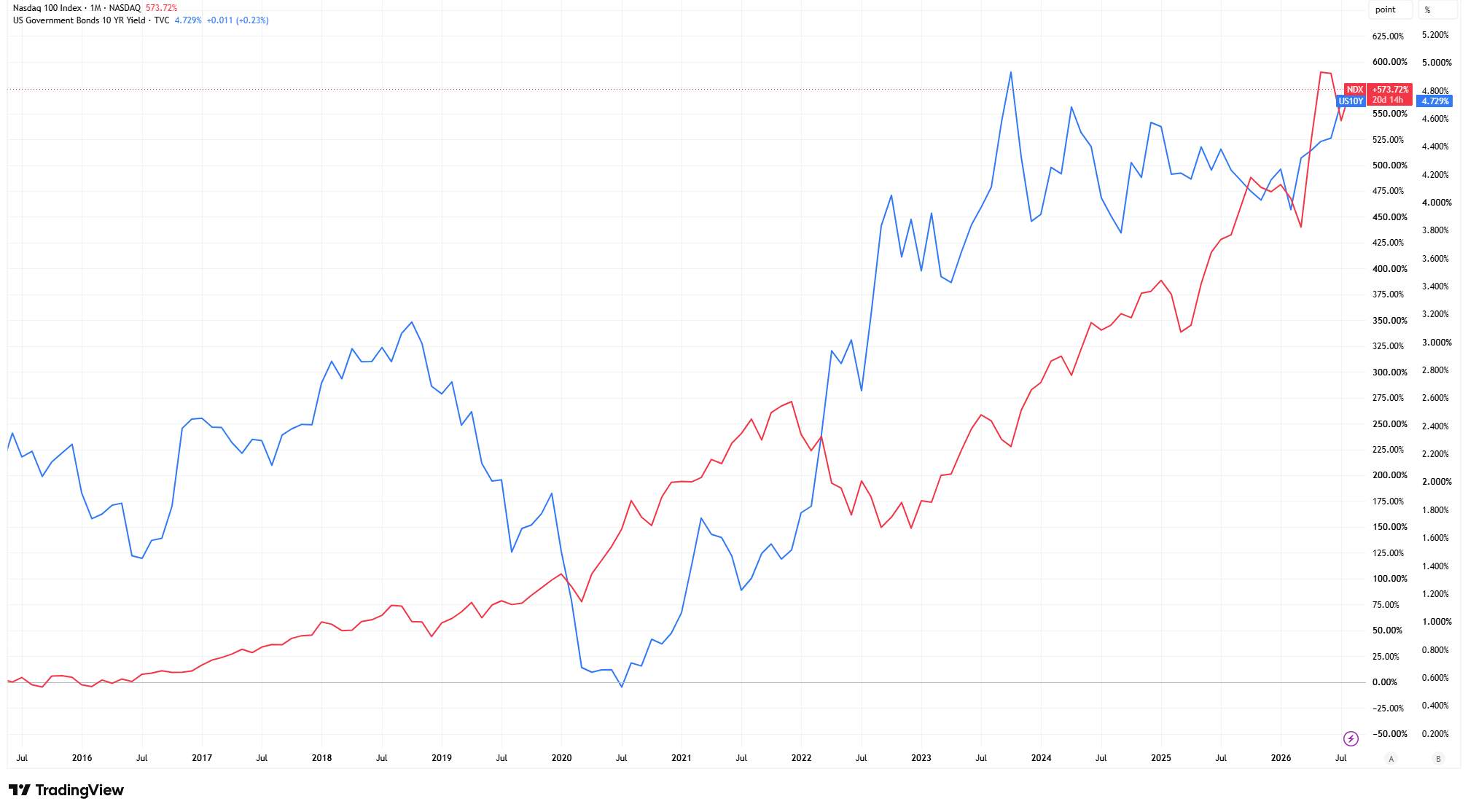
Source & Methodology: TradingView. The Nasdaq 100 is displayed in percentage performance terms from the selected starting date, while the US 10-Year Treasury yield is shown in its original percentage yield level on a separate axis. Both series use a monthly timeframe and cover the period from 2015 to the latest available date. Past performance is not a reliable indicator of future performance. Data as of 11 August 2026.
The chart compares the percentage performance of the Nasdaq 100 with the level of the US 10-Year Treasury yield. Periods of rapidly rising yields have sometimes coincided with pressure on growth stock valuations, although the relationship is not consistent. At other times, equities and yields have risen together as stronger economic growth and earnings expectations supported share prices.
Bottom Line
Bond yields matter to stock investors for two important reasons. They influence the rates used to value future company cash flows and change the relative attractiveness of bonds compared with equities.
Growth stocks can be particularly sensitive because more of their valuation may depend on profits expected further into the future.
However, rising yields do not automatically mean falling stock markets. Investors need to understand why yields are changing, what is happening to corporate earnings expectations and how broader economic conditions are evolving.
The US 10-Year Treasury yield is therefore best viewed as one component of a broader fundamental analysis framework rather than a standalone market forecasting tool.