

Fed Rate Decision in Focus as Markets Look for December Policy Clues


Table of Contents
The Fed rate decision on 28 October is expected to leave US interest rates unchanged. Policymakers may signal about December, and investors monitor these signals.
According to CME FedWatch, interest rate futures indicate a 90.6% probability that rates will remain at 3.75% to 4.00%, compared with just 29.1% a month earlier. With the immediate decision largely anticipated, attention is turning to whether the Federal Reserve’s statement and Chair Kevin Warsh’s comments suggest further tightening before the end of the year.
The Federal Reserve raised interest rates by 25 basis points in September. Policymakers now face a more complicated economic outlook. Holding rates would give the central bank more time to assess the impact of previous decisions. It would evaluate effects on inflation, employment and economic activity. However, a pause would not necessarily mean that the Fed has finished raising borrowing costs.
December remains particularly important because expectations for another increase are still strong. Between 16 and 20 October, Reuters surveyed economists. Ninety-four of one hundred expected rates to stay unchanged this month. All one hundred anticipated an increase in December. Futures markets have also reflected expectations of further tightening, although these probabilities can change as new economic information becomes available.
Inflation remains a central concern. September’s Consumer Price Index rose by 0.6% over the month, taking annual inflation to 3.7%, compared with 3.4% in August. Core inflation, which excludes food and energy, increased by 0.3% monthly and reached 2.6% annually. Higher petrol prices contributed to the increase in headline inflation, reinforcing concerns that price pressures may remain elevated.
At the same time, employment growth has been subdued. The US economy added just 29,000 jobs in September, while unemployment stood at 4.2%. This creates a difficult balance for policymakers, as further rate increases could help contain inflation but may also place additional pressure on hiring and economic growth.
Markets Increasingly Expect Fed to Hold Rates in October
The latest CME FedWatch data illustrates how sharply expectations have shifted over the past month, with markets now assigning a much higher probability to the Federal Reserve keeping interest rates unchanged at its October meeting.
Fed Rate Decision: October 2026 Rate Probabilities
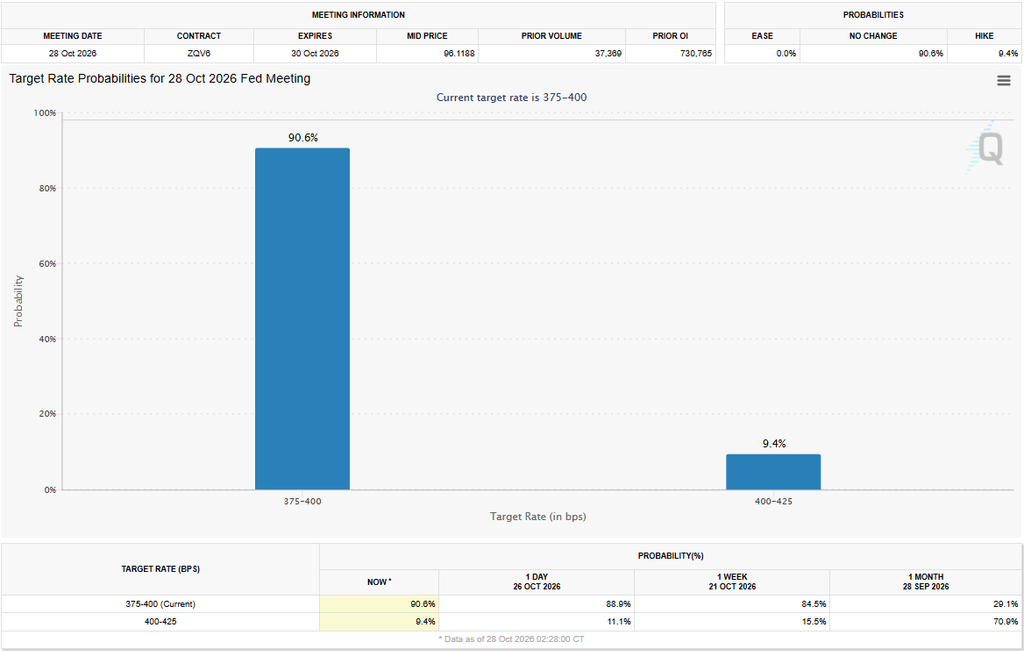
Source: CME Group FedWatch Tool. Data as of 28 October 2026.
Market expectations have shifted significantly towards an October pause. CME FedWatch indicates a 90.6% probability that the Federal Reserve will leave interest rates unchanged at 3.75% to 4.00%, up from 29.1% a month earlier. The probability of a 25-basis-point increase has fallen to 9.4%, highlighting the change in expectations ahead of the policy announcement.
The interest rate outlook is also influencing currency and bond markets. The US Dollar Index stood around 102.2 to 102.4 ahead of the decision, while the US 10-year Treasury yield was near 5.00%. Expectations that borrowing costs could remain elevated may support the dollar and Treasury yields, although movements also depend on broader economic and international developments.
For equity markets, the implications are more mixed. Higher borrowing costs can weigh on company valuations, particularly in sectors where future earnings play a larger role in share prices. However, a measured approach to further tightening could also reassure investors that policymakers are considering the risks to economic growth.
Investors will be watching the Fed’s assessment of inflation, employment and future policy adjustments when the decision is announced at 2:00 p.m. US Eastern Time. Warsh’s press conference, scheduled for 2:30 p.m. ET, may provide further insight into the outlook for December. Updated economic projections are not scheduled for this meeting, making policymakers’ comments particularly important.
For now, the question facing markets extends beyond whether rates remain unchanged in October. The Fed’s communication could influence expectations for December, while incoming inflation and employment data will remain important in determining how policymakers approach the next stage of monetary policy.
Want to stay up to date with all the latest news? Read more here.