



Oil Hits Six-Month High as AI Concerns Weigh on Stocks | Weekly Recap: 19-23 October 2026


This week’s Weekly Market Recap examines how surging oil prices, concerns over AI financing and mounting pressure on European bond markets unsettled global markets.
Brent crude climbed to its highest settlement since April, while gold suffered its steepest weekly decline since early June. US technology stocks experienced their sharpest daily sell-off in months, and European equities recorded their worst week since early September.
Meanwhile, US Treasuries staged their strongest daily rally in more than three years, even as French borrowing costs surged. The contrasting moves highlighted how investors were reassessing inflation, growth and financial risk ahead of a critical week for central banks.
Economic Overview
US economic activity remained resilient despite market volatility. Initial jobless claims fell to 194,000, while October’s preliminary manufacturing and services PMIs reached 56.0 and 57.9, respectively, signalling continued expansion.
In the UK, annual inflation accelerated to 3.5% in September, up from 3.1% and above expectations of 3.4%. Unemployment fell to 4.7%, strengthening expectations of a Bank of England rate increase in November.
Business activity also improved. The UK’s October composite PMI rose to 53.1, its highest since February, with new orders recording their strongest increase in more than two years. However, retail sales declined 0.4%, indicating continued pressure on household spending.
The euro area presented a weaker picture. Its composite PMI fell from 53.1 to 51.9, a four-month low, as higher energy costs and tighter financial conditions affected business confidence.
France’s reading dropped to 48.4, indicating contraction amid political and fiscal uncertainty, while Germany remained in expansion at 52.8.
The contrast was clear: the UK entered the final quarter with stronger business momentum, while the euro area showed signs of slowing. Both remained vulnerable to the inflationary impact of higher energy prices.
Equities, Bonds and Commodities
Equities
US equities ended the week mixed, with concerns over AI infrastructure spending triggering a sharp technology sell-off.
The S&P 500 declined 0.5% to 7,623.68, while the Nasdaq Composite closed at 25,955.34, (a decline of 0.7% over the week). The Dow Jones gained 0.4% over the week, despite dropping more than 650 points on Friday.
The most significant move came on Thursday, when the Nasdaq plunged 2.6%, its steepest daily decline since June, and the Philadelphia Semiconductor Index fell 6.7%.
Meta shares dropped 7% despite stronger-than-expected revenue, after substantial AI expenditure contributed to the company’s first cash outflow in more than a decade. The sell-off highlighted growing investor scrutiny of whether AI investment can deliver sufficient returns to justify its cost.
In Europe, the STOXX Europe 600 fell approximately 1.4% to 635.77, while the FTSE 100 declined 1.76% to 10,690.36, its largest weekly fall since 2 October.
Disappointing corporate results added to the pressure. Kering plunged 16.6% on Friday following weak Gucci sales, while Volvo Cars fell more than 24% after reporting a larger-than-expected quarterly loss.
Bonds
US Treasuries recorded a sharp rally as investors sought safety during the technology sell-off.
The 10-year Treasury yield plunged approximately 19 basis points on Thursday, its largest daily decline since March 2023, briefly falling below 5%. Despite rebounding on Friday, the yield ended the week approximately nine basis points lower at 5.00%.
French government bonds moved in the opposite direction.
France’s 10-year yield rose approximately 27 basis points over the week, climbing above 5% amid political unrest and concerns over the country’s public finances. The yield premium over German government bonds widened towards levels last seen during the eurozone debt crisis.
The divergence highlighted how investors were responding differently to market risks: seeking safety in US government debt while demanding higher returns to hold French bonds.
Commodities
Brent crude surged 6% to US$116.72 per barrel, following renewed attacks on Saudi Arabian energy infrastructure and fears of further escalation involving Iran. WTI also advanced, gaining 2.3% to US$103.27 per barrel.
The rise in oil prices carried wider economic implications. Persistently expensive energy can increase production and transport costs, squeeze household purchasing power and complicate central banks’ efforts to control inflation.
Gold fell approximately 4% to around US$4,000 per ounce, briefly trading below this threshold on Friday.
The decline was unusual because gold weakened even as equities fell and Treasury yields eased. Elevated interest-rate expectations remained a headwind, while the simultaneous sell-off suggested that traditional safe-haven relationships were not holding consistently.
Sector Performance
Global sector returns revealed a clear preference for defensive businesses over more economically sensitive areas.
Healthcare led with a 2.56% gain, followed by Utilities at 2.12%. Their outperformance reflected the relative resilience of businesses with more stable demand during periods of market uncertainty.
Energy advanced 1.80%, supported by rising crude prices, while Consumer Staples gained 1.05% and Financials rose 0.32%.
At the other end, Consumer Discretionary was the weakest sector, declining 2.22%, followed by Industrials at -2.09%. Both face challenges from higher operating costs and potential pressure on consumer and business spending.
Information Technology & Communication Services fell 1.54%, as investors continued questioning the returns on large-scale AI investment.
The 4.78-percentage-point gap between the strongest and weakest sectors highlighted a broader shift towards defensive positioning. Weakness extended beyond technology, suggesting investors were increasingly concerned about how higher costs could affect the wider economy.
Sector Performance: 19-23 October 2026
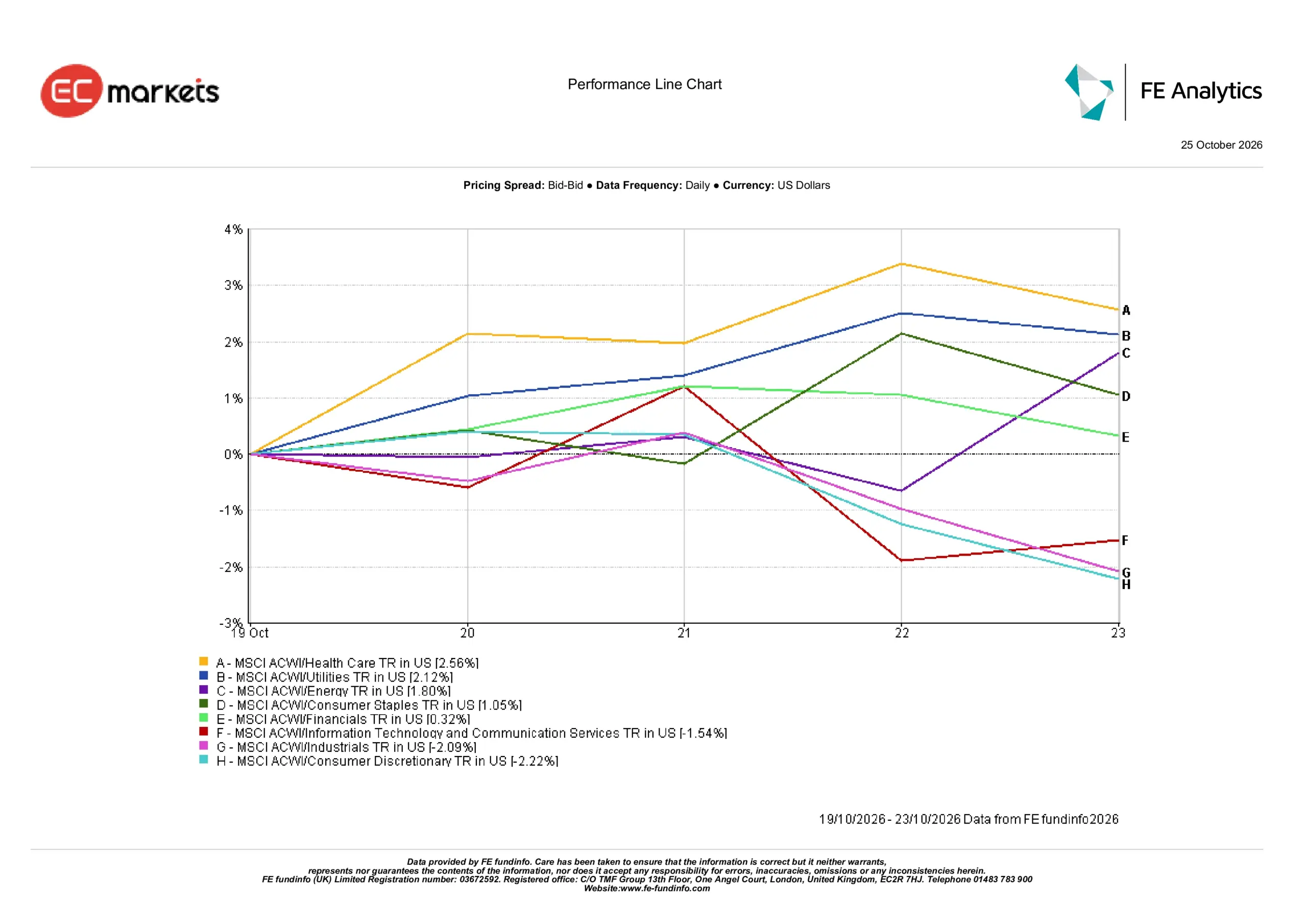
Source: FE Analytics. All indices total return in USD. Past performance is not a reliable indicator of future performance. Data as of 23 October 2026.
Regional Markets
All five MSCI regional indices recorded negative weekly returns, although the scale of losses varied considerably.
The MSCI United Kingdom TR was the strongest, declining just 0.07% in US-dollar terms. This contrasted with the FTSE 100’s 1.76% decline, reflecting differences in index composition, dividend treatment and currency translation.
The MSCI Europe TR fell 0.58%, as weaker corporate earnings and rising energy costs weighed on sentiment.
North America declined 0.78%, with technology-related weakness contributing to losses despite relatively resilient US economic data.
In Asia, Japan fell 1.48%, as technology-sector weakness and a stronger yen weighed on sentiment. The Nikkei experienced particularly sharp selling during the week, highlighting the region’s exposure to changing expectations for AI-related investment.
China was the weakest region, falling 4.52%. Chinese and Hong Kong equities also came under pressure, with major benchmarks reaching multi-month lows before recovering some ground.
The regional results highlighted an uneven global sell-off. While UK and European equities proved relatively resilient in US-dollar total-return terms, losses were considerably more pronounced across Asian markets, particularly China.
Regional Performance: 19-23 October 2026
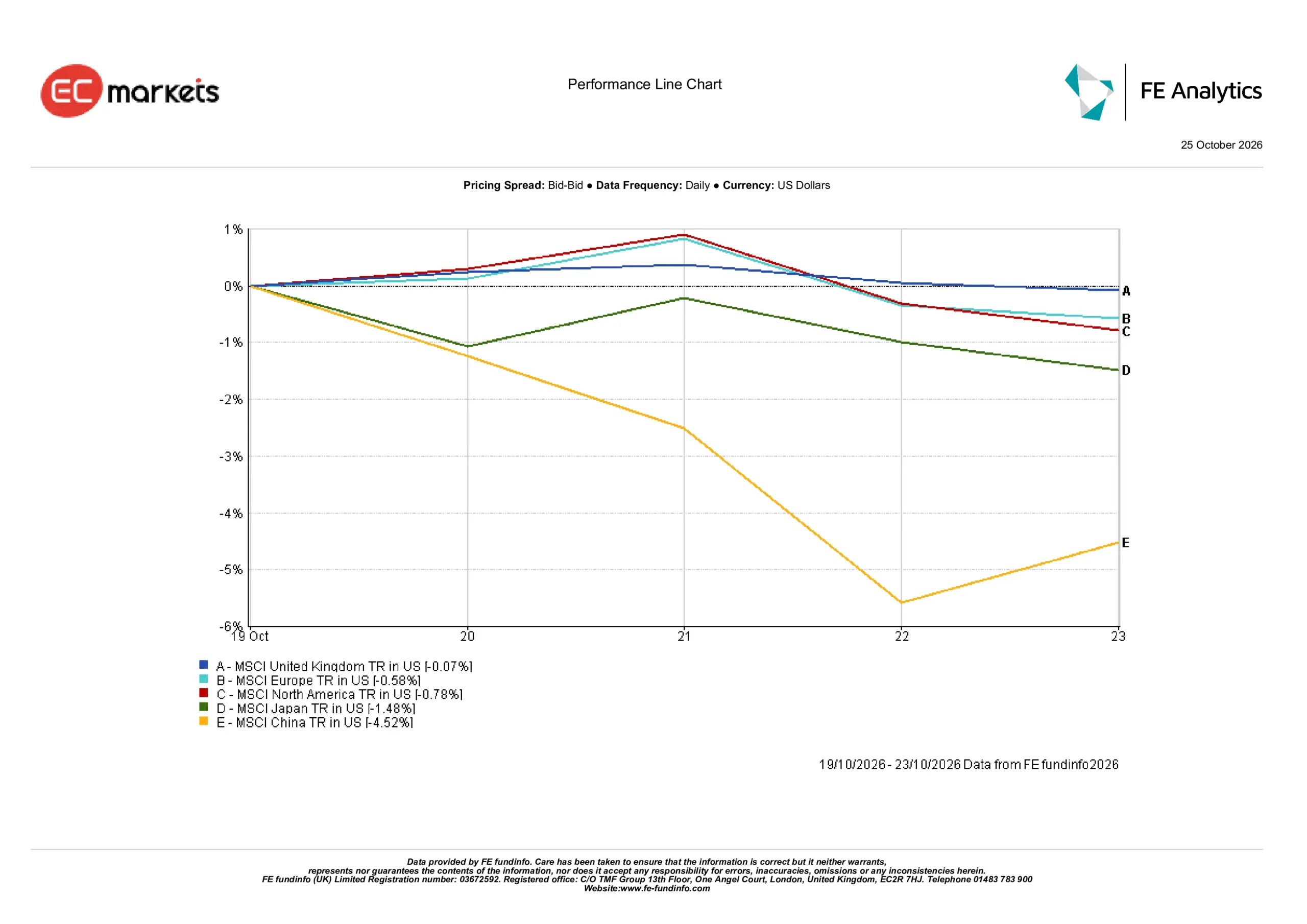
Source: FE Analytics. All indices total return in USD. Past performance is not a reliable indicator of future performance. Data as of 23 October 2026.
Currency Markets
Currency markets reflected shifting interest-rate expectations, economic divergence and increased demand for safer assets.
EUR/USD edged lower from approximately 1.1214 to 1.1202, as slowing euro area activity and fiscal uncertainty weighed on the single currency.
GBP/USD finished near 1.3373, supported by stronger UK employment figures and higher-than-expected inflation. Sterling briefly reached a five-week high above 1.34 as expectations of a November Bank of England rate increase strengthened.
USD/JPY declined from 158.52 to 156.86, approximately 1.05%, as falling US Treasury yields and greater risk aversion supported the yen.
GBP/JPY fell from 210.42 to 209.76, reversing earlier gains as demand for the yen strengthened during the late-week equity sell-off.
Overall, currency movements highlighted growing differences in monetary policy expectations and economic performance. Sterling benefited from stronger UK data, while the yen gained support from declining US yields. With the Fed, ECB and BoJ all meeting next week, their policy guidance could prove decisive for the direction of major currency pairs.
Outlook and the Week Ahead
Markets now face a critical week for monetary policy, economic data and corporate earnings.
The Federal Reserve announces its decision on Wednesday, followed by the European Central Bank on Thursday and the Bank of Japan on Friday. Investors will assess how policymakers balance persistent inflation against tighter financing conditions and uneven economic growth.
US third-quarter GDP and PCE inflation data will provide further insight into economic resilience and price pressures. In Europe, preliminary GDP and national inflation releases will help determine whether slowing business activity is affecting broader growth.
The UK Budget on 28 October will also be closely watched for its implications for government borrowing, fiscal credibility and investor confidence.
Meanwhile, Alphabet, Microsoft and Amazon are due to report earnings. Their capital expenditure plans, cloud revenues and AI investment returns will be particularly important following renewed scrutiny of technology valuations.
With oil prices elevated and financing conditions increasingly important, the key question is whether corporate earnings can restore confidence in AI investment while central banks continue to confront persistent inflation.