














Inflation Cools, Oil Heats Up | Weekly Market Recap: 13-17 July


After spending much of 2026 running hot, inflation finally gets a cold shower. Headline CPI cooled to 3.5%, easing concerns that the Federal Reserve would need to tighten policy further and giving markets fresh confidence that price pressures are beginning to moderate.
The relief, however, proved short-lived.
Renewed conflict in the Middle East sent oil prices sharply higher, raising concerns that the very factor helping inflation cool could soon begin pushing it higher again. Combined with a broad semiconductor sell-off, the move encouraged investors to rotate towards energy, defensive sectors and companies with more resilient earnings.
Economic Overview
The week’s biggest macroeconomic development came from the United States, where June inflation surprised to the downside.
Headline CPI slowed to 3.5% year on year, below the 3.8% market forecast, while prices fell 0.4% month on month, marking the largest monthly decline since April 2020. Core inflation also eased to 2.6%, reinforcing signs that underlying price pressures continue to moderate.
The data reduced expectations of another near-term Federal Reserve rate increase. However, policymakers made it clear that one encouraging inflation report is unlikely to change the broader policy outlook, particularly as higher oil prices threaten to reverse some of the recent progress.
Elsewhere, US retail sales rose 0.2% in June, consumer sentiment reached a five-month high and labour-market conditions remained resilient.
Outside the US, the IMF warned that global disinflation has stalled, lowering its 2026 Eurozone growth forecast to 0.9% as higher energy prices continue complicating the outlook. In the UK, GDP and manufacturing output both exceeded expectations, highlighting continued resilience despite restrictive monetary policy.
Equities, Bonds and Commodities
US equities ended the week lower as the semiconductor sell-off outweighed softer inflation data and a resilient start to earnings season.
The S&P 500 declined 1.6%, closing at 7,457.69, while the Nasdaq Composite fell 2.9% to 25,520.24 as investors reassessed AI-related valuations and reduced exposure to chipmakers.
The Dow Jones Industrial Average slipped 0.9%, ending the week at 52,146.42.
European markets proved more resilient, supported by corporate earnings and merger activity, while Japan and Taiwan underperformed due to their greater exposure to semiconductor stocks.
Bond markets reflected lower expectations of further Federal Reserve tightening, although rising oil prices limited gains. The US 10-year Treasury yield finished the week at 4.55%, while the two-year Treasury yield ended at 4.18%.
Although softer inflation initially supported government bonds, investors remained cautious about pricing in policy easing while energy prices continued moving higher.
Commodities
Commodity markets were dominated by geopolitical developments.
Brent crude surged approximately 13% over the week, settling at $88.10 per barrel, while West Texas Intermediate climbed to $82.49 amid renewed concerns over potential supply disruptions through the Strait of Hormuz.
Gold recorded its largest weekly decline since early June, falling approximately 3.4% to trade near $4,000 per ounce. Higher Treasury yields and a stronger US dollar weighed on the non-yielding asset despite ongoing geopolitical tensions. Even after the weekly pullback, gold remains around 20% higher than a year ago.
Sector Performance
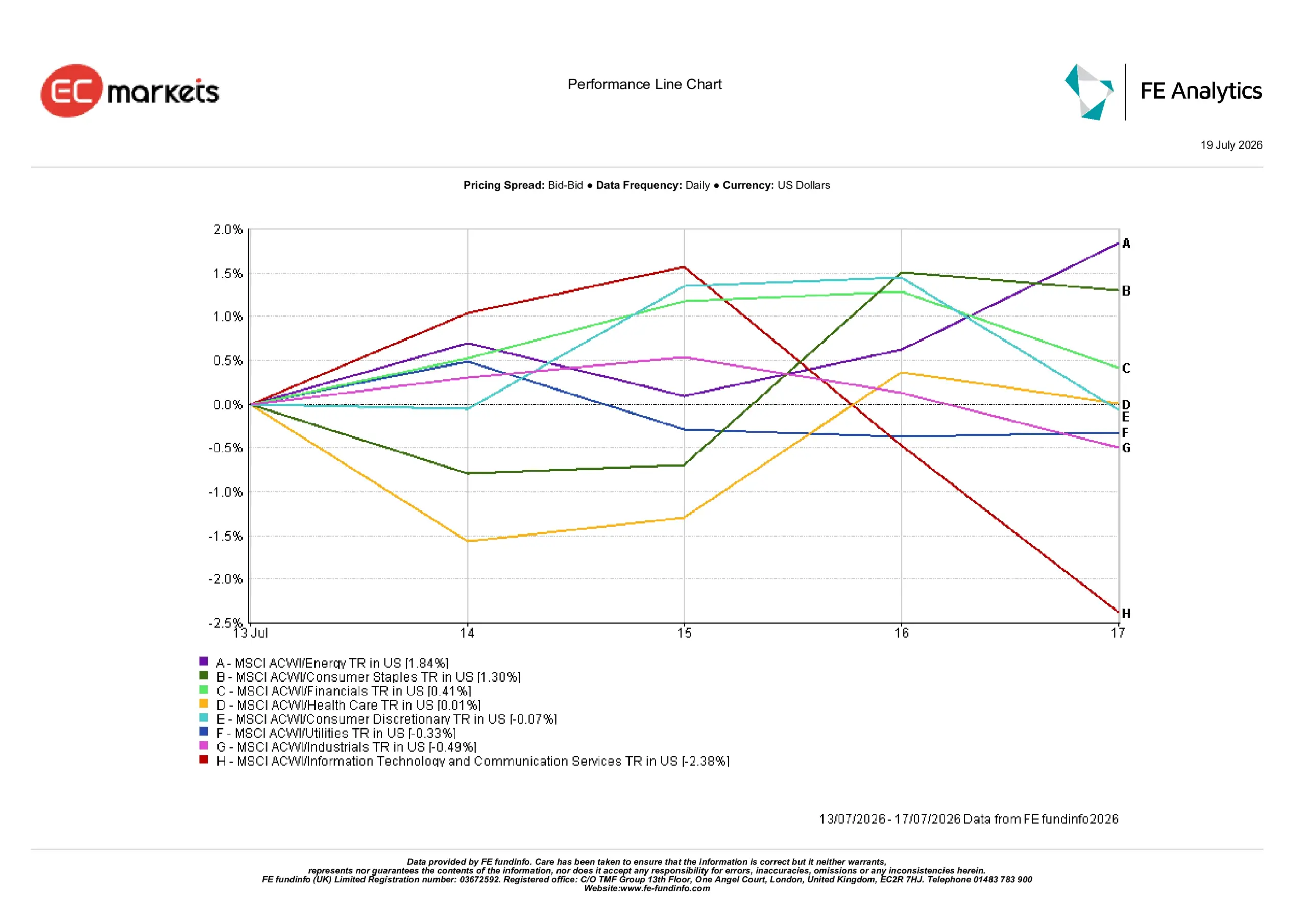
Sector rotation reflected investors’ preference for energy and defensive earnings while technology came under renewed pressure.
Energy led the market with a gain of 1.84%, supported by sharply higher crude prices.
Consumer Staples advanced 1.30%, while Financials gained 0.41% and Healthcare finished broadly unchanged (+0.01%).
Consumer Discretionary (-0.07%), Utilities (-0.33%) and Industrials (-0.49%) all finished lower as investors became more cautious towards economically sensitive sectors.
Information Technology & Communication Services was the weakest-performing sector, falling 2.38%, reflecting continued profit-taking across semiconductor stocks and growing scrutiny of AI-related valuations.
Sector Performance: 13-17 July 2026
Source: FE Analytics. All indices total return in USD. Past performance is not a reliable indicator of future performance. Data as of 17 July 2026.
Regional Markets
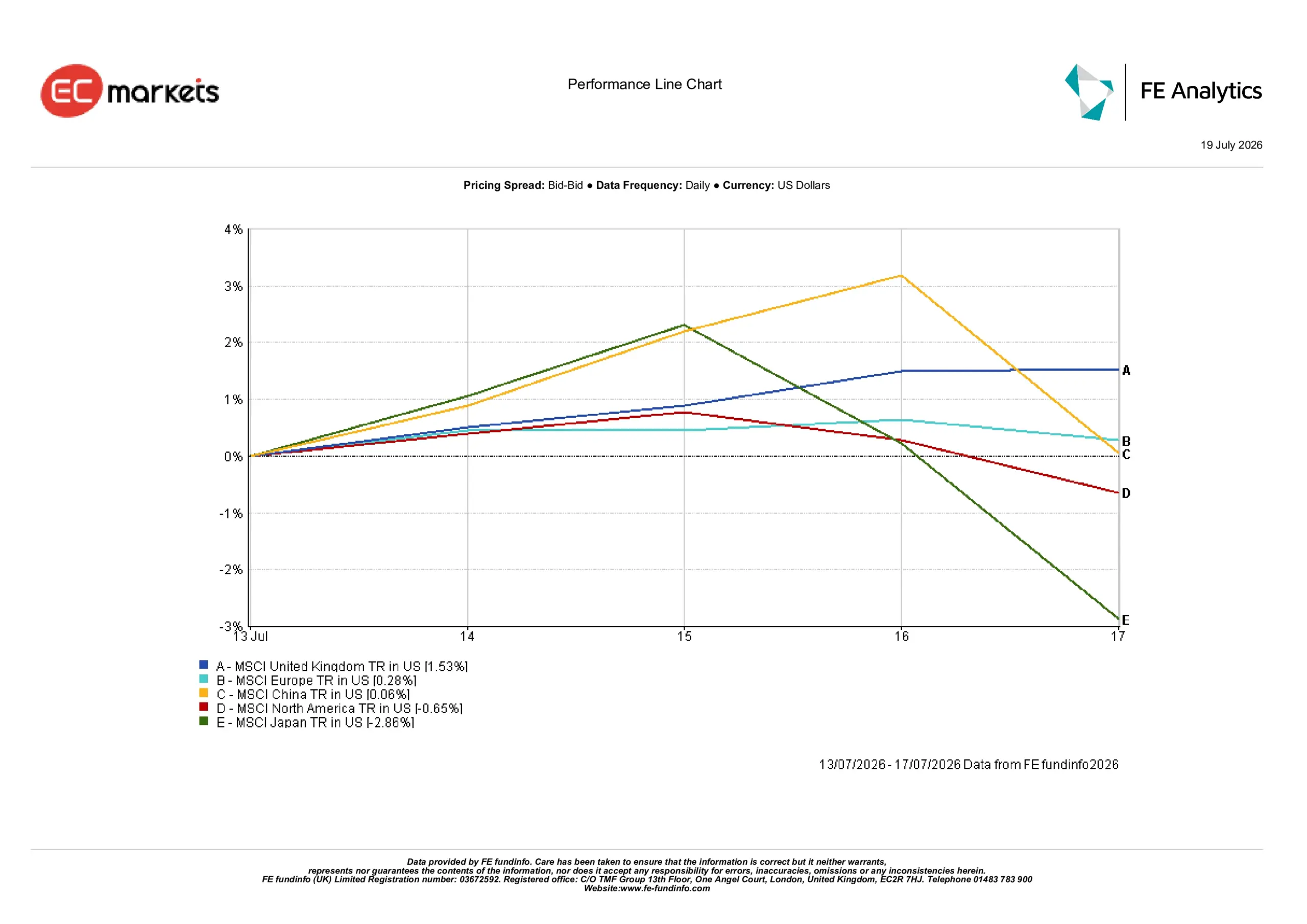
Regional markets diverged as technology-heavy economies came under the greatest pressure.
The United Kingdom was the strongest-performing region, gaining +1.53%, supported by resilient economic data and sterling strength.
Europe rose +0.28%, helped by earnings and takeover activity, while China edged +0.06% higher.
North America declined -0.65%, reflecting weakness across US technology shares.
Japan was the weakest-performing region, falling –2.86%, as the global semiconductor correction weighed heavily on export-focused equities.
Regional Performance: 13-17 July 2026
Source: FE Analytics. All indices total return in USD. Past performance is not a reliable indicator of future performance. Data as of 17 July 2026.
Currency Markets
Foreign exchange markets continued to reflect changing interest-rate expectations alongside renewed geopolitical risk.
The US Dollar Index slipped around 0.2%, ending the week near 100.75. Softer inflation initially weakened the dollar, although safe-haven demand linked to the Middle East conflict helped the greenback recover part of those losses.
GBP/USD traded above 1.3560 during the week before consolidating near 1.3474. Sterling remained supported by stronger UK economic data and expectations that the Bank of England will maintain a restrictive policy stance.
EUR/USD finished broadly unchanged around 1.1439. Softer US inflation supported the pair early in the week, but weaker Eurozone growth expectations and higher energy prices limited gains ahead of this week’s European Central Bank meeting.
The Japanese yen remained historically weak, with USD/JPY ending the week around 162.40 as the wide interest-rate differential continued favouring the dollar despite repeated intervention warnings from Japanese authorities.
Overall, currency markets remained driven by monetary-policy expectations, geopolitical developments and the relative resilience of the US economy.
Outlook and Week Ahead
Attention now turns to the European Central Bank meeting, where investors will look for signs that rising energy costs are influencing the policy outlook. Flash PMI surveys across the US, UK and Eurozone will also provide an updated picture of business activity and demand.
Technology earnings will be another major focus following the recent semiconductor sell-off. Forward guidance from large technology companies will be closely watched for signs that AI-related investment can continue supporting elevated valuations.
Meanwhile, developments in the Middle East remain the largest source of market risk. Any further disruption to global energy supplies could complicate the improving inflation outlook and reinforce expectations that central banks will keep interest rates higher for longer.
For now, markets are likely to remain selective, favouring resilient earnings, defensive sectors and regions less exposed to elevated borrowing costs and technology volatility.