



Tech Shares Slide as Central Banks Stay Cautious | Weekly Market Recap: 26-30 October 2026


Global markets ended October under pressure as concerns over artificial intelligence (AI) spending weighed on US technology stocks. Meanwhile, central banks in the US, Europe and Japan held interest rates steady, with persistent inflation and Middle East tensions complicating the outlook for monetary policy.
Despite strong US economic growth, investors questioned whether heavy investment in AI would deliver the expected returns. Defensive sectors and European equities held up better as technology shares came under pressure.
Economic Overview
Central banks in the US, Europe and Japan held interest rates unchanged as persistent inflation, high energy prices and Middle East tensions complicated the policy outlook.
The US Federal Reserve (the Fed) held rates at 3.75%–4.00% on Wednesday. Ten officials voted to hold, while two, Governor Lisa Cook and Cleveland Fed President Beth Hammack, favoured a 25-basis-point increase. Fed Chair Kevin Warsh said the economy continued to grow strongly but that officials needed more information before deciding their next move, reaffirming the Fed’s 2% inflation target.
US data reinforced the challenge. Third-quarter GDP growth accelerated to an annualised 3.4% from 2.2%, while the Fed’s preferred inflation measure, the PCE price index, rose 0.5% in September and 3.6% year on year. Initial jobless claims fell to 194,000.
The European Central Bank (ECB) also held its three key rates unchanged, warning that higher energy prices could fuel inflation and slow growth. Eurozone GDP expanded 0.4% in the third quarter, while German inflation eased to 2.8% in October from 3.3%. ECB President Christine Lagarde also announced she would step down on 7 February 2027.
The Bank of Japan maintained its rate at 1.25%, with eight members voting to hold and one favouring an increase. It raised its inflation forecast and signalled that further rate increases remain possible.
In the UK, the Autumn Budget proposed less new government bond issuance than expected, helping longer-term gilt yields ease.
Equities, Bonds and Commodities
Equities
US equities declined as concerns over the scale and profitability of AI investment weighed on technology stocks.
The S&P 500 fell 0.6% over the week, while the Nasdaq Composite lost 2.0% and the Dow Jones Industrial Average declined 0.9%.
Friday accounted for much of the weakness. The S&P 500 dropped 1.8% during the session, while the Nasdaq fell 2.9%, as corporate earnings intensified concerns over technology spending.
Intel shares plunged approximately 29%, their sharpest one-day decline since 1974, while Amazon fell 1.9%. Nvidia dropped 4.9%, with AMD, Micron and Broadcom also coming under pressure. Energy stocks performed better following earnings from Exxon Mobil and Chevron.
European equities held up better. The STOXX Europe 600 gained approximately 1.7% over the week, while the FTSE 100 closed Friday at 10,729.78. Gains in AstraZeneca and BT provided support, although weakness in banking and mining shares limited the advance.
Bonds
US Treasury yields declined late in the week as investors sought safer assets amid the equity sell-off. The 10-year Treasury yield ended near 4.9%, while the two-year yield also eased. Longer-dated UK gilt yields fell following the Budget, while Japan’s 10-year government bond yield stood near 2.8% on Friday.
Commodities
In commodities, Brent crude rose approximately 1.5% to $117.64 per barrel, supported by concerns over attacks on Middle Eastern energy infrastructure and shipping routes.
Gold moved in the opposite direction, falling approximately 3% to close below $3,900 an ounce, its lowest level in more than a year. Expectations of elevated interest rates weighed on the metal, while Friday’s equity sell-off may also have prompted investors to sell gold to cover losses elsewhere.
Sector Performance
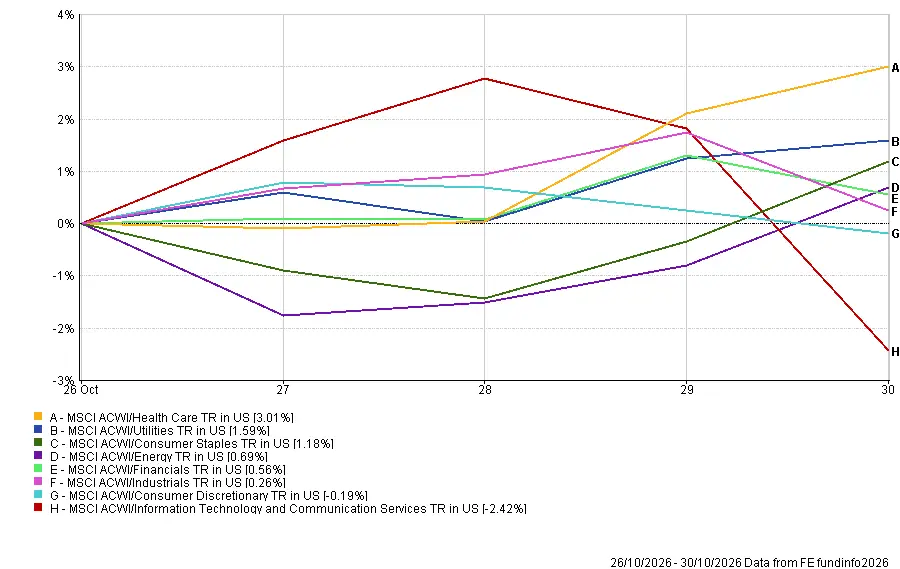
Healthcare led the way. The MSCI ACWI Healthcare index rose 3.01% in US dollars, with dividends included. Utilities rose 1.59%, Consumer Staples 1.18%, Energy 0.69%, Financials 0.56% and Industrials 0.26%.
Consumer Discretionary slipped 0.19%. Information Technology and Communication Services was the weakest sector, down 2.42%.
The results highlighted a shift towards more defensive sectors as investors reassessed technology valuations and the potential returns from AI investment.
Sector Performance 26-30 October, 2026
Source: FE Analytics. Past performance is not a reliable indicator of future performance. Data as of 30 October 2026.
Regional Markets
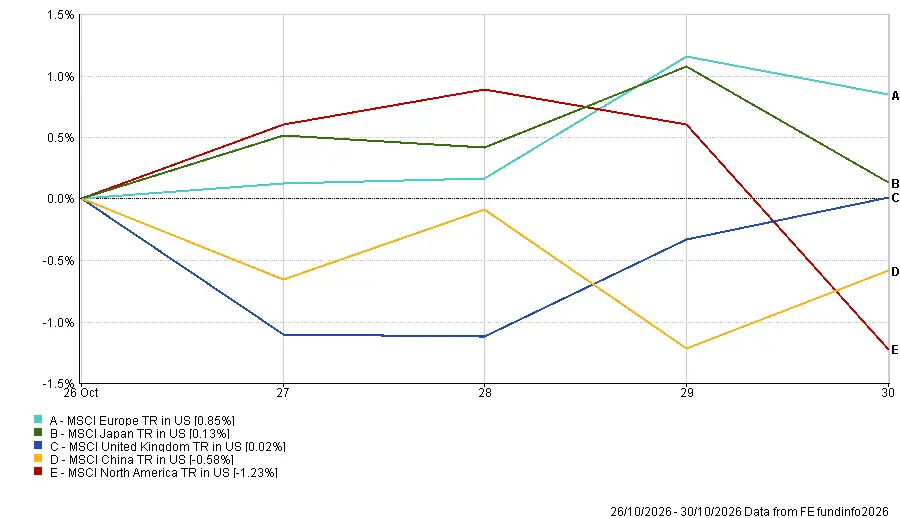
Europe was the best-performing region. The MSCI Europe index rose 0.85% in US dollars. Japan rose 0.13%, the UK was almost flat at 0.02%, and China fell 0.58%. North America was the weakest, down 1.23%, as Friday’s technology sell-off outweighed earlier gains.
Currency movements also influenced returns when measured in US dollars. The euro and yen weakened against the dollar, reducing dollar-denominated returns from Europe and Japan, while sterling strengthened slightly.
Regional Performance 26-30 October, 2026
Source: FE Analytics. Past performance is not a reliable indicator of future performance. Data as of 30 October 2026.
Currency Markets
The US dollar strengthened against the euro and Japanese yen over the week but weakened slightly against sterling.
Comparing Monday’s opening levels with Friday’s close:
- EUR/USD: Fell 0.37%, from 1.1202 to 1.1160. The euro weakened on Monday and Tuesday, recovered during the middle of the week, then slipped again on Friday.
- GBP/USD: Rose 0.10%, from 1.3379 to 1.3392. Sterling edged higher, with the UK Budget prompting only a limited market reaction.
- USD/JPY: Gained 0.46%, from 156.83 to 157.55. The yen weakened against the dollar despite the Bank of Japan raising its inflation forecast.
- GBP/JPY: Rose 0.54%, from 209.87 to 211.00, as sterling strengthened against the yen.
Outlook and The Week Ahead
Attention now turns to the Bank of England’s interest rate decision and the US October employment report, alongside further economic releases and corporate earnings.
Key events for 2-6 November 2026 include:
- Monday: US ISM Manufacturing PMI. Apple reports earnings after the US market closes.
- Tuesday: US JOLTS job openings, US midterm elections and the Reserve Bank of Australia’s (RBA) interest rate decision. AMD reports after the US close.
- Wednesday: US ADP employment data, trade figures, ISM Services PMI and eurozone October inflation estimates.
- Thursday: Bank of England interest rate decision and Monetary Policy Report, US jobless claims and productivity data. Cleveland Fed President Beth Hammack speaks.
- Friday: US October employment report.
The Bank of England is expected to raise rates by 25 basis points to 4.00%, which would mark its first increase in more than three years. Markets also see approximately a 79% probability of an RBA rate increase on Tuesday.
Friday’s US employment report will be particularly important following strong GDP and inflation figures. The data could influence expectations for the Fed’s December decision, while the US midterm elections may introduce further uncertainty around fiscal policy and market sentiment.