




US Stocks Rise as AI Optimism Meets Inflation Pressures | Weekly Recap: 5-9 October 2026


Our Weekly Market Recap examines a week in which US equities reached record highs, even as persistent inflation, elevated bond yields and rising energy prices kept investors cautious.
Artificial intelligence remained a source of optimism, but that enthusiasm was not reflected evenly across the market. Energy and defensive sectors outperformed, while technology-related companies faced growing scrutiny over valuations and financing costs.
Meanwhile, resilient US economic data and the Federal Reserve’s latest meeting minutes reinforced expectations that interest rates could remain elevated, leaving markets focused on the balance between economic growth and inflation.
This opening gives readers the main developments without giving away every statistic that follows.
Economic Overview
Markets balanced continued economic resilience against persistent inflation, elevated energy prices and uncertainty surrounding the next steps for major central banks.
Minutes from the Federal Reserve’s 15-16 September meeting showed that most policymakers expected another interest rate increase before the end of 2026. Inflation remained a central concern, with limited progress towards the 2% target, although weaker employment growth supported a more cautious approach to the timing of further tightening.
US services activity continued to expand in September, although momentum slowed. The ISM Services PMI declined to 54.9 from 55.4 in August. The employment component returned to expansion at 50.1, while the prices index rose to 74.0, its highest level since July 2022, indicating continued cost pressures.
Initial jobless claims fell by 2,000 to 197,000 in the week ending 3 October, suggesting that layoffs remained limited despite slower hiring. However, preliminary University of Michigan data showed consumer sentiment falling to 46.3 in October from 48.1 in September. One year inflation expectations increased to 4.7%, while five year expectations rose to 3.5%.
The European Central Bank’s September meeting account showed unanimous support for its previous 0.25 percentage point rate increase. Policymakers acknowledged that inflation risks remained tilted to the upside, although several officials argued that stable core inflation and anchored longer-term expectations reduced the need for an immediate further increase.
German industrial production rose 2.0% month on month in August, supported by construction and machinery output. In Japan, average cash earnings increased 3.8% year on year, while household spending fell 3.1%. Chinese markets reopened after the Golden Week holiday, with limited major economic data published during the shortened trading period.
The week’s data pointed to an economy that remained resilient despite signs of softer employment and consumer confidence. With inflation pressures still elevated, central banks had little reason to signal a rapid shift away from restrictive policy.
Equities, Bonds and Commodities
Equities
US equities advanced over the week, with the S&P 500 gaining 1.2%, the Dow Jones Industrial Average rising 0.9% and the Nasdaq Composite adding 0.6%. Both the S&P 500 and Nasdaq reached record highs as investors continued to favour companies exposed to artificial intelligence and data centre investment.
However, enthusiasm became more selective as the week progressed. Investors reassessed technology valuations and the financing costs associated with large-scale AI infrastructure, while reports concerning OpenAI’s revenue outlook and planned fundraising added to questions about the sector’s longer-term growth expectations.
PepsiCo reported a 5.6% increase in third-quarter net revenue and 3.1% organic revenue growth, although it lowered its full-year core earnings growth guidance. Delta Air Lines reduced its annual profit forecast as substantially higher fuel costs outweighed resilient passenger demand and higher fares.
European equities recovered on Friday as oil prices and bond yields eased. The STOXX Europe 600 finished the week with a marginal gain after earlier declines linked to energy prices, inflation concerns and French fiscal uncertainty. The FTSE 100 gained 0.9%, helped by Friday’s retreat in gilt yields.
Bonds
The US 10-year Treasury yield climbed to 5.364% on Wednesday, its highest level since 2002, before retreating to approximately 5.26% on Friday. Despite reaching a multi-decade high, the yield declined by around 3.5 basis points over the full week. UK gilt and euro area government bond yields also eased on Friday after reaching multi-decade highs earlier in the week.
Commodities
Brent crude settled at US$104.72 per barrel, gaining approximately 2.4% over the week. Prices were supported by Middle East supply concerns and the shutdown of more than 70% of US Gulf of Mexico crude production as Hurricane Isaias approached.
Spot gold rose approximately 1.3% over the week to around US$4,194 per ounce. Bargain buying supported the metal after it reached a two-month low, although elevated interest rates and a firm dollar remained headwinds.
Sector Performance
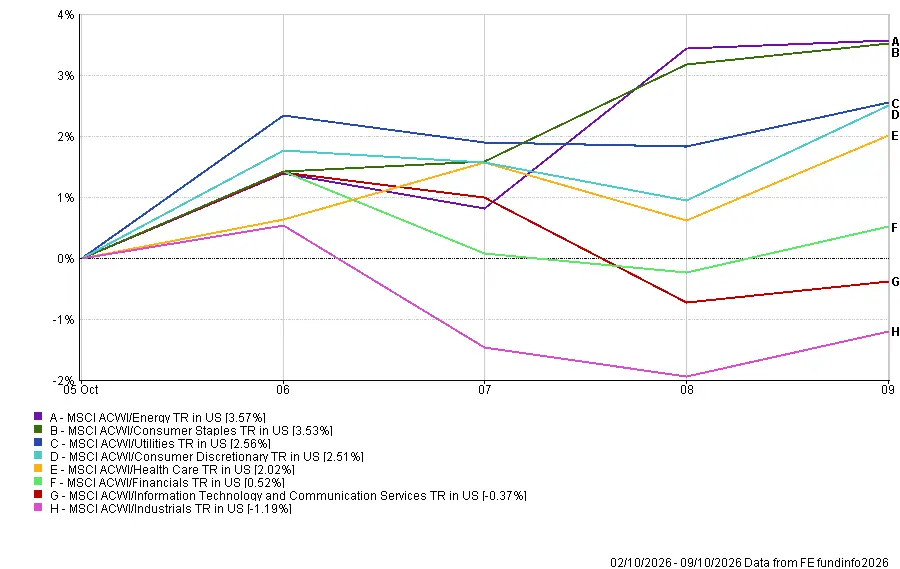
Energy led global sector performance with a 3.57% gain, supported by higher crude oil prices and concerns over geopolitical and weather-related supply disruptions. Consumer Staples followed closely, returning 3.53%.
Utilities gained 2.56%, Consumer Discretionary advanced 2.51% and Healthcare rose 2.02%, while Financials increased 0.52%.
Despite the continued focus on artificial intelligence, Information Technology and Communication Services declined 0.37% as investors became more selective towards technology-related companies. Industrials recorded the weakest performance, falling 1.19%.
The divergence highlights an important feature of the week: major US indices advanced, but sector leadership shifted towards energy and more defensive areas of the market.
Sector Performance October 5th-9th, 2026
Source: FE Analytics. All indices total return in USD. Past performance is not a reliable indicator of future performance. Data as of 9 October 2026.
Regional Markets
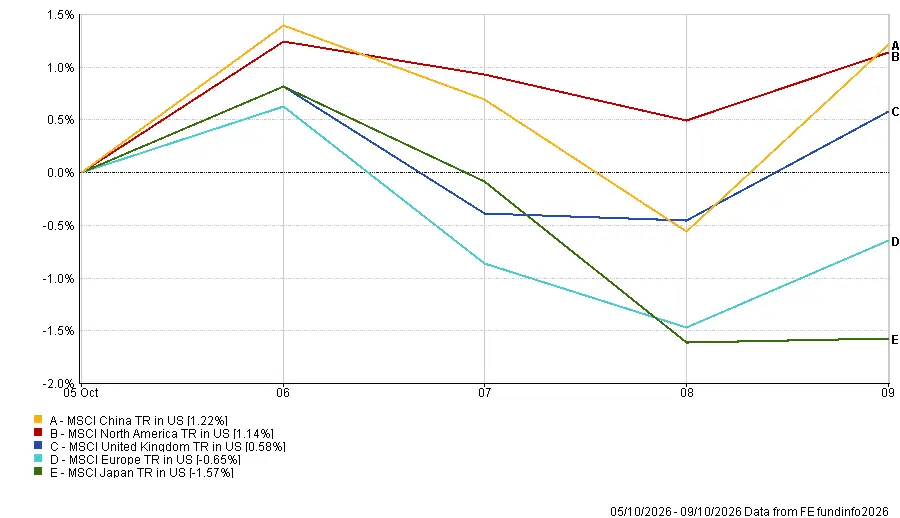
China was the strongest regional market, with the MSCI China Total Return Index gaining 1.22% in US-dollar terms during a holiday-shortened trading week. North America followed with a 1.14% increase, reflecting gains across major US equity markets.
The United Kingdom advanced 0.58%, while Europe declined 0.65%. Japan recorded the weakest regional performance, falling 1.57%.
Currency movements also influenced returns for US-dollar investors. A weaker euro and yen reduced translated returns from Europe and Japan, while sterling’s relatively stable performance against the dollar limited the currency effect on UK equities.
The results showed a clear regional divergence, with China and North America outperforming while European and Japanese markets faced a more difficult week.
Regional Performance October 5th-9th, 2026
Source: FE Analytics. All indices total return in USD. Past performance is not a reliable indicator of future performance. Data as of 9 October 2026.
Currency Markets
The US dollar strengthened against the euro and yen as elevated Treasury yields and expectations of further Federal Reserve tightening continued to support the currency.
EUR/USD declined from Monday’s opening level of 1.1258 to Friday’s close of 1.1202. Concerns over European government finances and the ECB’s cautious policy outlook also weighed on the euro.
GBP/USD was little changed, moving from 1.3241 to 1.3235 over the week.
Against the yen, the dollar advanced as the interest-rate differential between the US and Japan continued to favour the US currency. USD/JPY rose from 157.72 to 158.34, while GBP/JPY increased from 208.87 to 209.56.
Overall, the dollar remained firm, with the euro and yen under greater pressure than sterling.
Outlook and The Week Ahead
Attention now turns to September’s US Consumer Price Index on Wednesday, followed by producer prices, retail sales and initial jobless claims on Thursday. Industrial production and import and export prices are scheduled for Friday. Together, these releases will help markets assess whether inflation remains persistent enough to justify another Federal Reserve rate increase.
In Europe, UK monthly GDP, industrial production, construction output and trade data will provide an update on economic activity. Euro area industrial production and the final September inflation reading will also offer further evidence on the balance between growth and price pressures.
The US third-quarter earnings season begins with JPMorgan Chase, Goldman Sachs, Wells Fargo and Citigroup on Tuesday, followed by Bank of America and Morgan Stanley on Wednesday. Beyond the headline results, investors will be watching what bank executives say about consumer finances, lending conditions and the effects of elevated borrowing costs.
With inflation data, bank earnings, Treasury yields and oil prices all in focus, markets face another test of whether economic resilience can continue to support equities without reinforcing expectations of tighter monetary policy.