














Oil Surges Above $100 as Sticky Inflation Pressures Global Markets | Weekly Recap: 7-11 September 2026


Oil prices surged above $100 per barrel and persistent inflation strengthened expectations for tighter monetary policy during a difficult week for global markets. US, European and Asian equities declined, while government bond yields climbed as investors reassessed the outlook for interest rates.
Energy was the only global sector to finish higher, benefiting from renewed disruption to Middle Eastern supplies. Meanwhile, stronger-than-expected US inflation and an ECB rate increase reinforced concerns that central banks may need to keep monetary policy restrictive for longer.
Economic Overview
US inflation remained the dominant macroeconomic theme as higher energy costs added to existing price pressures and strengthened expectations for another Federal Reserve rate increase.
Consumer prices rose 0.4% month-on-month in August, accelerating from 0.1% in July, while annual inflation remained at 3.4%. Core inflation, excluding food and energy, increased 0.3% on the month and 2.4% year-on-year.
Producer prices reinforced the picture. The PPI for final demand rose 0.4% in August and 5.4% year-on-year, with goods prices increasing 1.1% as energy prices jumped 4.2%. The measure excluding food, energy and trade services rose 0.3% on the month and 4.7% annually.
Together, the releases strengthened expectations that the Federal Reserve could raise interest rates at its September meeting, with markets assigning an approximately 87% probability to a quarter-point increase by Friday.
US labour-market conditions remained comparatively resilient, with initial unemployment claims declining slightly to 206,000 in the week ending 5 September.
In Europe, the European Central Bank raised its deposit rate by 25 basis points to 2.50%, its second increase of the year. The ECB also raised its 2026 inflation forecast to 3.0% and its growth projection to 0.9%, while warning that risks remained tilted towards higher inflation and weaker growth.
Elsewhere, the UK economy expanded 0.4% month-on-month in July, while Japan’s second-quarter annualised growth was revised higher to 1.4%, reinforcing expectations for further Bank of Japan tightening. China’s exports increased 25% year-on-year in August, while imports rose 28.2%.
Overall, economic activity remained resilient, but persistent inflation and rising energy costs strengthened the case for tighter monetary policy.
Equities, Bonds and Commodities
Global equities came under pressure as rising oil prices, higher government bond yields and tighter monetary policy expectations outweighed encouraging corporate results.
In the US, the S&P 500 declined 0.8%, the Nasdaq Composite fell 0.7% and the Dow Jones Industrial Average lost 1.6%. All three indices recovered on Friday as oil prices retreated, but the rebound was insufficient to reverse earlier losses.
Oracle provided one of the week’s major corporate stories, reporting first-quarter revenue of US$19.3 billion, up 30% year-on-year. Cloud revenue increased 62% to US$11.6 billion, while cloud infrastructure revenue surged 121% to US$7.4 billion. However, concerns around capital expenditure, debt and negative free cash flow limited the positive market response.
European markets were also weaker, with the STOXX Europe 600 falling 1.66% and the FTSE 100 declining 1.67% over the week, despite recovering 0.4% on Friday.
Government bond markets sold off as persistent inflation and tighter monetary policy expectations pushed yields higher.
The US 10-year Treasury yield ended near 4.97%, while the two-year yield rose to around 4.60%. Selling pressure extended internationally, with Japan’s 10-year government bond yield ending close to 3%, the UK 10-year gilt around 5.35% and Germany’s equivalent yield near 3.50%.
The broad rise in sovereign yields reflected growing concern that persistent inflation could keep interest rates higher across several major economies.
Brent crude surged approximately 8.7% over the week to US$104.61 per barrel, as attacks affecting tankers, shipping routes and energy facilities intensified concerns about prolonged disruption to Middle Eastern supplies.
Gold moved in the opposite direction, declining around 1.5% over the week as higher Treasury yields and stronger expectations for a Federal Reserve rate increase reduced the appeal of non-yielding assets.
Sector Performance
The FE Analytics sector data reflected the impact of the week’s oil shock, with Energy the only sector to finish higher.
Energy was the only sector to finish higher, gaining 1.42% as Brent crude moved above US$100 per barrel. Information Technology and Communication Services declined 0.92%, while Utilities fell 0.94%.
Consumer Staples declined 1.11% and Financials lost 1.34%. Industrials fell 1.69%, while Consumer Discretionary declined 1.87% as higher fuel costs and tighter financial conditions weighed on consumer facing companies.
Healthcare was the weakest performing sector, falling 3.65%. Weakness in major pharmaceutical companies, including a sharp decline in Novartis following drug development setbacks, contributed to the sector’s underperformance.
Sector Performance September 7-11, 2026
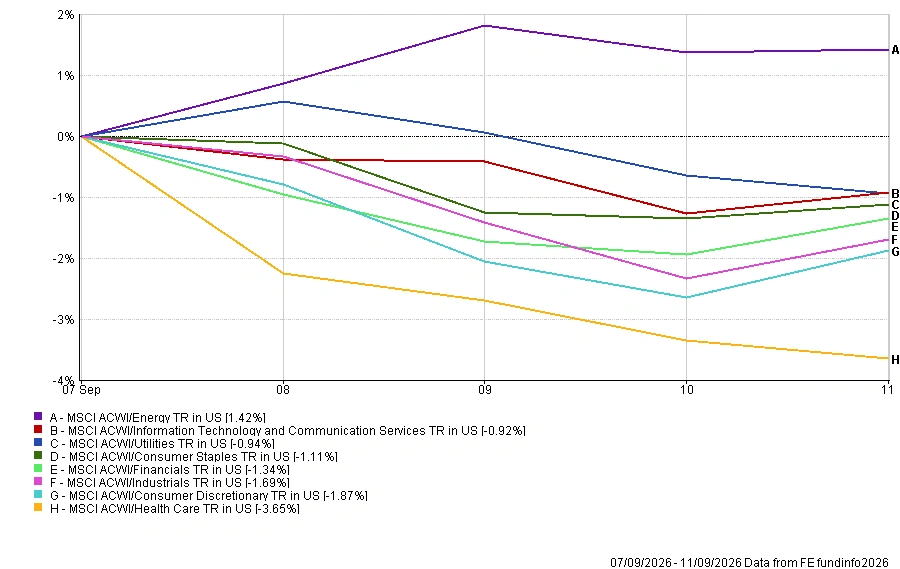
Source: FE Analytics. All indices total return in USD. Past performance is not a reliable indicator of future performance. Data as of 11 September 2026.
Regional Markets
All five regions covered by FE Analytics declined during the week as higher energy prices, rising bond yields and tighter monetary policy expectations weighed on global equities.
North America was the strongest region despite falling 0.86%, reflecting the comparatively resilient performance of US equities. The United Kingdom declined 1.68%, while Europe fell 1.84% as higher energy prices, borrowing costs and the ECB’s rate increase weighed on sentiment.
Japan declined 2.00%, although yen appreciation cushioned the decline when returns were translated into US dollars. China was the weakest region, falling 2.12%, as strong trade data failed to offset concerns around domestic demand and tighter global financial conditions.
Regional Performance September 7-11, 2026
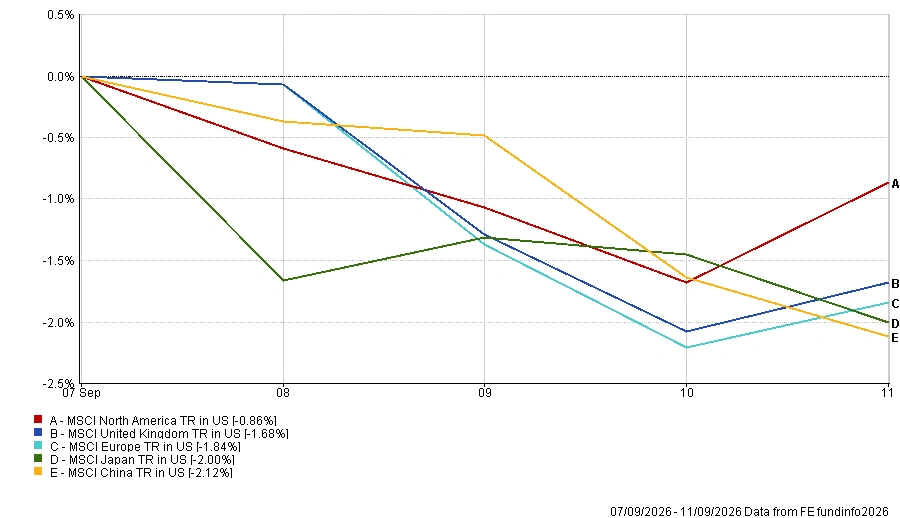
Source: FE Analytics. All indices total return in USD. Past performance is not a reliable indicator of future performance. Data as of 11 September 2026.
Currency Markets
Currency markets reflected diverging monetary policy expectations, with the Japanese yen recording the strongest move among the major currencies covered.
EUR/USD moved from 1.1618 to 1.1600, leaving the euro marginally weaker. The ECB’s rate increase initially provided support, but stronger US inflation reinforced expectations for Federal Reserve tightening.
GBP/USD edged higher from 1.3515 to 1.3520, supported by stronger-than-expected UK growth data later in the week.
The more significant move came from the yen. USD/JPY fell from 156.03 to 153.55, while GBP/JPY declined from 210.99 to 207.59, as expectations for further Bank of Japan tightening strengthened.
Overall, the yen was the week’s clearest currency outperformer, reflecting growing expectations that the Bank of Japan could tighten policy further.
Outlook and The Week Ahead
Central banks take centre stage next week, with monetary policy decisions due from the Federal Reserve, Bank of England and Bank of Japan.
The Federal Reserve meets on 15-16 September, with investors focused on its interest-rate decision, updated economic projections and Chair Kevin Warsh’s guidance on whether further tightening may be required. After the latest inflation data increased expectations for a September rate rise, the decision could set the direction for global markets.
In the UK, labour-market data arrive Tuesday followed by inflation on Wednesday, ahead of Thursday’s Bank of England decision. The Bank is expected to keep Bank Rate unchanged at 3.75%, with retail sales following on Friday.
The Bank of Japan announces its policy decision Friday, shortly after national inflation data, with expectations for further tightening remaining in focus.
Elsewhere, US retail sales, housing data and industrial production will provide further evidence on the strength of the US economy. China will release industrial production, retail sales and unemployment figures, while the euro area publishes industrial production, trade and final inflation data.
For now, markets face a difficult combination of rising energy costs, persistent inflation and tighter monetary policy expectations. With three major central-bank decisions ahead, the coming week could determine whether those pressures intensify or begin to ease.