














Resilient Economic Data Supports Markets Despite Fed Caution | Weekly Recap: 27-31 July 2026


Resilient economic data and another strong week of corporate earnings helped support global markets, even as central banks continued signalling caution on inflation. With the Federal Reserve holding interest rates steady and policymakers reinforcing a data-dependent approach, investors remained focused on whether economic strength can continue without reigniting price pressures. The result was another week of selective positioning, with investors continuing to favour resilient earnings, stronger fundamentals and quality businesses.
Economic Overview
Markets navigated one of the busiest weeks of the year as investors assessed central bank decisions, key economic data and another busy round of corporate earnings. While economic activity remained resilient, policymakers reinforced that inflation risks have not disappeared, encouraging investors to remain selective despite improving economic fundamentals.
The US Federal Reserve left interest rates unchanged at 3.50%-3.75%, maintaining its data-dependent approach as policymakers balanced resilient economic growth against inflation risks. However, divisions within the Federal Open Market Committee highlighted uncertainty around the outlook, with several members favouring tighter policy. Investors interpreted the meeting as reinforcing expectations that interest rates could remain restrictive for longer if inflation proves more persistent.
Elsewhere, economic data painted a broadly constructive picture. The US economy expanded at an annualised 1.5% in the second quarter, while the headline PCE Price Index rose 3.7% year-on-year and core PCE inflation held at 3.3%, suggesting underlying price pressures remained elevated despite continued signs of moderation. In Europe, euro area inflation edged up to 2.9%, reinforcing the European Central Bank’s cautious approach following its decision to leave interest rates unchanged. Meanwhile, the Bank of England and the Bank of Japan maintained their respective policy settings as policymakers continued to assess evolving domestic and global economic conditions.
Corporate earnings also remained a key driver of sentiment. Investors focused closely on major technology companies as markets looked for evidence that continued investment in artificial intelligence can translate into sustainable earnings growth. While earnings generally remained supportive, investors continued to reward companies demonstrating resilient profitability while becoming increasingly selective towards businesses with elevated valuations.
Overall, markets continued to balance resilient economic fundamentals against the prospect of higher-for-longer interest rates, encouraging a more selective approach to risk.
Equities, Bonds and Commodities
Equities
Global equity markets delivered mixed performance as investors weighed encouraging economic data and resilient corporate earnings against cautious central bank messaging.
In the United States, markets experienced increased volatility throughout the week. The S&P 500 fell around 0.4% to 7,489.72, while the Nasdaq Composite declined approximately 0.8% to end at 25,373.85, as investors assessed earnings from several large-cap technology companies and the outlook for artificial intelligence investment. Although revenue growth remained resilient, markets paid close attention to capital expenditure plans and future profitability.
European markets proved more resilient. The STOXX Europe 600 rose around 0.7%, while the FTSE 100 gained approximately 1.2%, benefiting from its exposure to internationally focused companies and stronger performances from the energy and financial sectors. Improving economic activity also helped support sentiment despite ongoing inflation concerns.
Asian markets were mixed. Chinese equities outperformed following renewed policy support, while Japanese equities were more volatile as investors reassessed the outlook for Bank of Japan policy and currency movements.
Bonds
The US 10-year Treasury yield finished at 4.75%, reflecting expectations that interest rates could remain higher for longer. German Bund and UK gilt yields also remained elevated as investors continued scaling back expectations for near-term policy easing.
Commodities
Commodity markets remained volatile as investors balanced ongoing geopolitical uncertainty against evolving supply expectations. Brent crude finished the week around 2.8% higher, trading in the mid-US$90s per barrel as renewed Middle East tensions rebuilt the geopolitical risk premium. In contrast, WTI crude fell 6.46% to US$84.63 per barrel, highlighting continued divergence across oil benchmarks.
Gold edged 0.14% lower to around US$4,050 per ounce as higher-for-longer interest-rate expectations and elevated bond yields reduced demand for non-yielding assets, although prices remained close to record highs.
Sector Performance
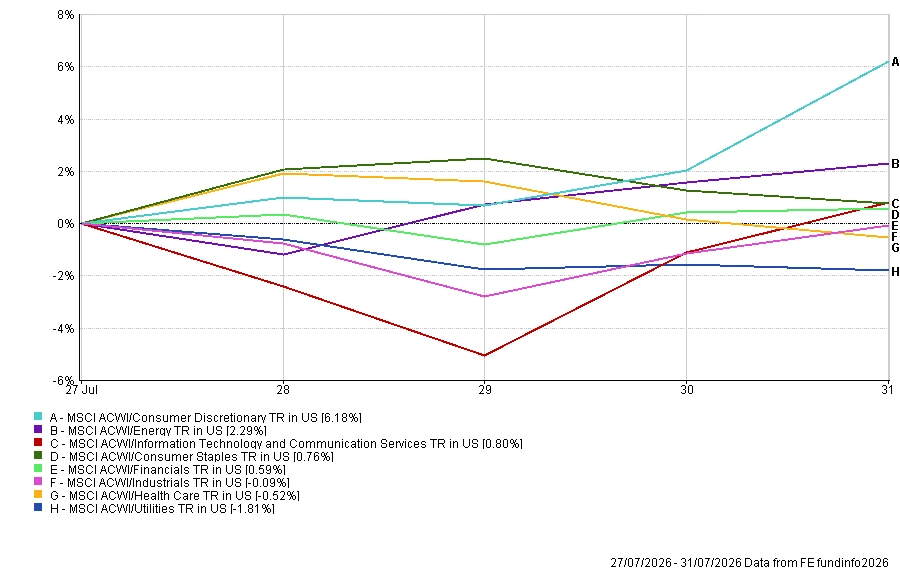
The FE Analytics sector data showed a clear preference for consumer-facing and growth-oriented sectors during the week.
Consumer Discretionary delivered the strongest return, rising 6.18%, as resilient earnings and improving investor sentiment supported companies linked to household spending. Energy followed with a gain of 2.29%, supported by firm commodity prices, while Information Technology and Communication Services advanced 0.80% as major technology earnings remained an important driver of market sentiment.
Consumer Staples rose 0.76% and Financials gained 0.59%, reflecting continued demand for defensive businesses and support from elevated bond yields. Industrials edged 0.09% lower, while Healthcare declined 0.52%. Utilities were the weakest-performing sector, falling 1.81%, as investors favoured areas offering stronger earnings momentum.
Sector Performance July 27th – 31st 2026
Source: FE Analytics. All indices total return in USD. Past performance is not a reliable indicator of future performance. Data as of 31 July 2026.
Regional Markets
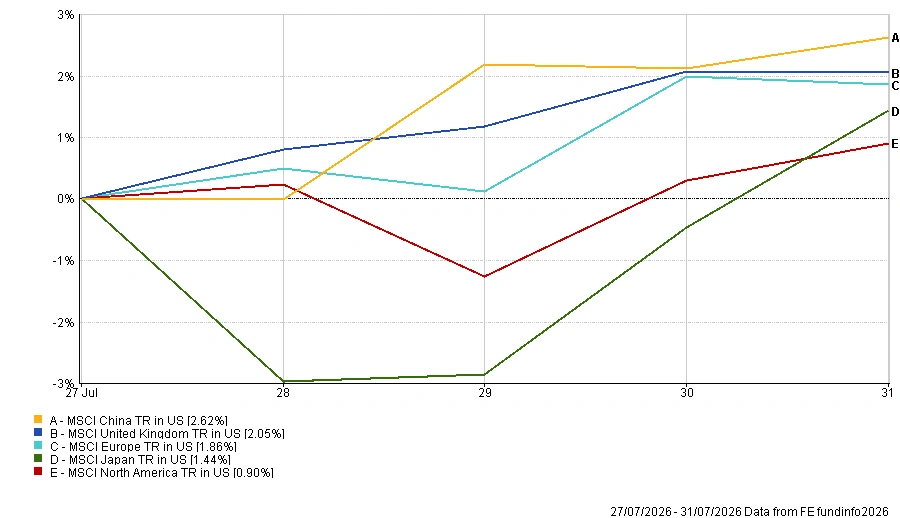
Regional performance reflected differing economic conditions, sector composition and currency movements across major markets.
China delivered the strongest return, gaining 2.62% as improving investor sentiment and policy support helped lift equity markets. The United Kingdom also performed strongly, rising 2.05%, supported by its exposure to energy, financials and internationally focused companies.
Europe gained 1.86%, benefiting from resilient corporate earnings and improving business activity, while Japan returned 1.44% as investors responded to domestic policy developments and a stronger yen boosted returns in US dollar terms. North America rose 0.90%, with gains moderated by mixed performance across large-cap technology stocks despite another busy earnings week.
Regional Performance July 27th – 31st 2026
Source: FE Analytics. All indices total return in USD. Past performance is not a reliable indicator of future performance. Data as of 31 July 2026.
Currency Markets
Currency markets reflected changing expectations for monetary policy following the Federal Reserve’s latest policy decision and another week of closely watched economic data.
The euro strengthened against the US dollar, with EUR/USD rising from 1.1378 on 27 July to 1.1528 on 31 July, as investors reassessed the outlook for US interest rates following the Fed meeting.
Sterling also strengthened, with GBP/USD advancing from 1.3331 to 1.3482, supported by resilient UK economic data and a softer US dollar.
The Japanese yen strengthened significantly during the week, with USD/JPY falling from 163.70 to 157.58 as investors sought safe-haven assets and expectations around Japanese monetary policy evolved. As a result, GBP/JPY also declined sharply, moving from 218.43 to 212.45.
Overall, foreign exchange markets reflected shifting interest-rate expectations, with a weaker US dollar and stronger yen dominating the week’s moves.
Outlook and The Week Ahead
Attention now turns to fresh inflation and labour-market data as investors assess whether central banks can begin easing policy later this year.
Markets will also continue monitoring energy prices, geopolitical developments and corporate earnings, particularly from the technology sector, for further evidence that resilient growth can continue alongside moderating inflation.
For now, investors remain focused on resilient earnings, strong balance sheets and companies with pricing power while maintaining a selective approach to risk.