













How Leverage Works in Trading: Understanding Margin and Risk


Table of Contents
- Understanding Leverage: What is it?
- Understanding Leverage: How is it Expressed?
- Why Do Brokers Offer Leverage
- What Is Margin
- Understanding the Relationship Between Trade Value, Margin and Leverage
- Example: How Leverage Magnifies Gains and Losses
- Understanding Leverage and How it Affects the Market
- Understanding Leverage: Does it Increase Risk?
- What Is a Margin Call
- Leverage and Margin Examples
- Bottom Line
Understanding leverage is essential for anyone trading leveraged financial products. It is one of the most widely discussed concepts in financial markets, yet it is also one of the most misunderstood. It allows traders to gain exposure to a larger market position using a relatively small amount of capital.
While leverage can increase potential returns, it can also magnify potential losses, making it essential to understand how it works before trading leveraged products.
This guide explains how leverage works, how it relates to margin and why understanding both is an important part of managing trading risk.
Understanding Leverage: What is it?
Leverage allows a trader to control a larger market position by depositing only a percentage of the total trade value.
Rather than paying the full value of an investment upfront, the trader provides a smaller amount of capital known as margin, while the remaining exposure is made available through leverage.
For example, using 10:1 leverage means that every $1 of your own capital provides exposure to $10 worth of the underlying asset.
This increases market exposure, but it does not change how the underlying asset itself moves.
Understanding Leverage: How is it Expressed?
Leverage is usually expressed as a ratio such as 2:1, 5:1 or 10:1. For example:
- 2:1 leverage means every $1 of your own capital provides exposure to $2 worth of the underlying asset
- 5:1 leverage means every $1 provides exposure to $5
- 10:1 leverage means every $1 provides exposure to $10
- 20:1 leverage means every $1 provides exposure to $20
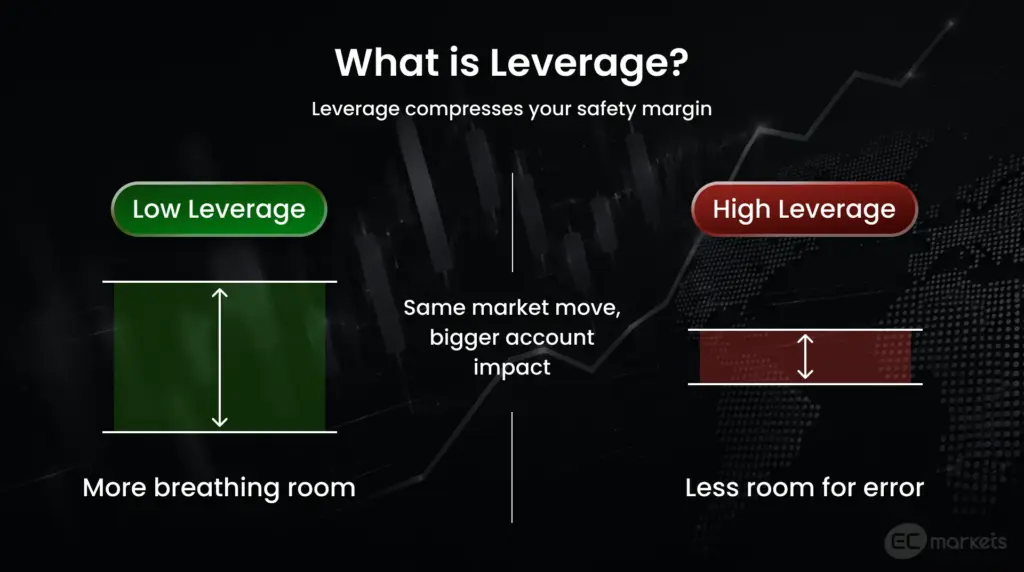
Higher ratios increases market exposure, but it also increases the impact of both gains and losses.
Why Do Brokers Offer Leverage
Many financial markets involve assets with relatively high values. Purchasing these assets outright may require significant capital, making them less accessible to some market participants.
Leverage allows traders to access larger market positions using a smaller initial deposit. This enables greater flexibility when trading a variety of financial instruments.
However, greater exposure also means that gains and losses are magnified, which is why leverage should always be used carefully.
What Is Margin
Margin is the amount of money a trader must deposit to open and maintain a leveraged position.
It is not a fee or an additional trading cost. Instead, margin acts as a security deposit that allows the leveraged position to remain open.
The amount of margin required depends on the leverage being used and the value of the position.
Understanding the Relationship Between Trade Value, Margin and Leverage
Leverage, trade value and margin are directly related.
The relationship can be expressed using the following formula:
Trade Value = Margin × Leverage
This means the total size of a position equals the amount of money you deposit (margin) multiplied by the leverage available.
For example, suppose a trader has $1,000 available as margin and uses 10:1 leverage.
Trade Value = $1,000 × 10
Trade Value = $10,000
This means the trader controls a position worth $10,000, even though they have only deposited $1,000 of their own capital.
The remaining exposure is made available through leverage. While this allows the trader to control a larger position, any gains or losses are calculated on the full $10,000 position rather than the initial $1,000 deposit.
Example: How Leverage Magnifies Gains and Losses
Imagine a trader opens a $10,000 position using $1,000 of margin with 10:1 leverage.
| Market Movement | Position Value | Profit / Loss |
| Asset rises 5% | $10,500 | +$500 |
| Asset falls 5% | $9,500 | −$500 |
Although the underlying asset moves by exactly the same percentage in both cases, the gain or loss is calculated using the full $10,000 position rather than the initial $1,000 margin.
The same principle applies whether prices rise or fall. Just as leverage can magnify potential gains, it can also magnify potential losses.
Understanding Leverage and How it Affects the Market
No. Leverage does not influence how the underlying asset moves. Whether a trader uses leverage or not, the asset rises and falls by exactly the same percentage.
Leverage simply changes the size of the trader’s exposure to those price movements.
Understanding Leverage: Does it Increase Risk?
Yes. Leverage magnifies both profits and losses because gains and losses are calculated using the total market exposure rather than the initial margin deposited.
This means relatively small market movements can have a significant impact on a trader’s account balance.
For this reason, leverage should always be considered carefully alongside appropriate risk management techniques.
What Is a Margin Call
If losses reduce the funds available in a trading account below the required margin level, a broker may require the trader to deposit additional funds or reduce their open positions.
This process is commonly known as a margin call.
A margin call does not necessarily mean a trader has lost their entire investment. Instead, it indicates that additional funds may be required to maintain the leveraged position.
If sufficient funds are not added and market losses continue, some positions may be closed automatically to help limit further losses. This is intended to help prevent losses from continuing to increase beyond the available funds in the account.
Although margin requirements vary between brokers and regulators, traders should understand how these mechanisms operate before trading leveraged products.
Leverage and Margin Examples
| Leverage | Margin Required | Exposure From $1,000 |
| 2:1 | 50% | $2,000 |
| 5:1 | 20% | $5,000 |
| 10:1 | 10% | $10,000 |
| 20:1 | 5% | $20,000 |
This example is provided for illustration and educational purposes only and does not represent financial advice, trading recommendations, or actual market signals.
Bottom Line
Leverage allows traders to control larger market positions using a relatively small amount of capital through the use of margin.
While this can increase market exposure, it also increases the impact of both gains and losses. Understanding how leverage, margin and risk work together is therefore essential before trading leveraged financial products.
Rather than focusing on how much leverage is available, disciplined traders focus on understanding the risks involved, managing their exposure appropriately and using leverage only as part of a well-considered trading strategy.