













Margin & Leverage: What is Margin in Trading?
A common question among those new to trading is: what is margin in trading? It is a concept that is often misunderstood. For anyone considering forex trading with leverage, understanding it correctly early on is essential. Many traders enter the market without fully knowing how to answer 'what is margin in trading?' and what it demands of them. Trading on margin is not just about gaining access to larger positions. The mechanics behind it, such as position sizing and capital allocation, have direct consequences for every leveraged position held. This article breaks down those mechanics from the basics of leverage in trading to the margin risk thresholds that determine when a broker intervenes.
What is Leverage in Trading?
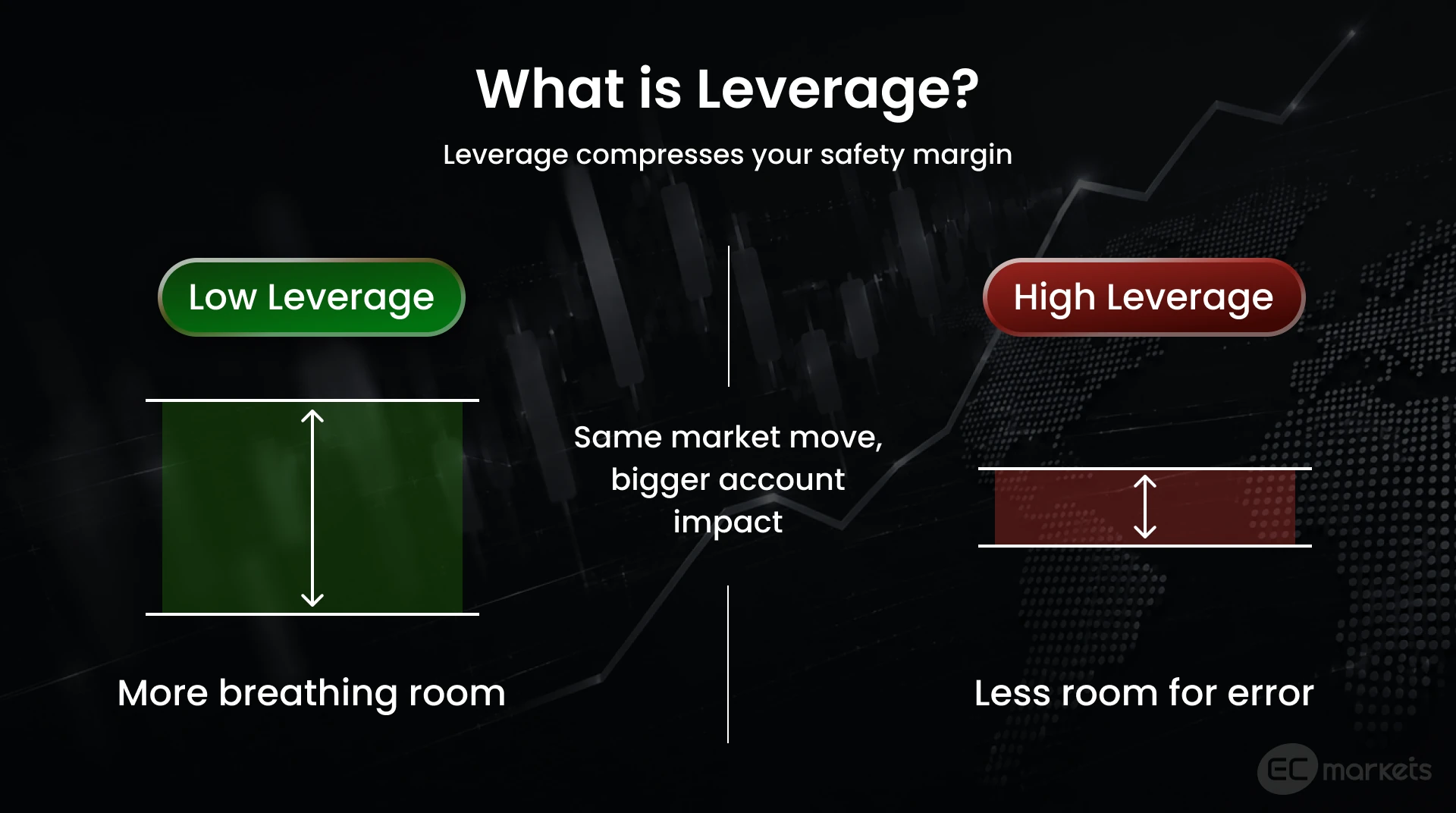
To answer 'what is margin in trading?', it is first necessary to understand what leverage is. Leverage is a multiplier and it allows a trader to take a larger position than their capital would normally allow. A common misconception about leverage in trading is that it is a loan that a trader receives from the broker. However, it is more like a tool used to amplify market exposure, whereby the broker sets aside part of the trader's capital as margin. Leverage in trading should be looked at as borrowed market exposure, not a performance enhancer.
Leverage can scale gains as much as it can scale losses — it has no preference for direction. This is why forex trading with leverage is about managing the downside, not chasing the upside. For instance, at a leverage ratio of 1:50, a $1,000 deposit can control a $50,000 notional position. An unfavourable 2% move in price would result in a $1,000 loss — 100% of the deposit. In a volatile market, there is very little room for error with 1:50 leverage, as a 2% swing could occur within minutes. This is why forex trading with leverage demands discipline - excessive leverage compounds the speed at which losses can occur and is one of the main reasons many retail accounts do not survive.
What is Margin in Trading and How Does it Work?
Margin exists because of leverage. It is the deposit that a trader must provide to the broker to open a leveraged position. The broker holds this deposit as security and reserves this amount for as long as the position stays open. That is essentially how trading on margin works.
To break this down further, opening a leveraged position requires a minimum margin, called the 'required margin'. The amount of required margin a trader must deposit depends on the leverage ratio offered by the broker. Any portion of equity not tied up as required margin is called 'free margin', which can act as a buffer if the market were to move against an open position.
Here is a simple example to show how it works:
Suppose a trader has $5,000 in their account and their account has a leverage of 1:10. This means that the margin requirement for this account is (1 / 10) or 10%. If the trader would like to open a position worth $10,000, their account would look like this:
- Equity: $5000
- Required margin (reserved): 10% × $10,000 = $1,000
- Free margin (available buffer): $5,000 − $1,000 = $4,000
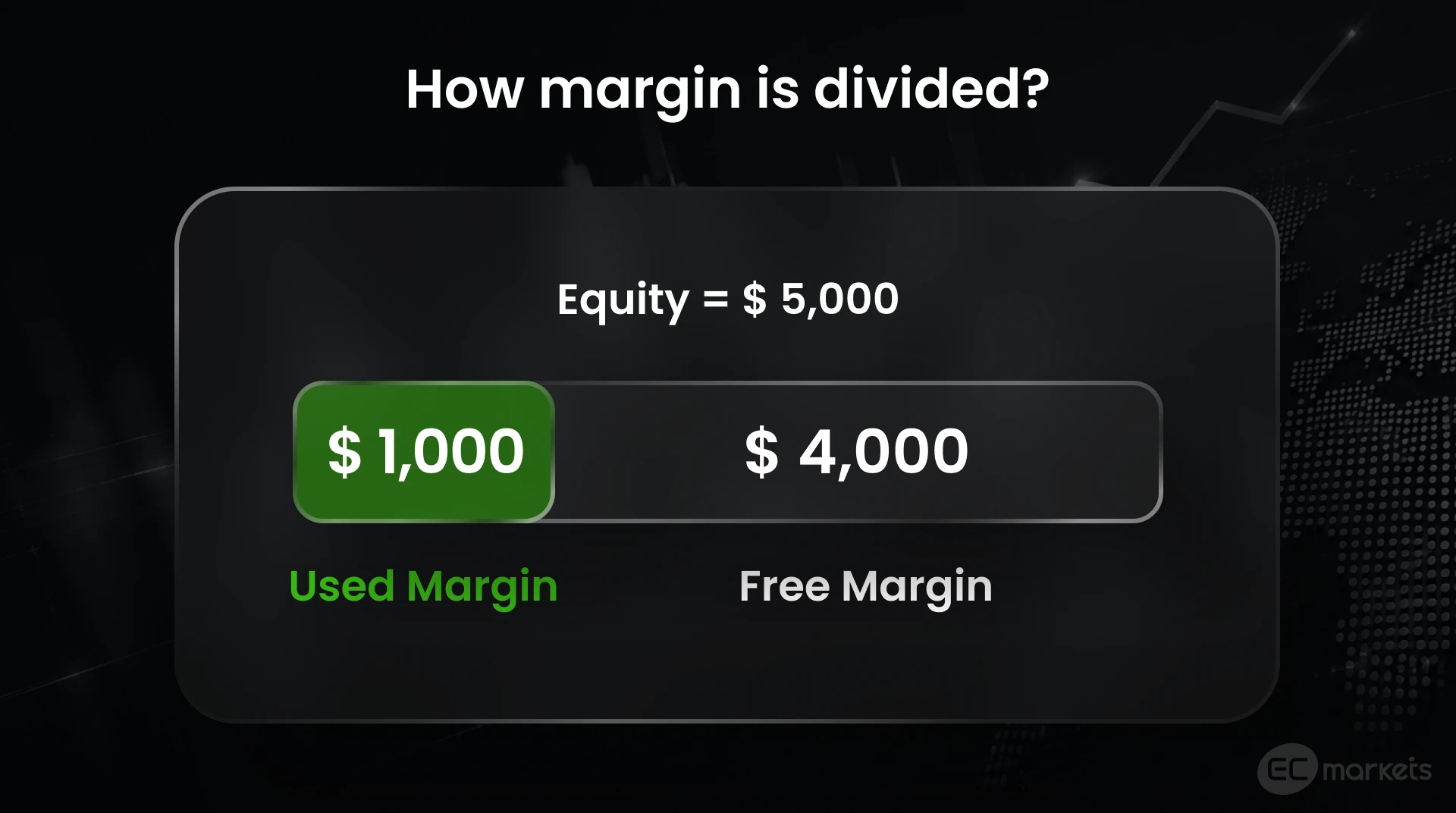
This is what trading on margin looks like in practice, where a fraction of capital controls a much larger position, with the remaining equity acting as a buffer against any adverse price movements.
Why Use Leverage in Trading?
If trading on margin is risky, why do it? The answer is capital efficiency.
For example, one standard lot in EUR/USD is exactly €100,000. Without leverage, a trader would need to fork out the equivalent amount of USD to open that trade. This is not practical for most, so forex trading with leverage solves this by requiring only a fraction of that amount as margin to gain full exposure. As mentioned, any portion of equity not tied up as required margin is 'free margin', and this is useful for two main reasons:
- Free margin acts as a buffer by absorbing any unrealised losses before they erode the required margin.
- Having extra capital means traders can open other trades, such as buying gold and shorting GBP/JPY, at the same time. This allows traders to build a portfolio and avoid concentrating exposure in a single market direction.
But why would anyone want to open such a large position and increase their risk by using leverage in trading? Currency price movements are often very small. Forex trading with leverage amplifies those tiny pip movements to make them matter. This is why experienced traders determine their stop-loss distance first, before deciding what their position size will be, keeping the margin deposit as low as possible.
Margin Risk Thresholds
A key part of answering 'what is margin in trading?' is to understand that brokers track a trader's margin levels in real time. As losses accumulate, the margin buffer shrinks, and if it shrinks too much, the broker will intervene. These interventions occur at two major margin level thresholds: the margin call and the stop-out level.
What is Margin Level?
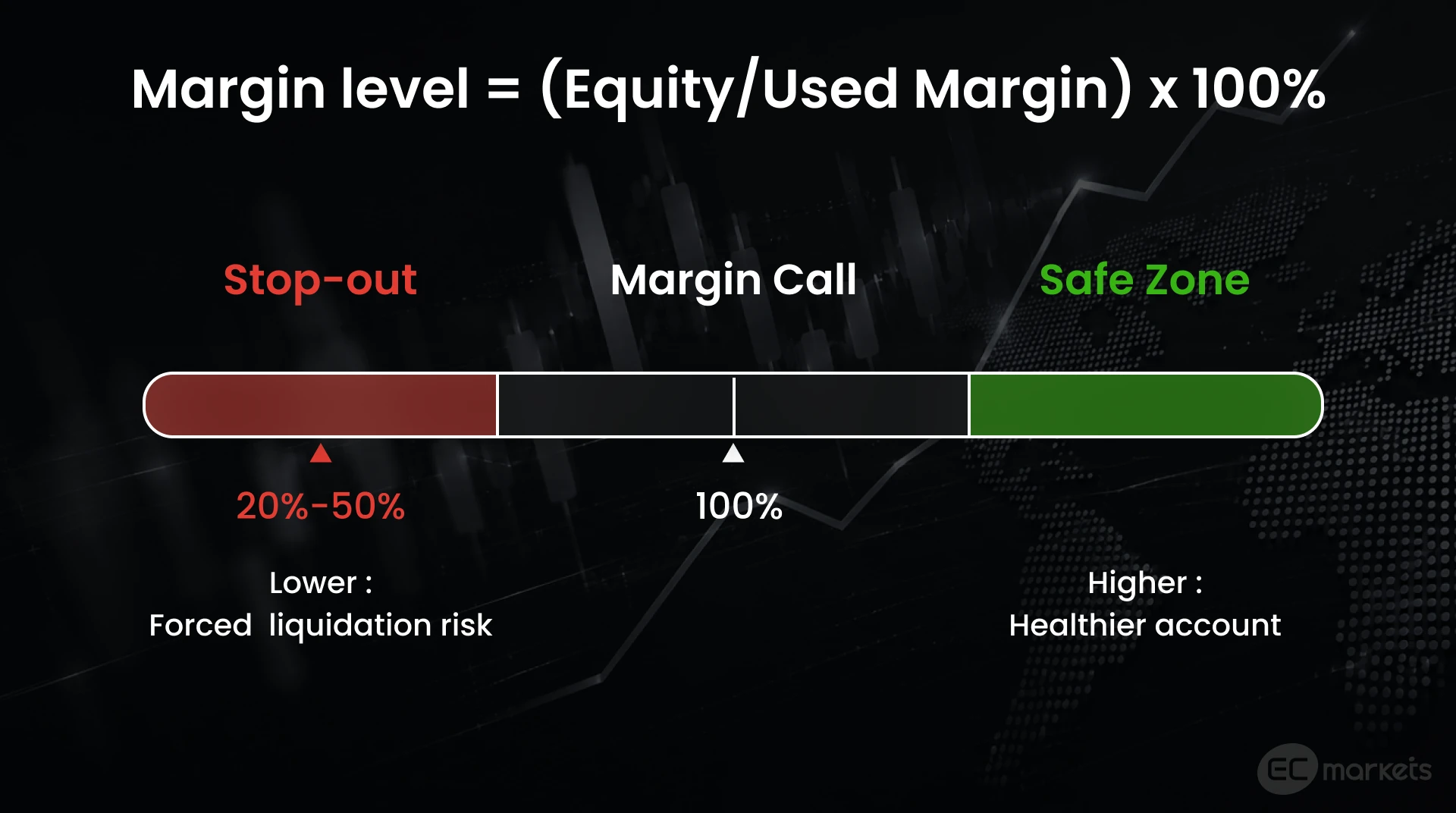
Margin level is a percentage that represents how much equity a trader has in relation to their used margin - the higher the percentage, the healthier the account.
Margin Level (%) = (Equity ÷ Used Margin) × 100
- Equity = How much the account is currently worth (includes unrealised gains or losses).
- Used Margin = Deposit value that is currently locked up.
For example, if an account has a equity of $5,000 with $1,000 locked up as the required margin:
- Equity = $5,000
- Used Margin = $1,000
- Margin Level = ($5,000 ÷ $1,000) × 100 = 500%
If equity falls from $5,000 to $1,000, then:
- Margin Level = ($1,000 ÷ $1,000) × 100 = 100%
When the margin level drops to 100%, it means losses have depleted the account's free margin, so there is no capital left to act as a buffer for the deposit. For most brokers, this is the level at which a margin call is triggered.
What is a Margin Call?
A margin call is when the broker sends the trader a warning that their margin level has fallen to or below the broker's required threshold. Although this threshold varies by broker, it is typically when an account's margin level falls to 100%. When a margin call is triggered, traders must either deposit additional funds to restore their margin level, or close or reduce open positions. This is one of the more abrupt realities of forex trading with leverage - a seemingly manageable position can deteriorate quickly in volatile conditions.
What is Stop-Out Level?
If losses continue to grow, the margin level will keep falling and may reach the broker's stop-out level (usually at a margin level of 20–50% depending on the broker). At this point, the broker automatically begins closing open positions to limit further losses to the account.
It is best not to wait for a margin call. By the time the broker is forced to step in, significant damage has already been done. Therefore, it is essential to establish a solid risk management plan, including setting stop-loss levels.
Trading Costs | What is Margin in Trading?
Forex is a dynamic environment and it can be easy for beginners to overlook certain aspects in the excitement of using leverage in trading. To protect capital as much as possible, it is important to account for the following costs when trading on margin:
- Spread: Often one of the most underestimated costs of trading on margin. At the moment a trade is executed, the free margin decreases by the size of the spread. This immediate execution cost can push a thinly capitalised account towards a margin call before price has moved at all, especially on larger positions.
- Various Margin Requirements: When forex trading with leverage, the more unpredictable the pair, the higher the deposit required. Exotic pairs typically have lower leverage and therefore require higher margin than major pairs. This is because exotics have reduced liquidity and higher volatility, making them riskier to trade. Traders should always check the margin requirements for each pair before entering a trade.
- Swaps: Holding a trade overnight can cost money. It is typically at the end of the New York trading session when a swap (also called a rollover) is charged or credited. Depending on the difference in interest rates between the two currencies in the pair (the base and quote currency), the swap can either be debited or credited to the account. By themselves, swaps are small, but over several days of negative swaps while holding an open position, they can gradually erode the free margin.
Conclusion | What is Margin in Trading?
Margin is what makes leveraged trading possible. Leverage in trading increases exposure and many beginners make the mistake of seeing this as a way to enhance performance. However, trading on margin is better understood as a collateral requirement that enables a trader to control a large notional position with a fraction of their underlying capital. Leverage in trading creates great potential for opportunity, but it also compresses the margin for error. Whether trading on margin in the deep liquidity of forex, commodities or indices, the margin level is the metric that determines how much room remains before a margin call, a stop-out, or both. Forex trading with leverage requires active management of margin level, position sizing and risk thresholds because losses can accumulate faster than manual intervention allows. Establishing rules for position sizing and maximum drawdown limits is essential to protecting the buffer. Remember, trading on margin does not change the market — it changes the consequences.
Now that 'what is margin in trading?' has been covered, the next step is to learn about what disciplined risk management means.
Note:
This content is for general information and educational purposes only and does not constitute investment advice or a personal recommendation. Any examples are for illustration only and should not be treated as a signal or invitation to trade. This material does not take into account your investment objectives, financial situation or needs. CFD trading is high-risk; losses may exceed deposits.