












Understanding Forex Risk Management
Table of Contents
- What is Forex Risk Management?
- Why is Forex Risk Management Important?
- How to Build a Forex Risk Management Framework
- Managing the Risk of Each Trade
- Key Forex Risk Management Tools
- Common Mistakes When Managing Trading Risks
- Tips for Managing Trading Risks in Forex
- Conclusion | Understanding Forex Risk Management
Forex is often marketed as an exciting path to wealth, but for the long-term professional, the reality is starkly different - it is a game of defence. The most sophisticated strategy in the world will not protect an account without a rigorous forex risk management framework. Anyone can open a position, but managing trading risks over the long term is the real skill. Trading risk management is not just about protecting funds. This guide looks past the marketing hype to focus on the fundamentals of capital preservation. It covers why professionals prioritise managing the downside and how to build a trading risk control plan that keeps a trader in the market long enough to execute a strategy effectively.
What is Forex Risk Management?
Forex risk management is a structured set of rules designed to protect a trader’s capital from market volatility. The forex market moves fast; economic surprises and geopolitical headlines can cause prices to move sharply in a matter of seconds, and that speed is exactly why it matters to have trading risk controls in place. Managing trading risks is an essential part of helping traders stay in the game long-term. It is less about chasing the biggest possible wins and more about limiting potential losses, especially when conditions change. Trading risk management starts with clear boundaries, including establishing an appropriate position size, defining the level at which a trade is invalidated and determining how much capital to risk per trade.
Why is Forex Risk Management Important?
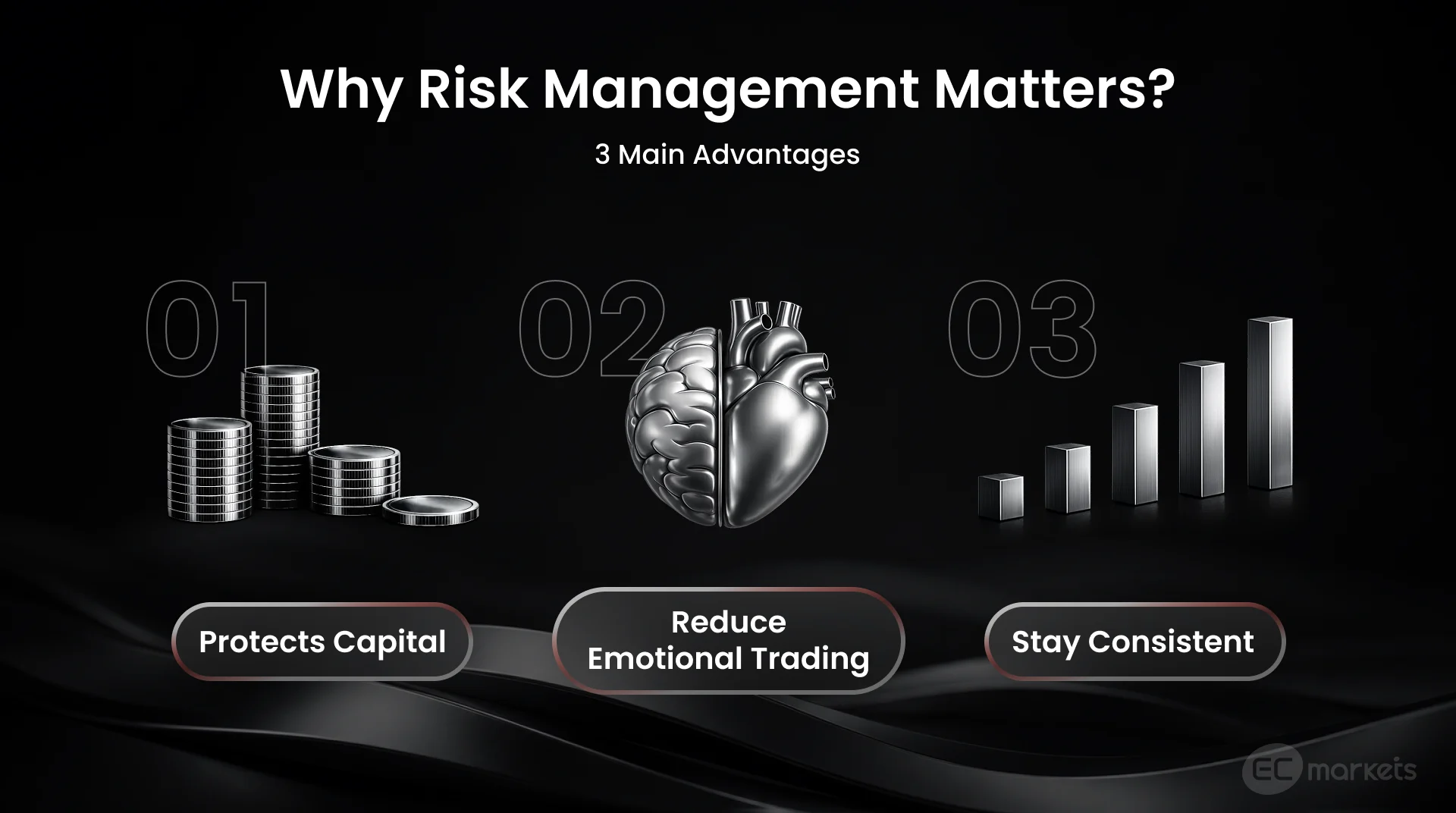
Even the strongest of trading risk management strategies can be undermined by a single big loss. Many beginner traders make the mistake of focusing too much on potential upside and overlook the need for a strong trading risk control plan in place. To emphasise its importance, here are three main advantages of prioritising forex risk management:
- Protects Capital
Account balance is what enables traders to participate in the market. Managing trading risks with discipline limits the impact of any single event so that the account can withstand normal market volatility. - Reduces Emotional Decision-Making
Large price swings and losses can cause traders to chase losses, double down and hesitate at critical moments. Predefining position size, stop-loss levels and exit rules are crucial trading risk controls that help traders execute under the same rules every time, whether the market is calm or chaotic. - Supports Long-Term Consistency
Consistency in trading is not about never making losses, rather it is about controlling them so that enough trades can be carried out to prove if a strategy works. Forex risk management itself does not directly give traders an edge when trading, but it provides the stability needed to gain one.
How to Build a Forex Risk Management Framework
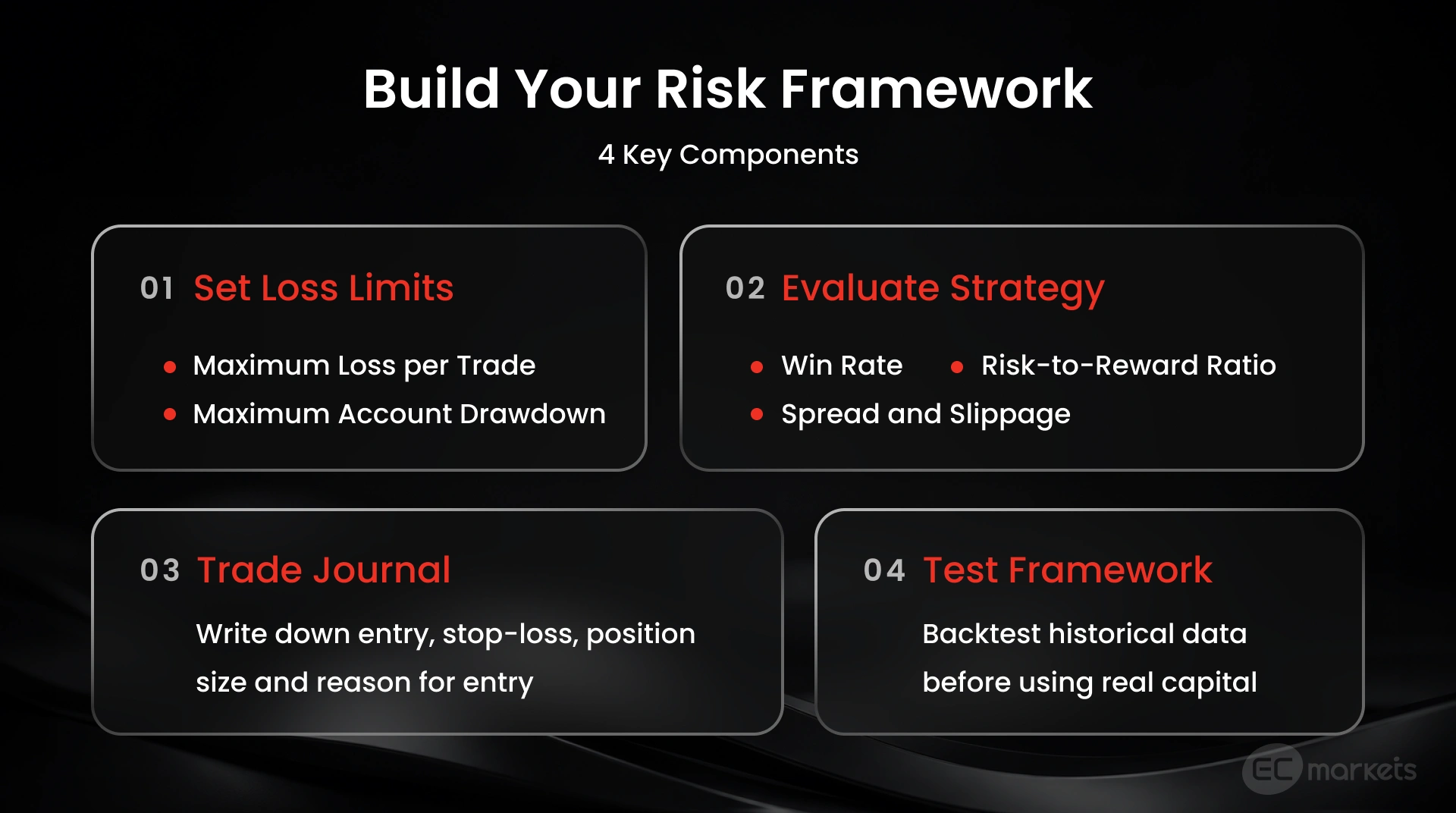
Forex risk management must be as structured as possible. Having a framework to guide decision-making reduces the likelihood of relying on gut feeling by setting distinct rules. Having rules is the basis for all trading risk management and they should be followed in all market conditions. Let's take a look at the key components of this framework:
- Establish Loss Limits. When managing trading risks, there are two essential thresholds to set before any trading happens: the maximum acceptable loss per trade and the maximum acceptable drawdown for the entire account. If account equity falls by a certain percentage, trading should stop and the approach should be reviewed.
- Check win rate and risk-to-reward ratio. A strategy needs to prove that it can make money long term, and the proof lies in these numbers. The combination of the two metrics must produce a positive outcome after all costs, including spread and slippage. For example, a strategy with a 50% win rate that makes twice as much on winners as it loses on losers is likely to be profitable over time. For this to be an effective trading risk control, review a minimum of the past 50 trades of a strategy to determine whether the strategy produces a positive expectancy.
- Keep a trade journal. Write down the details of the trade, such as entry, stop-loss, position size, and the reason for entering the trade. Also, make a note of any feelings at the time of the trade. The goal here is more than just record-keeping, it is to be able to identify patterns in order to highlight any weaknesses that need to be taken into account when forming a trading risk management plan. Examples of such patterns could be moving the stop-loss levels, increasing position size after a loss, taking profits too early due to nervousness and deviating from the trading plan.
- Test the framework. Before trading with real capital, test the plan against historical price data. Apply the trading risk controls, including loss limits and stop-losses, exactly as they would be applied in live trading. The point of this is less about finding the perfect strategy and more about testing one under pressure. In other words, can it survive difficult periods? A strategy that does not perform on past data is unlikely to perform any differently in live markets.
Managing the Risk of Each Trade
Now that we know how to build an overall framework for trading risk management, how do we go about managing trading risks at the level of each individual trade? Let's break down four non-negotiable trading risk controls that all beginner traders need to know.
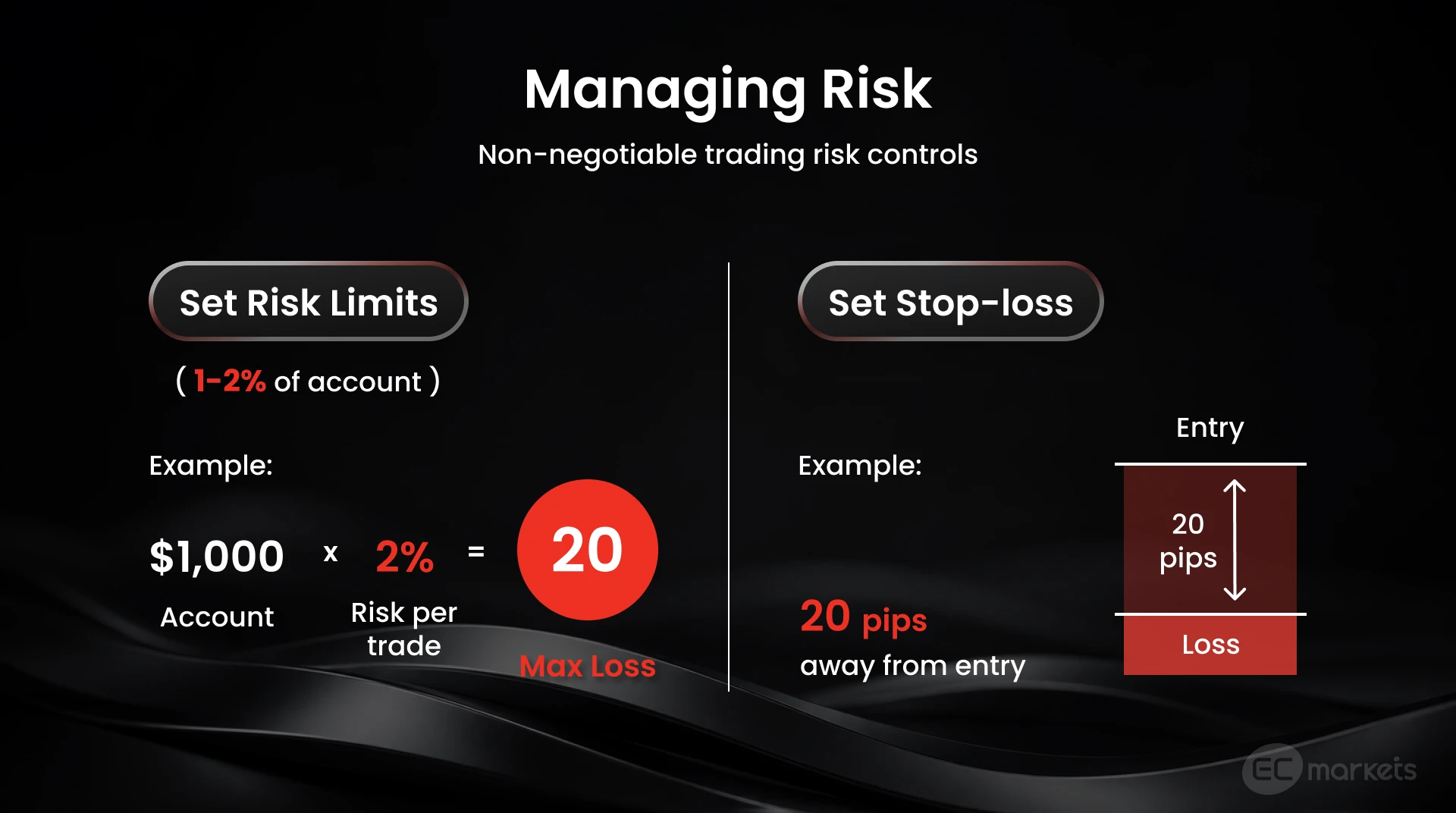
- Define the maximum acceptable loss per trade. A common guideline is to risk no more than 1-2% of account equity for any single trade. For example, a 2% loss on a $1,000 account means capping losses at $20 per trade.
- Establish the stop-loss level. This is one of the most important parts of any trading risk management plan. Identify the price level at which the trade is invalidated should price move unfavourably. For example, that price level could be 20 pips away from entry, in which case a stop-loss order will be triggered if the market reaches that price.
- Calculate the position size. Position size cannot be calculated until both maximum acceptable loss and stop-loss level are established. Using the predefined maximum acceptable loss (e.g. $20) and stop-loss level (e.g. 20 pips away from entry), determine a position size that ensures both conditions are met.
- Set a profit target. Decide what ‘enough’ looks like – greed ruins more good trades than most like to admit. This can be done by simply setting a fixed take-profit level, a partial exit (closing part of the trade and letting the rest run further) or a trailing stop. Profit targets should be set in advance, though they can be adjusted as the trade develops.
Key Forex Risk Management Tools
Managing trading risks does not need to be difficult. Using the right tools can significantly help traders strengthen the execution of their forex risk management plan by reducing reliance on manual processes. Below are three key tools that traders commonly use.
- Position Size Calculators: By inputting two values, maximum acceptable loss and stop-loss pip distance, the calculator will work out the right position size to use. This reduces the risk of errors associated with manual calculation and helps to ensure the trade remains within the predefined risk parameters.
- Automated Tools: Many platforms offer the use of trading robots, also called ‘Expert Advisors’ on MetaTrader 4, to automate tasks when managing trading risks, such as placing a stop-loss at the moment of entry. Automation helps to ensure tasks are not missed and are completed without hesitation. However, traders should be careful not to treat automation as a guarantee. Connectivity issues, system errors or unusual market conditions can affect the performance of trading robots, so traders should avoid developing a significant reliance on them and instead treat them as a support tool.
- Workspace Setup: Trading platforms can be configured to support decision-making and forex risk management. Adding tools and displays directly to the interface, such as spread displays, session indicators, price alerts and risk scripts, helps create a more systematic trading environment. This supports consistent monitoring, minimising reliance on memory and reducing impulsive decision-making.
Common Mistakes When Managing Trading Risks
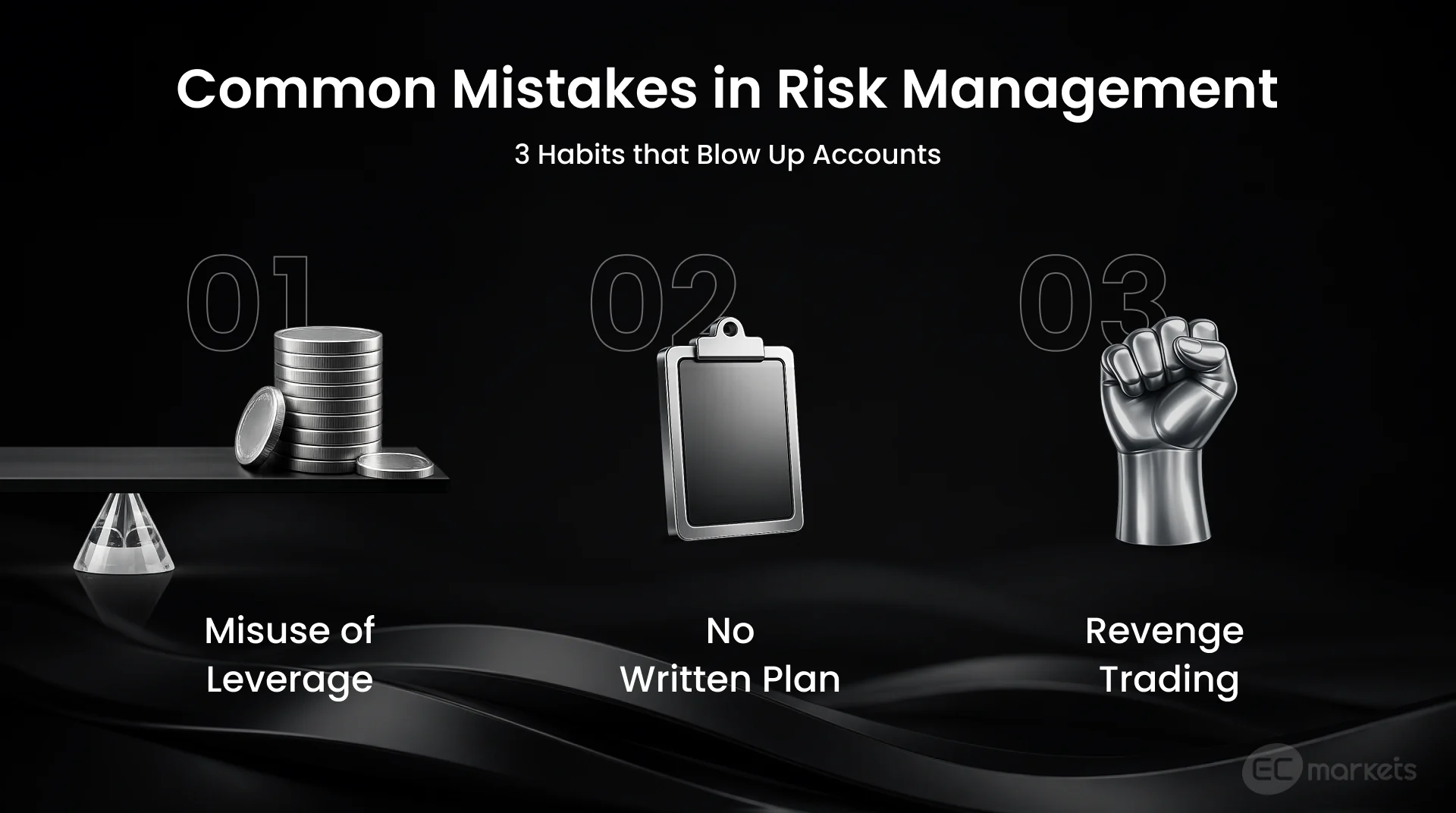
Risk management in forex trading takes practice. It is normal to get stuck and make mistakes. What is more important is learning from those mistakes, because more often than not, it is bad habits and emotions that get in the way of success. Beginner traders who can avoid these mistakes early on are off to a good start:
- Misuse of leverage. Many beginners get too caught up in the potential of multiplying their gains when the main focus should be on mitigating downside risk as much as possible. Using leverage to create oversized positions leaves very little room for normal price fluctuations as a routine pullback, wider spread or a quick spike can be enough to trigger a margin call. Traders who are disciplined in their trading risk management care less about how much exposure to carry and more about how much their equity can take without forcing an exit.
- Trading without a written plan. Anyone trading without a solid plan is just improvising and will not last long in the game. Traders must establish their entry criteria, stop-loss levels and maximum acceptable losses before a position is opened. Trading without a clear trading risk management plan will almost always lead to reactive decision-making, such as moving stops, expanding the risk threshold and exiting early. No plan means no trading risk controls, and this can cost a trader their entire account equity.
- Revenge trading. This is when a trader bumps their position size in an attempt to win back losses. The worst time to increase risk is when decision-making is at its worst. Many traders get this urge when they allow emotion to take over, throwing all trading risk management tactics out the window. Eliminating that impulse is the difference between disciplined and undisciplined trading.
Tips for Managing Trading Risks in Forex
- Review past trading data. Look back at the past 50 trades and determine if rules were being followed. Check risk limits, position sizes, stop-loss levels and if there was any revenge trading - identify any deviations from the plan. If any are found, stop trading and fix the root cause of why it happened. Leaving it unaddressed will allow it to happen again.
- Keep the rules visible. Write down the key numbers, such as maximum risk per trade, maximum acceptable loss per day and maximum position size. Ensure these trading risk controls are visible at all times as a constant reminder. Rules that are not written down are forgotten when markets are stressed. The goal is to leave no room for impulsive and reactive decision-making.
- Practice, Practice, Practice! A demo environment is a great place to get the basics of managing trading risks right, including placing stop-loss orders, calculating position size and managing orders. It is important to practise applying these trading risk controls. However, keep in mind that demo trading does not replicate the emotions experienced when trading with real money. Once the basics are down, the next stage is to open a small live account where the goal is not to make a profit, but to stick to a plan with real money on the line.
Conclusion | Understanding Forex Risk Management
Professional trading is not about predicting the future - it is about controlling what can be controlled: position size, downside limits and execution. Many beginners only pay attention to trading risk management after one outsized move wipes out weeks of progress. Seasoned traders treat it the other way around: capital preservation comes first and everything else is built on top of it.
A clear forex risk management framework changes how a trader operates. The focus shifts away from looking for a single 'big win' and towards running a process. Emotions do not disappear, but trading risk controls create guardrails when volatility spikes and decision-making gets harder. Long-term results are not determined by the best trade. They are determined by how consistently managing trading risks limits damage when trades do not work out.
Note:
This content is for general information and educational purposes only and does not constitute investment advice or a personal recommendation. Any examples are for illustration only and should not be treated as a signal or invitation to trade. This material does not take into account your investment objectives, financial situation or needs. CFD trading is high-risk; losses may exceed deposits.