












Limit Order vs Stop Order: Key Differences and How to Use Them
Table of Contents
While many new traders tend to click 'buy' and 'sell' without much thought, more experienced traders know the value in prioritising risk management. A big part of this is choosing the most suitable order type based on a trader's entry and exit requirements. In this guide, we'll learn about what a market order is, distinguish between a limit order vs stop order, and understand the importance of a stop loss order. The goal is to understand how each order type works and to choose the right one to use when entering or exiting a position.
What is a Market Order?
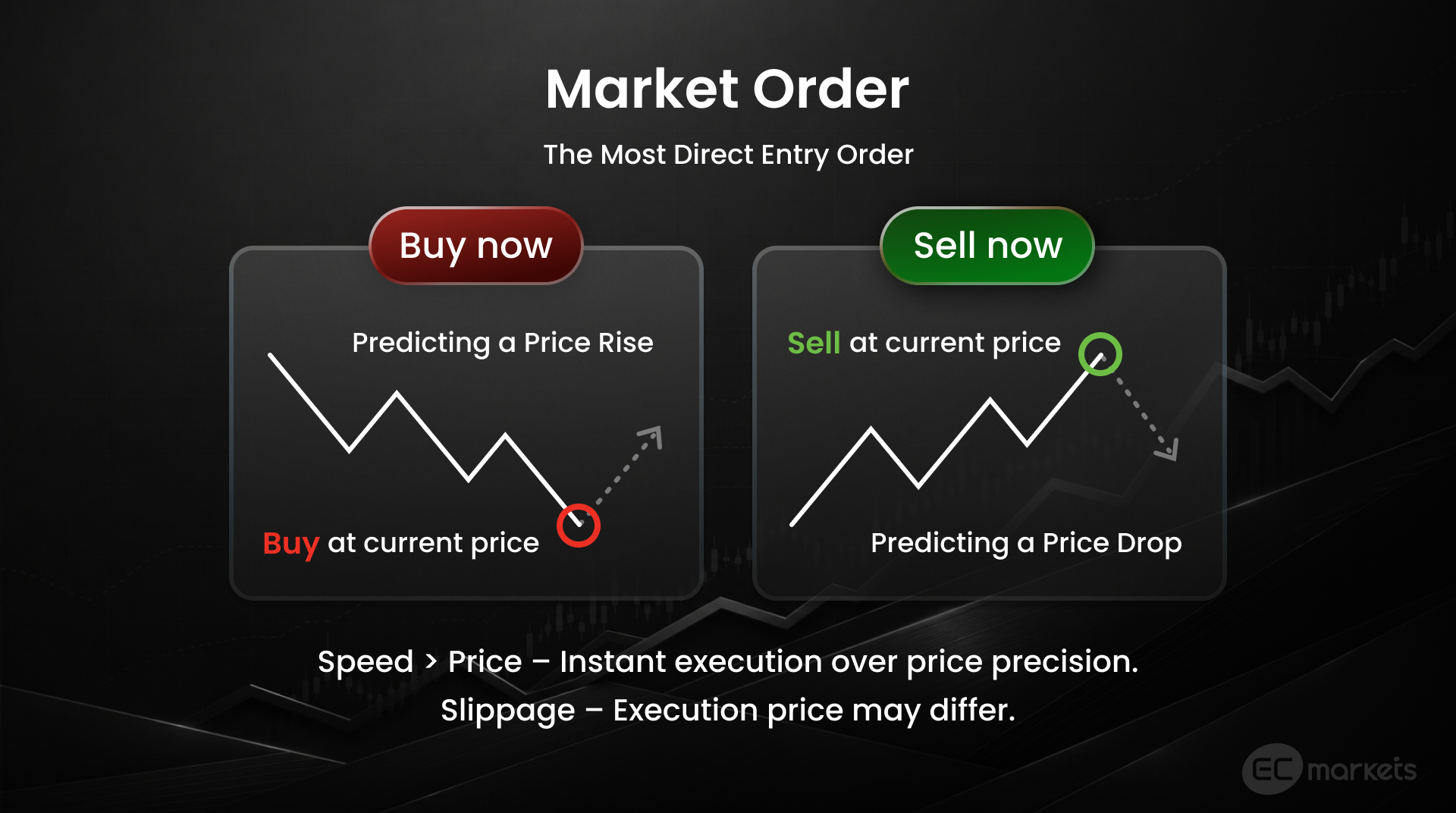
A market order is an instruction to the broker to immediately buy or sell at the best available price, which makes this order type the fastest way to open or close a trade. Traders typically place market orders to ensure they do not miss a sudden surge in momentum and want to 'get in (or out) now' – no bidding, no waiting. However, high execution speed and certainty come with less price precision.
Example of how a market order is used:
If GBP/USD is starting to fly, a market order prioritises getting a 'seat' on that 'plane' before it leaves the runway. However, speed is not free. Because the market order seeks immediate execution at the available market price, it is exposed to slippage: the difference between the expected price and the actual execution price. In fast-moving markets, the price on the screen may jump a few pips before the order is completely filled.
Let's use some numbers. A trader who clicks 'Buy Now' at 1.1050 during a news spike may end up having part (or all) of their trade executed at 1.1052. However, the trader who deliberately chooses to use a market order is often okay with this because they believe the market move will be big enough to cover the cost of slippage. For a professional, a market order is a tool of urgency and it is often used when the risk of 'missing the move' outweighs the cost of a slightly less-than-perfect entry price.
What are Limit Orders? | Limit Order vs Stop Order
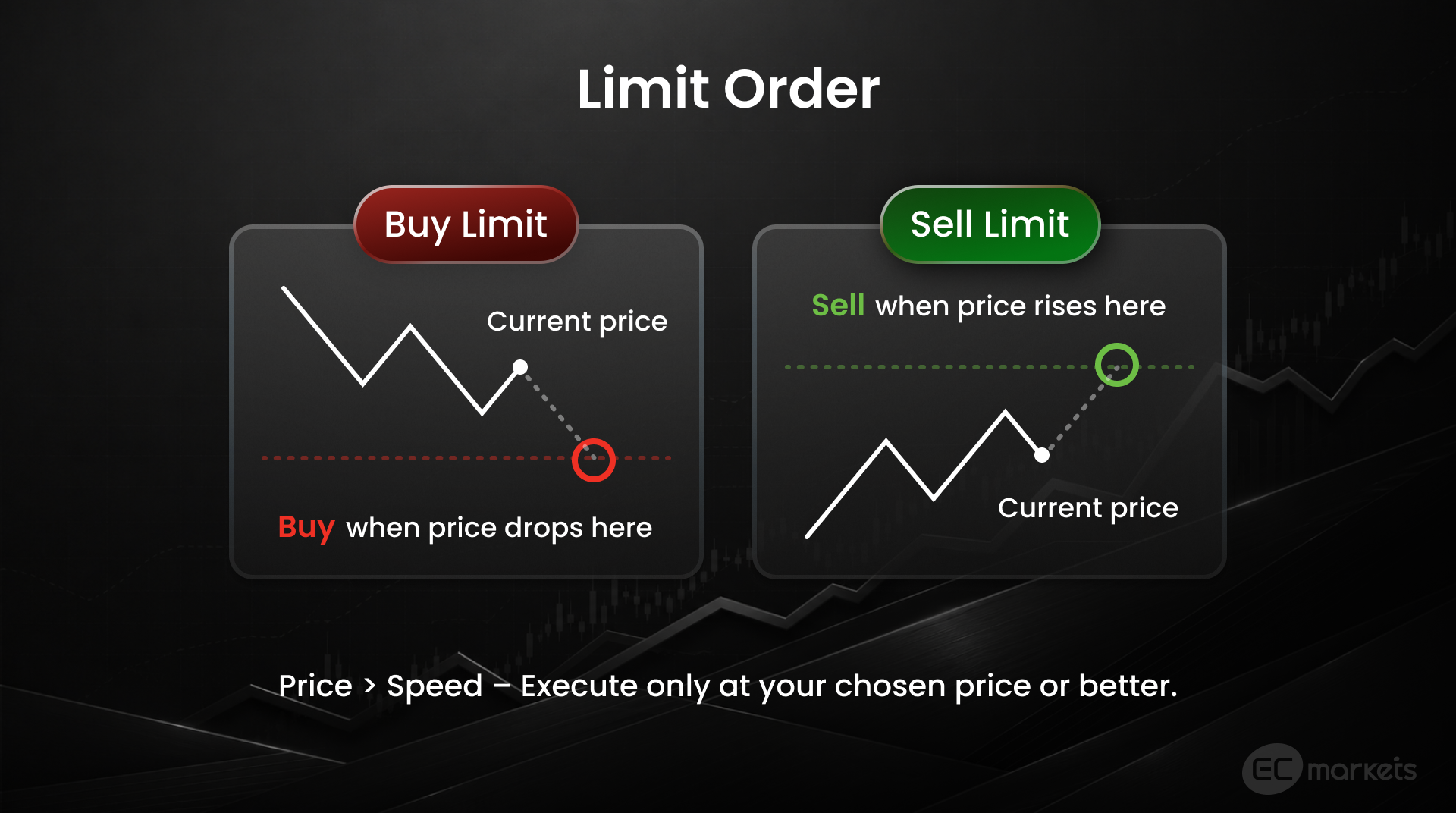
Limit orders prioritise price precision over execution certainty. To place a limit order, a trader must specify the exact price they are willing to pay (for buy orders) or accept (for sell orders). This order type eliminates the risk of being filled at a worse price than the limit. There are two types of limit orders:
Buy Limit
A buy limit order instructs the broker to buy at 'this price' or lower. They are best placed below current market levels (usually below a solid support zone) to only buy when the price drops to a specific level. Buy limits can be used to:
- Enter a long position (buy the dip and expecting the price to rise).
- Exit a short position (take profit at the target price or better).
Sell Limit
A sell limit order instructs the broker to sell at 'this price' or higher. They are usually placed above a clear resistance zone to only sell when the price rises to a specific level. Sell limits can be used to:
- Enter a short position (sell the rally and expecting price to fall).
- Exit a long position (take profit at the target price or better).
What to watch out for:
Limit orders guarantee the specified price or better – that is their main advantage. But here is the catch: the order might not get filled at all. Price could come within a fraction of the limit, then reverse hard without the trader on board. Short traders may also see that the chart price touched the take-profit price, but their order was not executed because the chart shows the bid price, while closing their short position requires the ask price to reach the target.
This can frustrate traders, especially when the analysis was right but the entry never triggered. However, that is actually the point – capital is protected by sticking to the plan instead of chasing moves out of FOMO (fear of missing out). Limit orders work best for patient traders who would rather miss a trade than compromise on entry quality.
What are Stop Orders? | Limit Order vs Stop Order
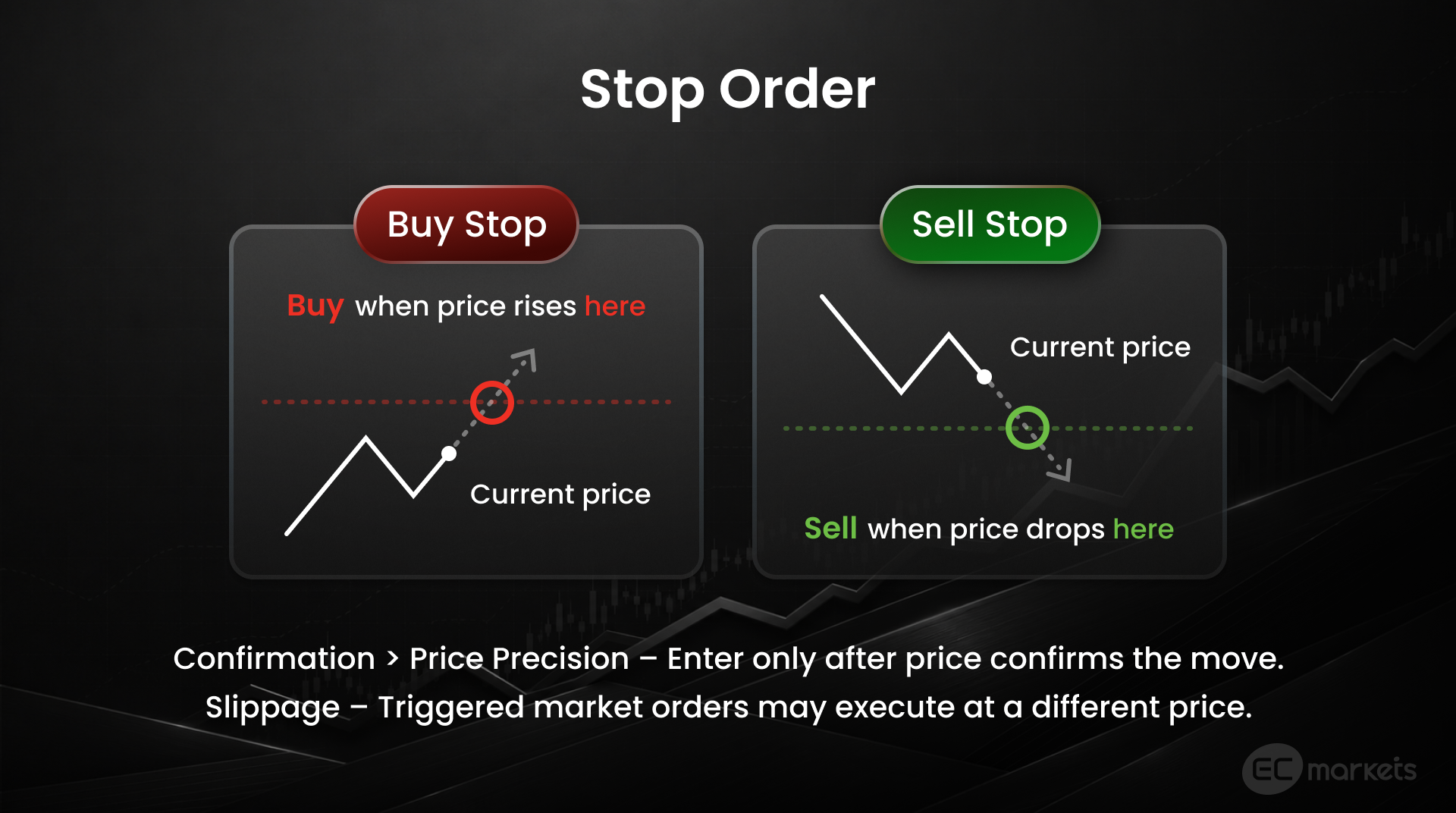
While limit orders hunt for bargains, stop orders ask the market to prove momentum exists before committing to a trade. A stop order acts as a confirmation point where the trader only wants in (or out) if price shows real strength or weakness first.
Buy Stop
A buy stop is placed above current price and if price rises to the stop level, a market buy order will be triggered. Buy stop orders can be used to:
- Enter a long position to catch an upward movement.
- Cap losses by exiting a short position if price rises (aka a 'Stop Loss Order').
Sell Stop
A sell stop is placed below current price and if price falls to the stop level, a market sell order will be triggered. Sell stops can be used to:
- Enter a short position to catch a downward movement.
- Cap losses by exiting a long position if price falls (aka a 'Stop Loss Order').
Stop Loss
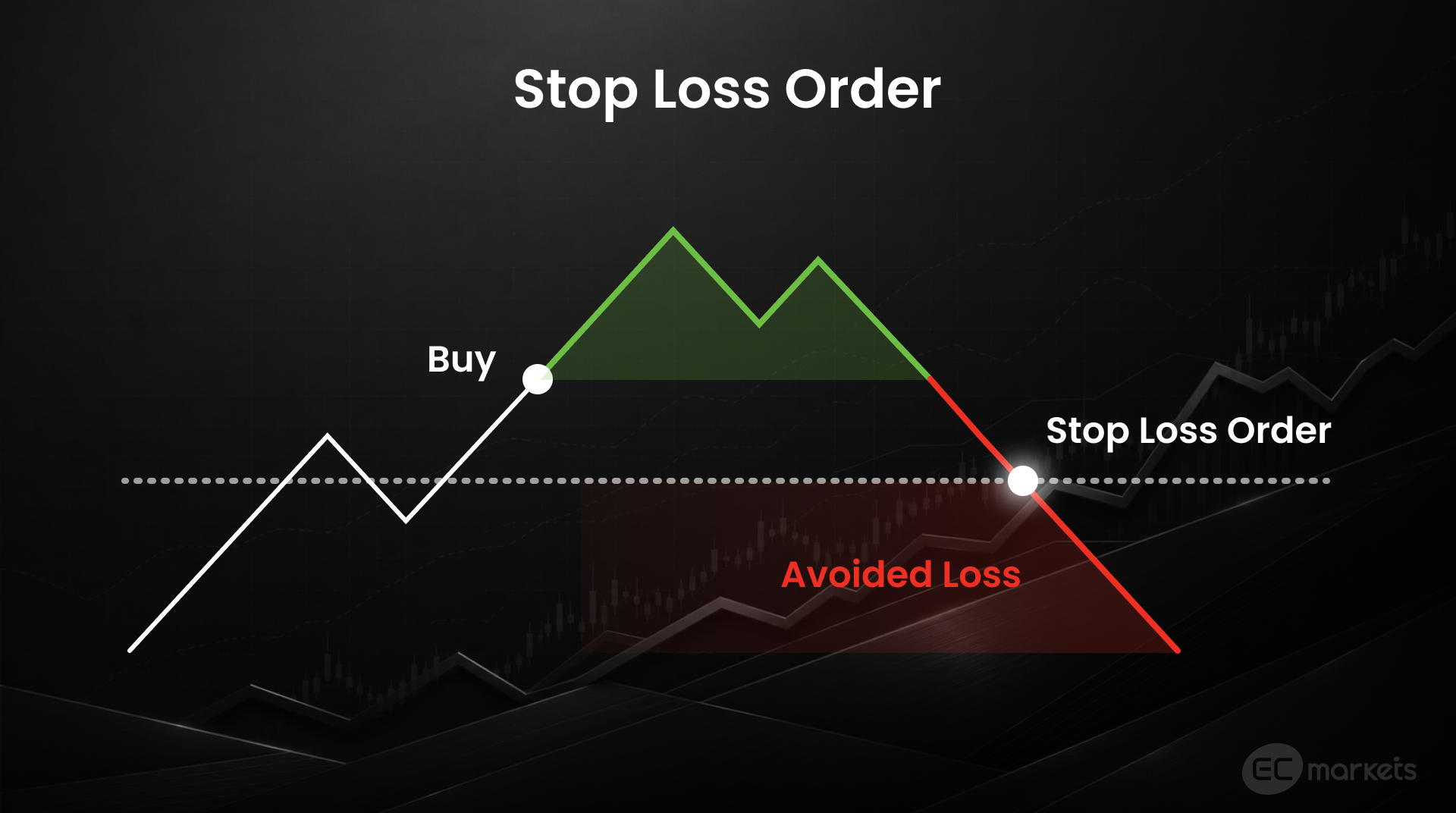
Stop loss orders are used to put a limit on losses if a trade goes badly. Traders will define their maximum acceptable loss per trade and place a stop loss order at their defined distance from the current price in the unfavourable direction. That way if price moves against the trader's current position and touches the stop level, a market order will be triggered to close the trade before further losses can be incurred (note that slippage can cause losses to exceed the planned amount).
- In a long position, place the stop loss order below the current market price.
- In a short position, place the stop loss order above the current market price.
Tip: Price often moves against a position and it is a risk that all traders must plan for in advance. Without something as simple as a stop loss order in place, traders leave themselves vulnerable to their emotions when they see their trade going negative. Stop loss orders are not optional – they are a crucial form of risk management that is key for long-term survival in the market.
Trailing Stop Loss
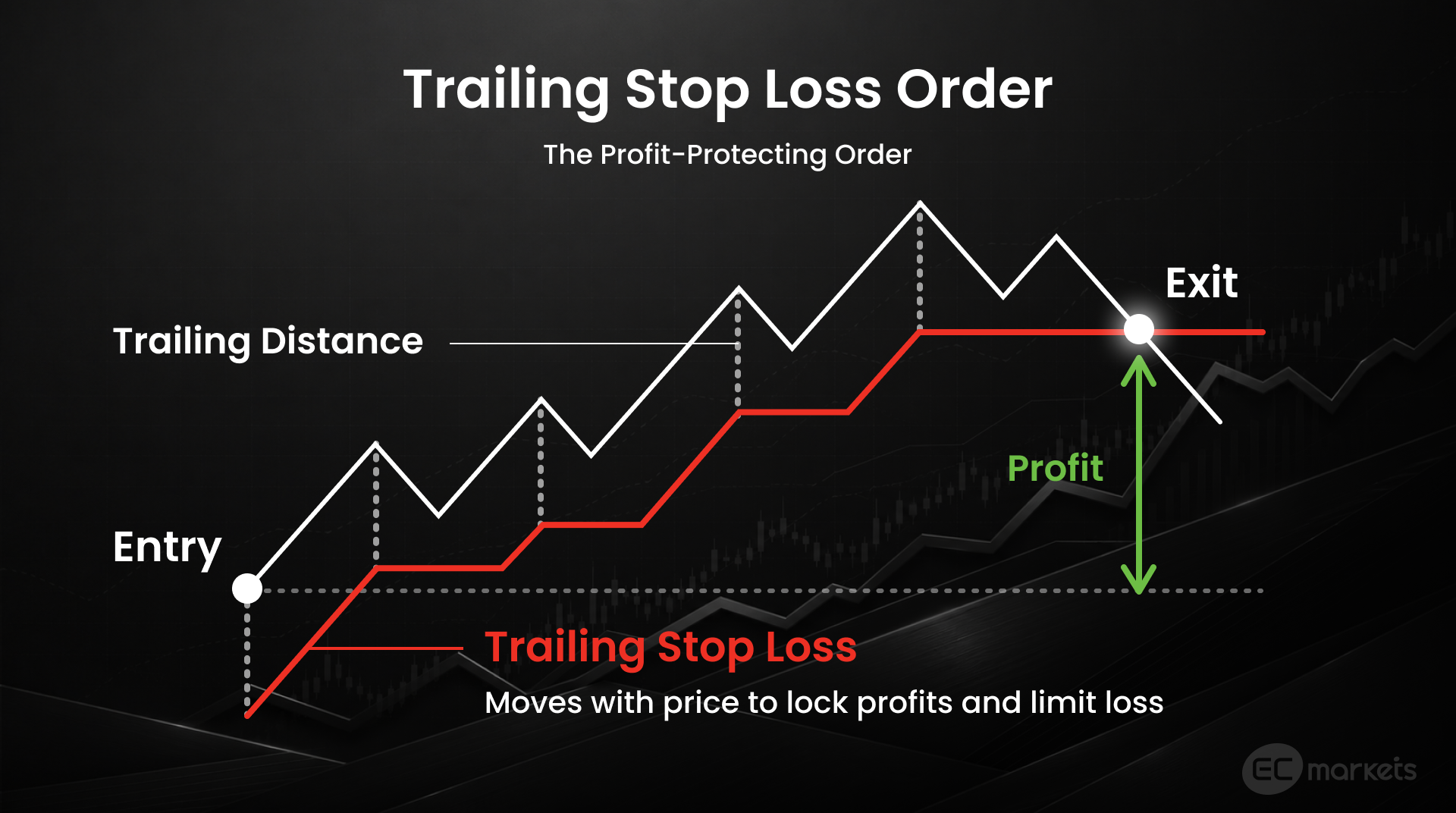
Rather than setting a fixed profit target, trailing stop loss orders are a type of stop loss that trails behind the price at a set distance to lock in profits as long as the market moves favourably. If the market moves in the unfavourable direction, a trailing stop loss will not move, and if price touches it, a market order will be triggered to close the position. This is especially useful for trend traders as a strong trend can run a lot further than an initial target, and it works for both longs and shorts.
The tricky part of trailing stop loss orders is how far to set the trailing distance. Make it too small and normal market fluctuations will kick the trader out of good trades early. If it's too far, a large portion of the gains can be lost when the trend eventually exhausts itself.
What is a Take Profit Order?
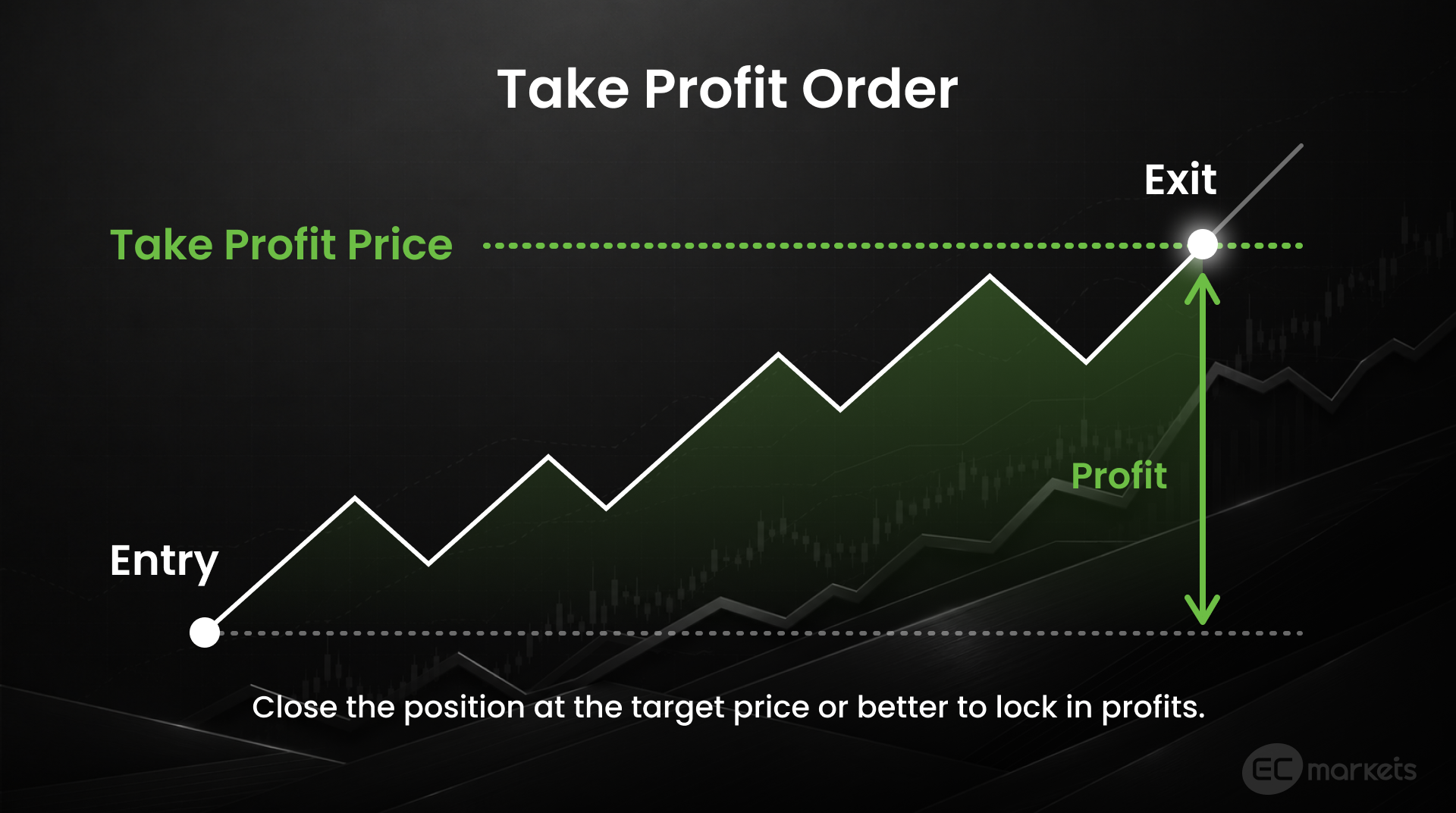
A ‘Take Profit Order’ is not necessarily an order type; rather it describes an order’s purpose: closing a position at a chosen profit target. These are different to stop loss orders as the focus is purely on securing wins as opposed to protecting against losses. Take-profits usually come in the form of an exit limit order, though some platforms use a triggered market order. Exact execution depends on the broker’s mechanics, the instrument being traded and market conditions.
- Long positions: the take profit sits above the entry price.
- Short positions: the take profit sits below the entry price.
Why do experienced traders still use take profit orders? Because they help remove greed from the equation. Without a preset target, a trader may sit there watching profits grow, hoping for more, only to watch them evaporate when the market turns. Take profits set an exit at chosen targets, such as logical structural levels, instead of letting emotions dictate when winners are closed.
Best Times to Use a Limit Order vs Stop Order
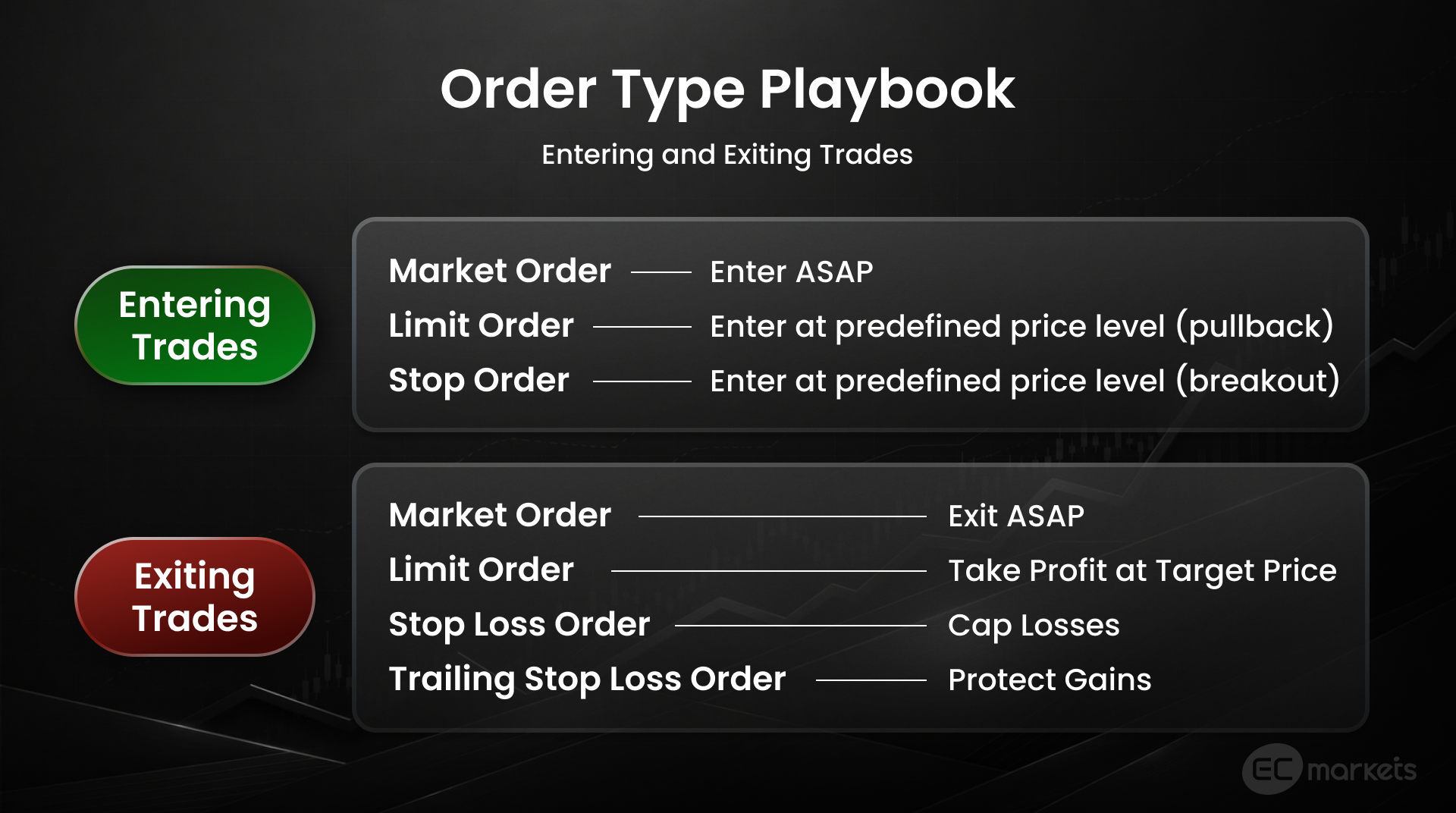
To navigate the market with institutional precision, the order type must match the strategic goal. Below is a playbook for for every limit order vs stop order decision.
For entries:
- Need in immediately? Use a market order.
- Why? A market order is best for fast moves where waiting is not an option, but traders must accept the slippage.
- Why? A market order is best for fast moves where waiting is not an option, but traders must accept the slippage.
- Want a guaranteed price? Use a limit order.
- Why? Limit orders are best for buying at support or selling at resistance. The specified price is guaranteed and the trade will not fill if price never makes it there.
- Why? Limit orders are best for buying at support or selling at resistance. The specified price is guaranteed and the trade will not fill if price never makes it there.
- Want confirmation? Use a stop order.
- Why? A stop order is best for breakouts. The trade only triggers once the market proves its momentum by hitting a specific level.
For exits:
- Need to protect capital? Use a stop loss order.
- Why? A non-negotiable stop loss order will automatically close the trade if the logic is proven wrong.
- Why? A non-negotiable stop loss order will automatically close the trade if the logic is proven wrong.
- Reached the goal? Take profit using a limit order.
- Why? Limit orders ensure the position is closed at the target price or better.
- Why? Limit orders ensure the position is closed at the target price or better.
- Riding a massive trend? Use a trailing stop loss order.
- Why? Trailing stop losses acts as a dynamic guardrail that follows the price to lock in gains without capping the upside.
Limit Order vs Stop Order in a Nutshell
Choosing the right order type starts with a clear plan for entering and exiting a trade. For entries, the limit order vs stop order decision comes down to prioritising price accuracy or prioritising immediate execution. For exits, a stop loss order helps manage downside, a take profit instruction sets a profit target, and a trailing stop follows favourable price movement. Planning for both sides of the trade is a key part of disciplined trading. That way, the thinking is already done, and all that’s needed is to follow the plan.
Note:
This content is for general information and educational purposes only and does not constitute investment advice or a personal recommendation. Any examples are for illustration only and should not be treated as a signal or invitation to trade. This material does not take into account your investment objectives, financial situation or needs. CFD trading is high-risk; losses may exceed deposits.