











AI Stocks Plunge as Global Markets Suffer Sharp Sell-Off | Weekly Recap: 16-20 November 2026


The global stock market sell-off reflected growing concerns over AI valuations and the outlook for interest rates.
Global equity markets suffered a sharp sell-off during the week of 16–20 November, with losses spreading across every major region and sector tracked. The Nasdaq Composite plunged 10%, while the S&P 500 recorded its steepest weekly decline since April 2025.
At the centre of the turmoil was artificial intelligence. Nvidia reported exceptional revenue growth and stronger-than-expected guidance, yet its shares continued to fall as investors reassessed AI valuations and future investment returns.
Meanwhile, expectations of further Federal Reserve interest-rate increases added to market uncertainty. Government bond yields declined as investors sought safer assets, while gold and oil also recorded substantial losses.
Economic Overview
Economic data painted a mixed picture of global growth, but the prospect of further monetary tightening remained a major concern for investors.
US Economic Data Sends Mixed Signals
US consumer spending remained resilient, with core retail sales rising 0.6%, exceeding expectations of 0.4%. This measure excludes motor vehicles, petrol, building materials and restaurants, providing an indication of underlying consumer spending.
Industrial activity was weaker. US industrial production declined 0.4%, against expectations of a modest increase, suggesting softer conditions in the manufacturing sector.
The Federal Reserve’s October meeting minutes added to concerns about the interest-rate outlook. Released on Wednesday, they showed that almost all policymakers considered further rate increases likely to be appropriate. Some also raised the possibility of a larger increase if inflation remained unfavourable.
With the Fed’s next decision scheduled for 9 December, investors faced the prospect of higher borrowing costs even as equity markets came under pressure.
Asian Economic Growth Disappoints
Economic weakness was also evident in Asia.
Japan’s economy contracted in the third quarter, surprising economists who had expected growth.
In China, October retail sales increased just 0.4% year on year, below the 0.8% forecast. Industrial production and investment also disappointed, adding to concerns about domestic demand and economic activity.
UK Inflation Edges Higher
UK economic data offered a more mixed picture.
Unemployment declined to 4.6%, better than the 4.7% expected, suggesting some resilience in the labour market.
However, annual inflation increased to 3.6% from 3.5%, driven partly by higher fuel prices. The figures reinforced the challenge facing the Bank of England as it balances persistent inflation against the outlook for economic growth.
Equities, Bonds and Commodities
Global financial markets experienced widespread selling pressure, with concerns surrounding AI valuations extending beyond technology shares into broader equity markets.
Equities
Global equities declined for seven consecutive sessions, their longest losing streak since September 2023, according to Bloomberg.
In the US, the S&P 500 fell 8.6% to 6,910.39, recording its steepest weekly decline since April 2025. The Nasdaq Composite plunged 10.0%, its largest weekly fall since March 2020, while the Dow Jones Industrial Average declined 8.0%.
Both the S&P 500 and Dow finished the week in correction territory, having fallen more than 10% from their previous record highs.
One of the week’s most striking developments came from Nvidia. The chipmaker reported quarterly revenue of US$115.8 billion, up 103% year on year, alongside stronger-than-expected guidance.
Despite these results, Nvidia shares fell 22.9% over the week, including a 14.0% decline on Friday. The reaction highlighted growing concerns about AI valuations and whether the scale of investment in AI infrastructure can continue to deliver the returns investors expect.
Anthropic’s stock market debut on Thursday added another major development to the AI sector. According to CNBC, the listing encouraged some investors to take profits from the AI rally rather than extend it.
The sell-off extended beyond US markets. The STOXX Europe 600 declined 5.8%, recording its weakest week since March, while the FTSE 100 fell 5.1%. In Asia, Japan’s Nikkei 225 lost 7.7%.
The widespread losses suggested that concerns initially concentrated in AI-related companies were affecting global equity markets more broadly.
Bonds
Government bonds attracted demand as investors reduced exposure to riskier assets.
The US 10-year Treasury yield declined from approximately 5.15% to 4.92% during the week.
Bond prices and yields generally move in opposite directions. As demand for government bonds increases, their prices rise and their yields fall.
The decline in yields contrasted with expectations of further Federal Reserve tightening, highlighting how concerns about equity markets and economic growth were influencing investor behaviour.
Commodities
Brent crude settled at US$92.57 per barrel, falling approximately 3.41% over the week as concerns about supply and global demand continued to weigh on oil prices.
Gold also experienced a sharp decline despite widespread equity market weakness.
Spot gold fell 8.9% to US$3,538.11 per ounce, its steepest weekly loss since March.
Expectations of further Fed rate increases and a firm US dollar weighed on the precious metal, demonstrating that gold does not always benefit from periods of market uncertainty.
Sector Performance
No sector escaped, although defensive industries held up relatively better than technology-related shares.
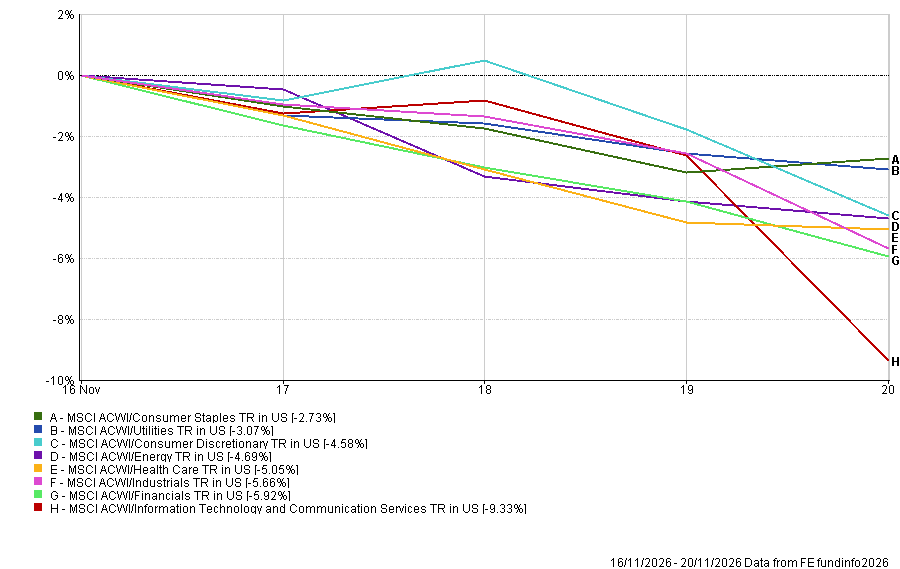
Consumer Staples was the strongest-performing sector despite falling 2.73%. Businesses selling everyday essentials, including food and household products, tend to experience more stable demand during periods of economic uncertainty.
Utilities followed with a 3.07% decline, also outperforming the wider market.
Consumer Discretionary fell 4.58%, while Energy declined 4.69%. Health Care lost 5.05%, Industrials dropped 5.66% and Financials fell 5.92%.
The largest losses were concentrated in Information Technology and Communication Services, which plunged 9.33%.
That was more than three times the decline recorded by Consumer Staples, illustrating how concerns surrounding AI investment and technology valuations shaped sector performance.
Sector Performance 16-20th November, 2026
Source: FE Analytics. All indices total return in USD. Past performance is not a reliable indicator of future performance. Data as of 20 November 2026.
Regional Markets
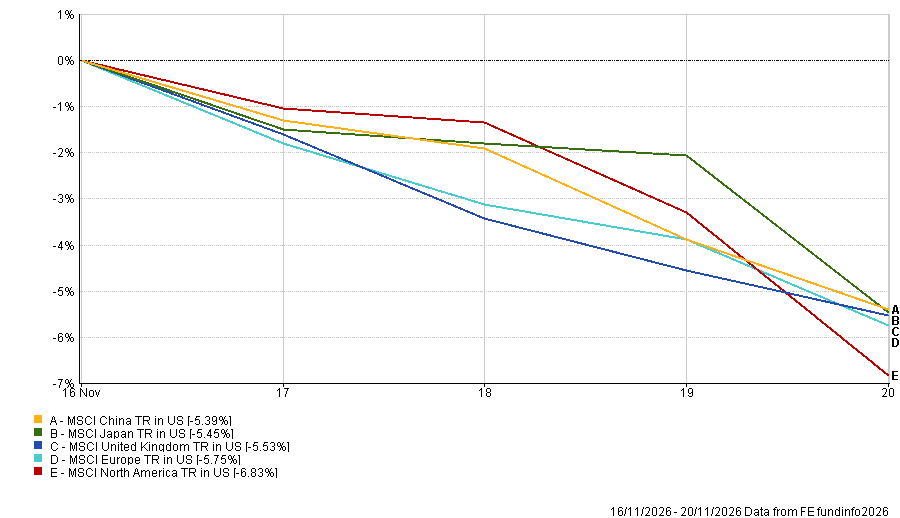
There was nowhere to hide. China fell 5.39%, the best result of the five regions, followed by Japan at 5.45% and the UK at 5.53%. Europe lost 5.75%, while North America was the weakest, down 6.83%.
Why do these look smaller than the S&P 500’s 8.6% fall? The charts start from Monday’s close, so they leave out Monday’s drop.
Regional Performance 16-20th November, 2026
Source: FE Analytics. All indices total return in USD. Past performance is not a reliable indicator of future performance. Data as of 20 November 2026.
Currency Markets
The US dollar strengthened against the euro and sterling but weakened against the Japanese yen, which benefited from increased demand as investors sought safer assets during the equity sell-off.
Comparing Monday’s opening levels with Friday’s closing levels:
EUR/USD 1.1033 → 1.0968: The euro weakened against the dollar as expectations of further Fed tightening supported the US currency.
GBP/USD 1.3219 → 1.3083: Sterling declined amid persistent UK inflation concerns and broader dollar strength.
USD/JPY 159.64 → 158.54: The yen strengthened against the dollar as investors sought relatively safer assets during the market sell-off.
GBP/JPY 211.08 → 207.41: Sterling weakened more sharply against the yen, reflecting increased demand for the Japanese currency.
Overall, the yen’s strength stood out against the broader backdrop of dollar resilience, highlighting how changing risk sentiment influenced currency markets.
Outlook and The Week Ahead
Following one of the sharpest global equity sell-offs in recent months, investors will be watching closely for signs that market conditions are stabilising.
The week of 23-27 November brings important inflation, growth and business activity data, although the US Thanksgiving holiday will shorten the trading week.
Key events include:
- Monday: Flash purchasing managers’ indices (PMIs) for the euro area, UK and US will provide early indications of November business activity. Japanese markets will be closed for a public holiday.
- Tuesday: Germany’s Ifo Business Climate Index and the US Conference Board Consumer Confidence Index will offer insight into business and household sentiment.
- Wednesday: The second estimate of US third-quarter GDP and October’s Personal Income and Outlays report, which includes the Personal Consumption Expenditures (PCE) Price Index, the Fed’s preferred inflation measure.
- Thursday: US markets will be closed for Thanksgiving. The Bank of England publishes its Financial Stability Report, while the European Central Bank releases the account of its October monetary policy meeting.
- Friday: US stock markets will close early at 1:00 pm New York time. Tokyo inflation figures and China’s industrial profits data will provide further insight into Asian economic conditions.
Wednesday’s PCE inflation report will be particularly important for interest-rate expectations.
With markets anticipating another Fed rate increase in December, stronger-than-expected inflation could reinforce expectations of tighter monetary policy, potentially adding pressure to equities and supporting the dollar. A softer reading could ease some of those concerns.
Investors will also be watching whether the selling pressure in AI-related stocks begins to stabilise or continues spreading across other sectors.
The coming week will test whether global equities can regain their footing, or whether persistent inflation and concerns surrounding AI valuations will keep investors cautious ahead of the Fed’s December decision.