

Inflation Pressures Rise as Nvidia Shake-Up Weighs on Tech | Weekly Recap: 9-13 November 2026


Global markets navigated another week of persistent inflation, rising bond yields and uncertainty surrounding artificial intelligence. Stronger-than-expected US consumer prices reinforced expectations of further Federal Reserve tightening, while Nvidia’s leadership change weighed on technology shares.
Despite Friday’s losses, major US and European equity indices finished the week higher. Meanwhile, oil and gold declined, and the US dollar strengthened against major currencies.
Economic Overview
Inflation data and changing interest-rate expectations shaped markets during the week, with developments across the US, UK, Europe and China offering further insight into the global economic outlook.
US Inflation Strengthens Rate Hike Expectations
US consumer prices rose 0.4% in October after increasing 0.6% in September, exceeding the 0.3% forecast. Core inflation, which excludes food and energy, rose 0.3%.
Annual comparisons for most CPI measures were unavailable because the 2025 government shutdown prevented the collection of comparable data in October of that year.
Federal Reserve Governor Christopher Waller had said before the release that a half-point rate increase should be considered if core inflation reached 0.3% or higher. Following the report, markets fully priced in a quarter-point increase in December, while assigning a smaller probability to a half-point move.
Producer prices rose 0.3% in October and 6.5% from a year earlier. The annual increase was the largest since November 2022, although the monthly figure was slightly below expectations.
Together, the releases reinforced concerns that inflation pressures could keep US interest rates elevated.
UK and European Growth Remains Resilient
UK GDP increased 0.7% in the third quarter, following 0.5% growth in the second. Services expanded 0.9%, while construction output declined. The economy also grew 0.2% in September.
The figures suggested that the Bank of England may need to raise rates again after increasing Bank Rate to 4.00% earlier in November.
Euro area GDP grew 0.4% in the third quarter, compared with 0.6% in the second, while employment was unchanged from the previous quarter.
China Faces Weak Consumer Demand
China’s consumer inflation eased to 0.7% in October from 0.9% in September, reflecting subdued household demand.
Producer prices increased 5.7% year on year, their fastest pace since June 2022, as higher global energy costs increased pressure on manufacturers.
Overall, economic growth remained resilient, but persistent inflation and elevated energy costs strengthened expectations that major central banks would maintain restrictive monetary policies or raise rates further.
Equities, Bonds and Commodities
US equities recorded weekly gains despite a weaker finish, while rising Treasury yields and a stronger dollar weighed on commodities.
Equities
US equities gained over the week despite falling on Friday. The S&P 500 rose 2.5%, the Nasdaq Composite gained 2.3% and the Dow Jones Industrial Average advanced 2.1%.
Technology shares came under pressure late in the week following the resignation of Nvidia chief executive Jensen Huang, which increased uncertainty surrounding one of the largest companies associated with artificial intelligence.
Nvidia shares fell approximately 12.8% over the week. On Friday, the S&P 500 declined 0.4% and the Nasdaq fell 0.9%, while the Dow edged 0.1% higher.
European equities outperformed. The STOXX Europe 600 gained 2.44% to finish at a record high, while the FTSE 100 rose 2.14%.
Europe’s lower exposure to AI-related shares, strong corporate results and demand for insurers, oil producers and defensive companies supported the advance.
Bonds
Government bond yields increased as inflation data strengthened expectations for further policy tightening.
The US 10-year Treasury yield ended near 5.15%, approximately 29 basis points higher over the week. The two-year yield, which is particularly sensitive to interest-rate expectations, rose around 37 basis points to 4.88%.
Higher yields reflected investors’ reassessment of how far the Federal Reserve may need to tighten monetary policy.
Commodities
Brent crude settled at US$95.84 per barrel on Friday, falling approximately 2.5% over the week.
Concerns about excess supply and reduced immediate geopolitical risk outweighed uncertainty surrounding Middle Eastern energy infrastructure.
Gold futures also declined sharply, closing near US$3,880 per ounce and losing more than 4% over the week.
Higher bond yields, a stronger US dollar and expectations of tighter Federal Reserve policy reduced demand for the non-interest-paying metal.
Sector Performance
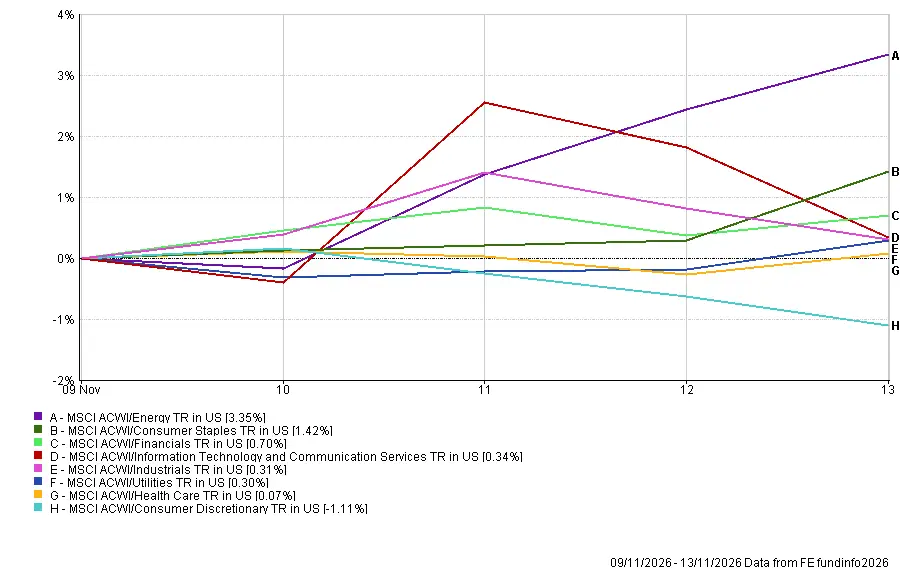
Energy led global sector gains despite a decline in crude oil prices, while Consumer Discretionary was the only sector to finish the week lower.
The MSCI ACWI Energy TR in US dollars gained 3.35%, supported by oil prices remaining elevated despite their weekly decline. Consumer Staples rose 1.42%, reflecting relatively stronger performance among businesses with more stable demand, while Financials gained 0.70% amid higher bond yields.
Information Technology & Communication Services advanced 0.34% despite the uncertainty surrounding Nvidia. Industrials gained 0.31%, Utilities rose 0.30% and Healthcare edged up 0.07%.
Consumer Discretionary was the weakest sector, falling 1.11%, as it underperformed the broader market.
Sector Performance 9-13th November, 2026
Source: FE Analytics. All indices total return in USD. Past performance is not a reliable indicator of future performance. Data as of 13 November 2026.
Regional Markets
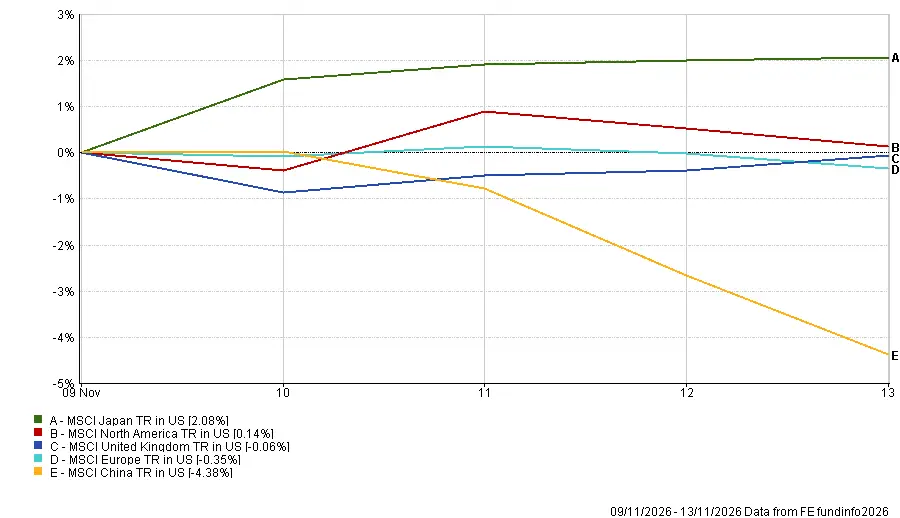
Japan led regional performance, while China recorded the steepest losses as concerns surrounding technology restrictions added to signs of weaker domestic demand.
The MSCI Japan TR in US dollars gained 2.08%, making it the strongest regional index. North America followed with a modest gain of 0.14%.
The MSCI United Kingdom TR in US dollars declined 0.06%, while MSCI Europe fell 0.35%. These returns differed from the gains recorded by local European and UK indices, partly because the euro and sterling weakened against the US dollar.
China was the weakest region, with the MSCI China TR in US dollars falling 4.38%.
Developments surrounding Nvidia raised concerns that Chinese cloud companies could face tighter US restrictions on access to advanced chips. Alibaba fell approximately 7% on Thursday, while weak consumer inflation reinforced concerns about subdued domestic demand.
Regional Performance November9-13th, 2026
Source: FE Analytics. All indices total return in USD. Past performance is not a reliable indicator of future performance. Data as of 13 November 2026.
Currency Markets
The US dollar strengthened against the euro, sterling and yen as higher inflation and rising Treasury yields reinforced expectations of further Federal Reserve tightening.
Comparing Monday’s opening levels with Friday’s closing levels:
- EUR/USD 1.1138 → 1.1023: The euro weakened against the dollar as US interest-rate expectations strengthened.
- GBP/USD 1.3361 → 1.3217: Sterling declined despite stronger UK GDP figures, as dollar strength outweighed support from domestic economic data.
- USD/JPY 158.36 → 159.69: The yen weakened against the dollar amid rising US bond yields.
- GBP/JPY 211.73 → 211.05: Sterling weakened against the yen, with the pound’s decline outweighing the Japanese currency’s losses against the dollar.
Overall, the dollar gained across all three major currency pairs, supported by expectations that US interest rates could remain higher for longer.
Outlook and The Week Ahead
The week of 16-20 November brings further economic releases and corporate developments, with Federal Reserve policy and the outlook for AI investment remaining central to market sentiment.
Key events include:
- Monday: China’s industrial production, retail sales and investment figures, following Japan’s preliminary third-quarter GDP release.
- Tuesday: US retail sales and industrial production, alongside UK labour market figures. Nvidia reports quarterly results after the US market closes.
- Wednesday: UK inflation figures and the minutes of the Federal Reserve’s October meeting.
- Friday: UK retail sales, with Japanese inflation data also due during the latter part of the week.
Investors will examine the Fed minutes for evidence of support for further rate increases, although the meeting took place before the latest US inflation data.
Nvidia’s results will also be closely watched for evidence of demand for AI chips and spending by major customers, particularly following the company’s leadership change.
UK inflation and employment figures will help markets assess whether the Bank of England may need to raise rates again, while economic data from China and Japan will provide further insight into conditions across Asia.
With inflation keeping pressure on interest rates and Nvidia’s results approaching, the coming week will test whether equity markets can maintain their gains despite higher borrowing costs and uncertainty surrounding AI investment.