














Higher Oil Prices Keep Markets on Edge | Weekly Market Recap: 20-24 July 2026


Financial markets adopted a more cautious tone this week as rising energy prices reignited inflation concerns, offsetting encouraging signs that global economic activity remains resilient. While economic data from the United States, Europe and the United Kingdom pointed to continued growth, investors questioned whether central banks will be able to begin easing interest rates as quickly as previously anticipated.
Brent crude briefly climbed above US$100 per barrel, pushing inflation back into focus and encouraging a more selective approach to risk. As bond yields moved higher and policymakers maintained a cautious stance, investors increasingly favoured companies with resilient earnings while reducing exposure to areas of the market more vulnerable to higher borrowing costs.
Economic Overview
Financial markets spent the week balancing resilient economic growth against renewed concerns that higher energy prices could slow recent progress on inflation. While economic data suggested activity remained relatively robust across the major economies, escalating tensions in the Middle East pushed oil prices sharply higher, prompting investors to reassess how quickly central banks will be able to begin easing monetary policy.
The European Central Bank left interest rates unchanged as expected, reinforcing its data-dependent approach while acknowledging that inflation risks remain. The deposit facility rate was maintained at 2.25%, the main refinancing operations rate at 2.40% and the marginal lending facility rate at 2.65%. Higher energy prices reinforced expectations that policymakers may keep interest rates restrictive for longer should inflationary pressures persist.
Economic data remained broadly supportive. In the United States, July flash PMI surveys showed business activity continuing to expand, while Germany’s private sector returned to modest growth and the United Kingdom’s retail sales rebounded more strongly than expected. China presented a more mixed picture, with policymakers maintaining an accommodative stance while weak domestic demand and continued pressure in the property sector weighed on investor confidence.
Overall, global markets adopted a more selective tone, favouring companies with resilient earnings while remaining cautious towards sectors more exposed to higher borrowing costs.
Equities, Bonds and Commodities
Global equity markets delivered mixed performance as investors balanced encouraging economic data against higher bond yields, rising oil prices and another busy week of corporate earnings. In the United States, the technology-led rally lost momentum as investors reassessed whether substantial investment in artificial intelligence will continue to justify elevated valuations. The S&P 500 declined around 0.6%, while the Nasdaq Composite fell approximately 2.1%. The Dow Jones Industrial Average also moved lower, although losses were more modest as investors rotated towards companies with more stable earnings.
European equities proved more resilient. The STOXX Europe 600 posted a modest weekly gain, while the FTSE 100 outperformed many of its regional peers, benefiting from its greater exposure to energy, mining and financial companies.
Asian markets were mixed. Japanese equities benefited from continued weakness in the yen, while Chinese markets remained under pressure as investors monitored domestic demand and the pace of economic recovery.
Bond markets reflected renewed caution around the inflation outlook. US Treasury yields moved higher as investors reduced expectations for near-term interest rate cuts, while German Bund and UK gilt yields also rose following the ECB’s cautious policy message.
Commodity markets were dominated by developments in oil. Brent crude briefly traded above US$100 per barrel before easing to finish the week at US$96.78 per barrel. Gold ended the week close to US$4,048 per ounce as geopolitical uncertainty supported safe-haven demand, although higher bond yields limited stronger gains.
Sector Performance
The FE Analytics sector data showed investors favouring sectors expected to benefit from firmer commodity prices.
Energy delivered the strongest return, rising 3.22% as higher oil prices improved the outlook for producers. Industrials gained 2.19%, Utilities advanced 1.85% and Healthcare rose 1.62% as investors favoured more defensive sectors.
Financials rose 0.99%, supported by higher government bond yields, while Information Technology and Communication Services both gained 0.59%. Although confidence in the long-term outlook for artificial intelligence remained intact, investors became more selective towards highly valued technology companies.
Consumer-facing sectors underperformed. Consumer Staples declined 1.44%, while Consumer Discretionary fell 4.68% as higher energy costs and borrowing costs weighed on sentiment.
Sector Performance July 20th – 24th 2026
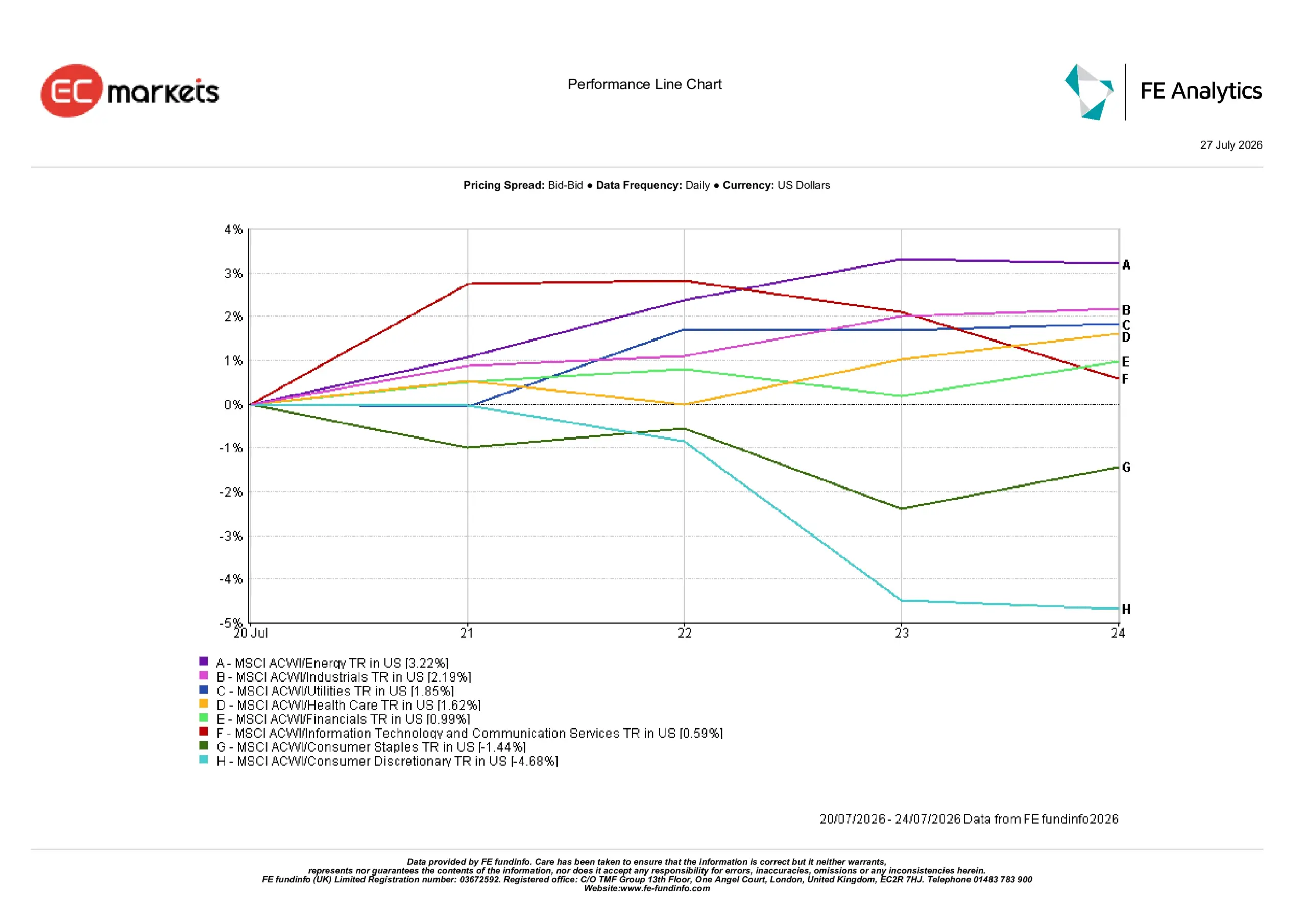
Sector performance for the week of 20-24 July 2026, led by Energy and Industrials, while Consumer Discretionary recorded the largest decline.
Regional Markets
Regional performance reflected increasingly selective investor positioning.
Japan delivered the strongest return, rising 1.79% in US dollar terms as continued weakness in the yen supported export-oriented companies.
The United Kingdom gained 1.34%, benefiting from its exposure to energy, mining and financial companies, while stronger retail sales also supported sentiment.
Europe advanced 0.53% as improving business activity helped offset concerns surrounding higher energy prices. North America declined 0.37% as weakness among large-cap technology companies outweighed gains elsewhere, while China fell 1.84% as concerns surrounding domestic demand and the property sector continued to weigh on investor confidence.
Regional Sector Performance July 20th – 24th 2026
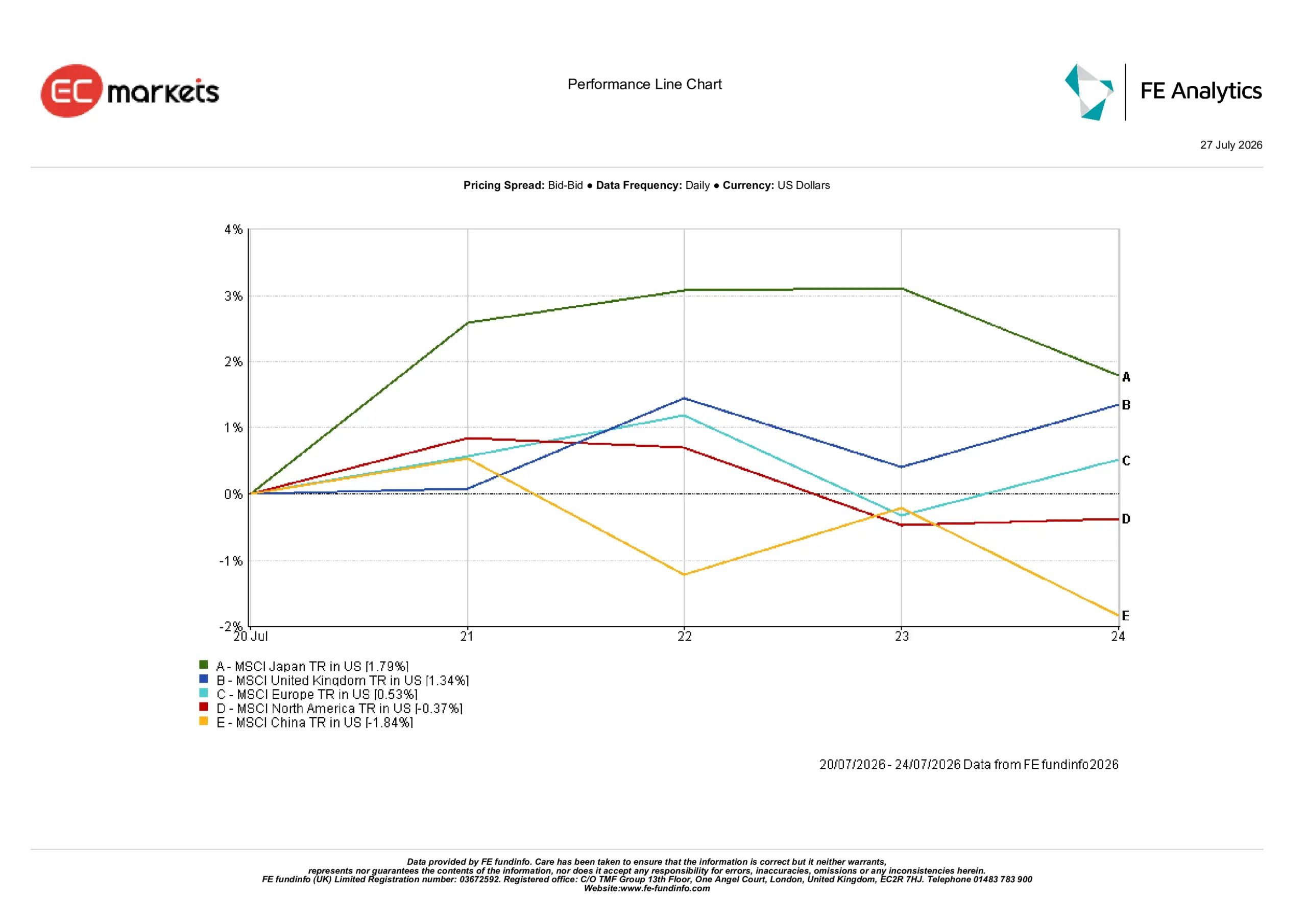
Source: FE Analytics. All indices total return in USD. Past performance is not a reliable indicator of future performance. Data as of 24 July 2026.
Currency Markets
Currency markets continued to reflect differences in monetary policy expectations.
The euro weakened against the US dollar, with EUR/USD moving from 1.1434 to 1.1368, while GBP/USD fell from 1.3452 to 1.3324 as broad US dollar strength outweighed stronger UK economic data.
USD/JPY rose from 162.45 to 163.85, reflecting the continued divergence between US and Japanese interest rate expectations. GBP/JPY edged lower from 218.57 to 218.31 as sterling softened while the yen remained under pressure.
Outlook and The Week Ahead
Attention now turns to the Federal Reserve’s latest policy decision, together with comments from Chair Jerome Powell, for further guidance on the outlook for interest rates.
Markets will also focus on US second-quarter GDP, Core PCE inflation and the Employment Cost Index. In Europe, preliminary inflation data will be closely monitored following the ECB’s latest policy meeting, while the Bank of Japan will remain in focus as investors assess the outlook for monetary policy.
Corporate earnings will continue to influence market sentiment, particularly among large technology companies, where investors are looking for evidence that artificial intelligence investment can continue to support earnings growth.
For now, markets continue to favour a more selective approach to risk, with investors remaining supportive of companies with resilient earnings while staying cautious towards areas more exposed to higher interest rates and elevated energy prices.