













Gold and the Dollar: When Opposites Start Moving Together


The relationship between gold and the US dollar is one of the most closely watched dynamics in global markets. While the two assets have historically moved in opposite directions, that relationship is not always consistent. At times, gold and the dollar can rise together or fall together, reflecting broader macroeconomic forces beyond currency movements alone.
Understanding when these correlations strengthen or weaken can help traders better interpret market sentiment and identify potential shifts in price behaviour.
Why the Relationship Matters
Gold and the US dollar are often viewed as natural opposites.
Because gold is priced in US dollars globally, a stronger greenback typically makes the metal more expensive for buyers using foreign currencies. This mechanism tends to dampen international demand. Conversely, when the dollar weakens, gold becomes cheaper abroad and demand usually rises.
Historically, this underlying link means gold and the US Dollar Index (DXY) often move inversely.
However, this inverse relationship is not a mechanical law. Over longer market cycles, both the DXY and gold can rise together or fall together. This occurs because gold responds to a broader set of drivers than currency movements alone.
Traders watch several factors that can temporarily weaken or even reverse the traditional dollar-gold relationship:
- Geopolitical uncertainty, which can increase demand for both assets as safe havens.
- Central-bank buying, which can support gold regardless of currency trends.
- Real interest rates, which often have a stronger influence on gold than the dollar itself.
- Long-term shifts in global reserve allocation and de-dollarisation trends.
Understanding these drivers helps traders recognise when broader macro forces are outweighing the traditional dollar-gold relationship.
Reading the Chart: Recent Price Action
By comparing gold prices directly against the DXY, traders can identify whether the traditional inverse relationship remains intact or whether other forces are influencing market behaviour.
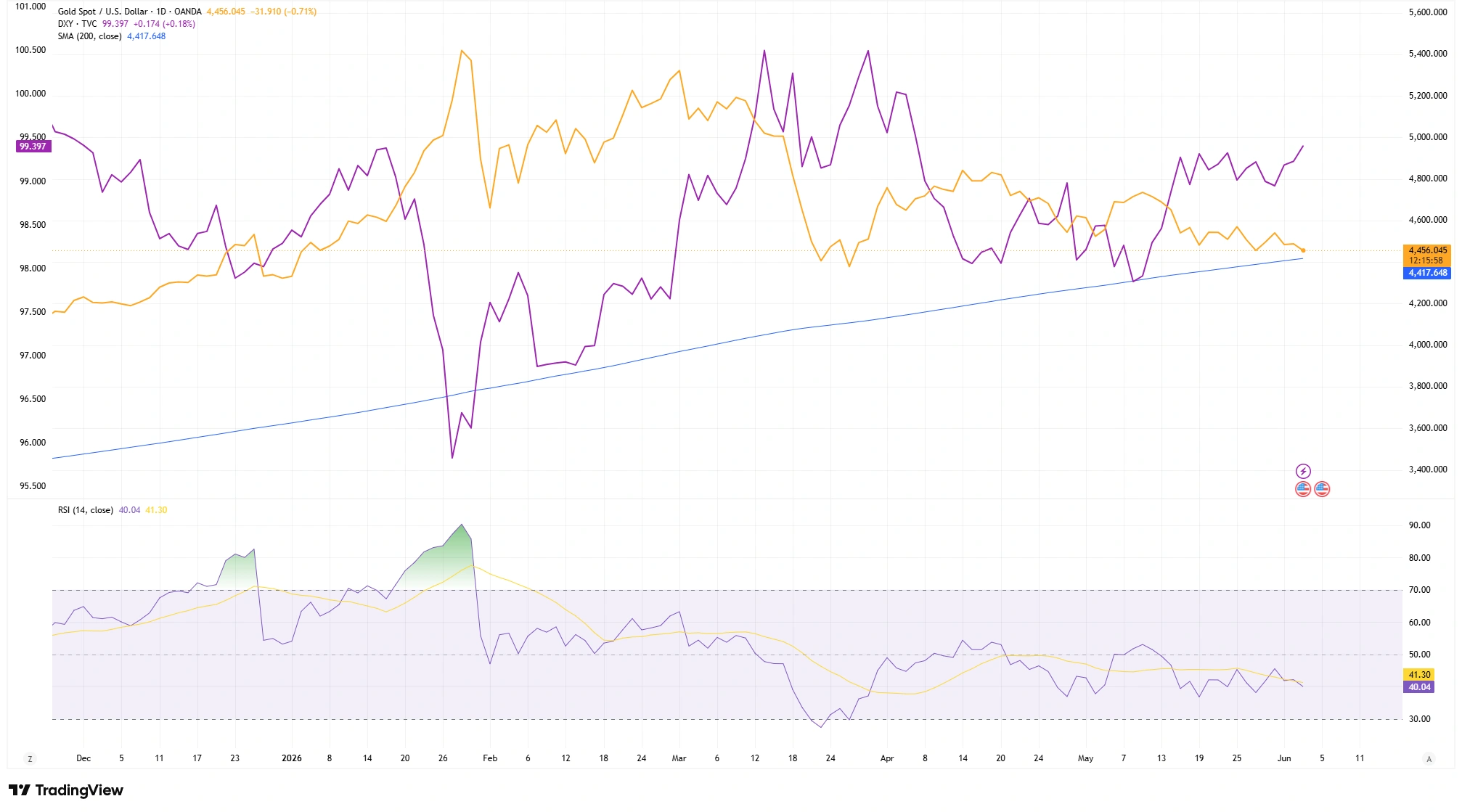
Gold vs DXY Technical Map (June 2026)
- Current DXY Level (Left Scale): 99.355
- Current Gold Spot (Right Scale): $4,456.900/oz
- 200-Period SMA (Gold): $4,417.652
- RSI (14): 40.09
As shown in the chart, the inverse relationship between gold and the US dollar has generally remained visible throughout much of the period, although it has not been perfectly consistent.
During several phases, particularly between January and March, periods of dollar weakness coincided with stronger gold performance. However, there were also stretches where gold remained relatively resilient even as the Dollar Index stabilised or recovered.
This is often where traders become particularly interested.
When gold continues to hold firm despite a stronger or stable dollar, it suggests that additional drivers may be supporting demand. These can include inflation concerns, central-bank purchases, geopolitical uncertainty or broader defensive positioning across financial markets.
Market Structure and Momentum
From a technical perspective, gold continues to trade above its 200-period simple moving average, which currently sits near $4,418 and acts as an important trend-support reference.
While the metal has pulled back from earlier highs, the broader structure remains constructive as long as price continues to hold above this longer-term moving average.
Momentum has also cooled.
The Relative Strength Index (RSI) currently sits near 40, reflecting softer buying pressure compared with earlier rallies.
On its own, this does not necessarily signal a trend reversal. Instead, it suggests that momentum has moderated and the market may be consolidating before establishing its next directional move.
Traders often use RSI alongside price structure rather than in isolation. A bounce from support accompanied by improving momentum can provide greater confidence than relying on an indicator alone.
Gold Spot (XAU/USD) vs US Dollar Index (DXY)
Source: TradingView. Past performance is not a reliable indicator of future performance. Data as of 3 June 2026.
The chart highlights periods where the traditional inverse relationship remained intact, alongside periods where broader macro drivers weakened or temporarily overrode that correlation.
When Correlations Start to Break
One of the biggest mistakes traders make is treating historical correlations as permanent.
In reality, relationships between markets strengthen and weaken over time.
When gold rises as the dollar falls, the traditional inverse relationship remains intact. However, there are periods when both assets move in the same direction.
If gold and the dollar rise together, it often reflects strong defensive demand driven by economic uncertainty or geopolitical risks.
Conversely, if both decline simultaneously, it may suggest improving risk appetite as investors move away from traditional safe-haven assets.
Understanding these shifts helps traders avoid relying too heavily on historical relationships and instead focus on what the market is doing in real time.
Bottom Line
The relationship between gold and the US dollar remains one of the most important intermarket relationships traders monitor.
While a weaker dollar often supports gold, the metal is also influenced by inflation expectations, real interest rates, central-bank activity and broader risk sentiment.
For that reason, traders should focus on how both assets are behaving in real time rather than assuming historical correlations will always persist.
When gold and the dollar begin moving together, it can signal that larger macro forces are shaping market behaviour.
Technical analysis helps provide that context by combining trend structure, momentum and market relationships into a clearer picture of what is driving price action beneath the surface.