













CFD Trading Costs Explained: The True Cost of Trading CFDs


Understanding CFD trading costs is just as important as understanding how markets move. Many new traders focus primarily on whether an individual trade is profitable. However, every CFD trade also involves trading costs that can affect the overall result, regardless of whether the position generates a gain or a loss.
Some trading costs apply when opening or closing a position, while others may apply when a position is held overnight. Although each cost may appear relatively small, they can accumulate over time, particularly for active traders. Understanding these costs provides a clearer picture of what traders should consider when evaluating the true profitability of a CFD trade.
What Are CFD Trading Costs?
Trading costs are the expenses associated with opening, holding and closing a trading position. These costs reduce the overall profit of successful trades and increase the overall loss of unsuccessful ones.
Different brokers apply different pricing structures depending on the financial instrument being traded, so traders should always understand the fees that apply before placing a trade.
Why CFD Trading Costs Matter
Even an advanced trading strategy that generates regular winning trades can produce disappointing overall results if trading costs are consistently overlooked.
For example, a trader who makes frequent trades throughout the day may pay spreads or commissions many times over. Over weeks, months or years, these cumulative costs can have a meaningful impact on overall trading performance.
Understanding trading costs allows traders to evaluate their net trading results more accurately and develop more realistic expectations about potential returns.
The Bid Price and Ask Price
Before understanding trading costs, it is helpful to understand how prices are quoted on a trading platform. Every CFD typically has two prices:
- The bid price is the price at which a trader can sell
- The ask price is the price at which a trader can buy
The difference between these two prices is known as the spread.
Example of Bid Price, Ask Price and Spread
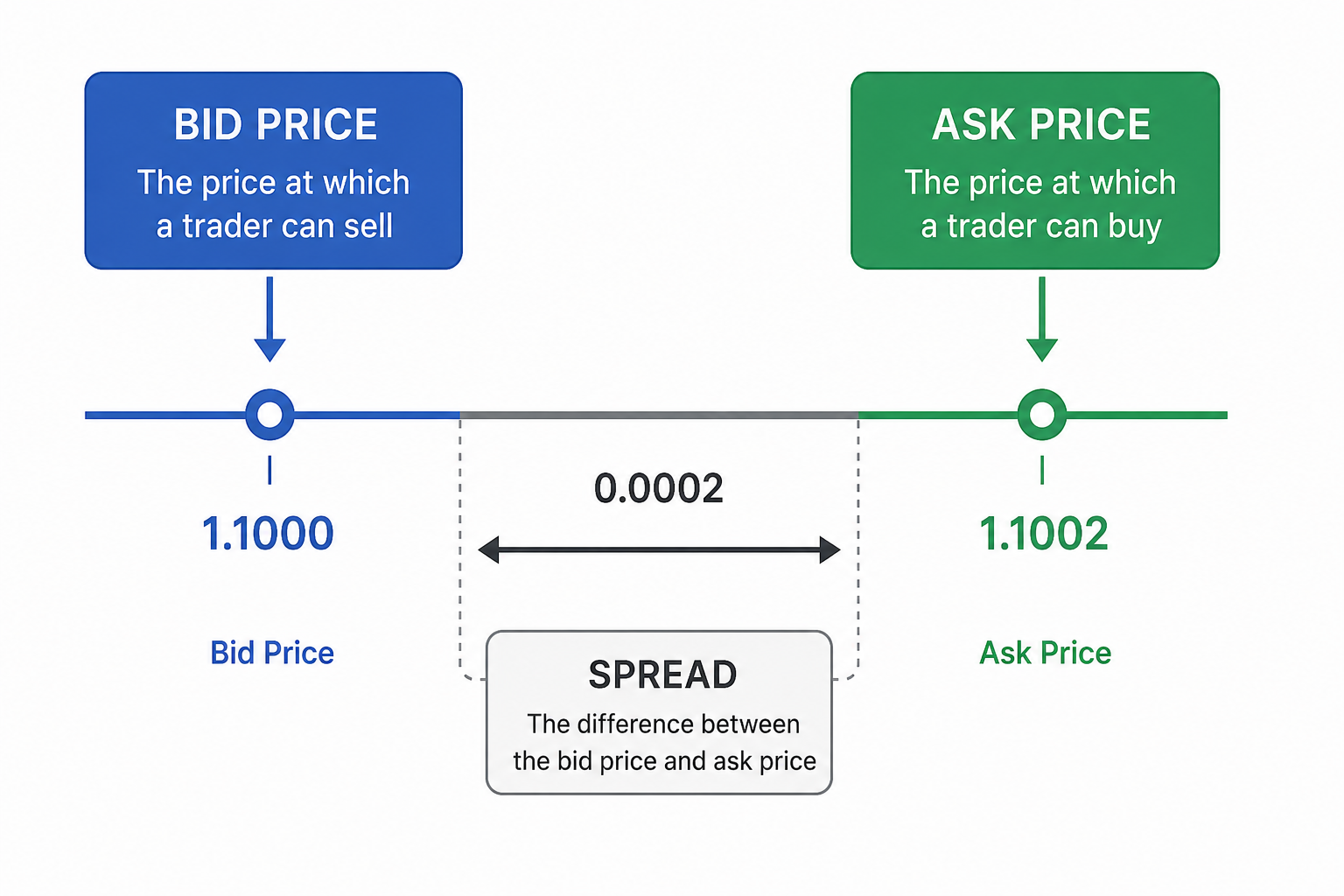
This chart is provided for illustration and educational purposes only and does not represent financial advice, trading recommendations, or actual market signals. Past performance is not a reliable indicator of future performance.
What Is the Spread?
The spread is one of the most common trading costs in CFD markets. When a trader opens a position, they normally buy at the higher ask price and sell at the lower bid price. As a result, every new trade begins with a small difference between the entry price and the current exit price.
This means a position usually needs to move in the trader’s favour by at least the width of the spread before it can become profitable. Spread sizes vary depending on factors such as the financial instrument being traded, market liquidity and current market conditions. During periods of increased volatility or reduced liquidity, spreads may widen, increasing the cost of entering and exiting a position.
What Is Commission?
Some CFD products charge a commission in addition to the standard market spread.
A commission is a separate fee charged by the broker for executing a trade.
Whether commission applies depends on the specific asset class and the broker’s pricing model. Some instruments include the transaction cost primarily within the spread, while others charge both a spread and a commission.
Before placing a trade, it is important to understand which pricing structure applies to the instrument being traded.
What Are Overnight Financing Charges?
CFDs are leveraged financial products. When a leveraged CFD position remains open past the daily market closing time, an overnight financing adjustment may apply.
These adjustments, sometimes referred to as swap or financing charges, reflect the cost of maintaining the leveraged position beyond the trading day. Depending on the position and prevailing interest rates, the adjustment may result in either a charge deducted from the account, or, in some circumstances, a credit added to the account.
For traders who hold positions for longer periods, overnight financing adjustments can become a significant component of total trading costs.
What Is Slippage?
During fast moving markets or major economic news events, trades are not always executed at exactly the requested price. This difference between the expected execution price and the actual execution price is known as slippage.
Slippage can be positive or negative.
- Positive slippage occurs when a trade is executed at a more favourable price than expected.
- Negative slippage occurs when execution takes place at a less favourable price than expected.
Although slippage is not a fee charged by the broker, it can still affect the execution price and may influence the overall trading result.
CFD Trading Costs Example
To see how these individual components interact, imagine a trader opening a leveraged CFD position worth £10,000.
The trading costs are as follows:
- The spread costs £10 when the position is opened
- A commission of £5 is charged when the trade is opened and another £5 is charged when it is closed
- The position is held overnight, resulting in an overnight financing charge of £3
The overall result is:
- Gross Trading Profit: £100
- Less Spread: £10
- Less Commission: £10
- Less Overnight Financing: £3
- Net Trading Profit: £77
Although the market movement generated a gross profit of £100, the trader ultimately retains only £77 after trading costs are deducted. This illustrates why traders should evaluate net trading results rather than focusing only on gross profits.
Net Trading Result = Gross Profit − Total Trading Costs
Bottom Line
Understanding CFD trading costs means looking beyond whether a trade is simply profitable or unprofitable.
Spreads, commissions, overnight financing adjustments and slippage can all influence the overall profitability of a trade.
Understanding the true cost of trading helps traders make more informed decisions, evaluate strategies more accurately and avoid overestimating potential returns. Rather than focusing solely on potential returns, experienced traders consider both the opportunities and the costs associated with every trade, allowing them to compare different trading strategies more effectively and make better informed decisions over the long term.