














What Happens When Credit Markets Start Warning of Trouble?


Most investors focus on stock markets when trying to understand where the economy is heading. Professional investors, however, often pay close attention to a different corner of the financial system first: the credit market.
Because lenders are directly exposed to the risk of not being repaid, credit markets can sometimes identify signs of stress before they appear in company earnings, economic reports or equity prices. As a result, movements in corporate borrowing costs are often viewed as an important signal for broader financial conditions.
Why Investors Watch Corporate Borrowing
Companies raise money in two main ways. They can sell shares to investors, or they can borrow money through loans and bonds. While stock markets tend to receive most of the attention, the borrowing market can provide valuable clues about how investors feel about the economy.
Lenders are usually focused on one question above all else: will they get their money back?
Because of this, they often become cautious sooner than stock market investors when economic conditions start to weaken.
Not all companies borrow at the same cost. Businesses with strong finances can usually borrow more cheaply, while companies with higher levels of debt or weaker financial positions typically have to pay more. The difference between what safer companies pay and what riskier companies pay is one of the most closely watched indicators in financial markets.
When Borrowing Costs Start Rising
When investors become worried about the outlook for the economy, they usually demand higher returns before lending money to companies. In practical terms, this means borrowing becomes more expensive.
For businesses, that can have real consequences. A company that previously borrowed at 3% may suddenly find itself refinancing debt at 8%. Even if sales remain stable, higher interest costs can reduce profits and leave less money available for hiring, expansion, research or dividend payments.
Investors pay particularly close attention when borrowing costs for riskier companies begin rising rapidly, as this often signals deteriorating confidence and increasing concerns about future economic conditions.
Historically, these shifts have provided important signals. Studies have shown that sharp increases in corporate borrowing costs have often appeared months before economic slowdowns or recessions. In other words, credit markets frequently begin anticipating trouble before it shows up in official economic data.
What History Can Teach Us
Past market cycles show why these signals matter.
During the Global Financial Crisis, the extra borrowing cost demanded from riskier companies rose from around 3% to more than 21%. As concerns about defaults and economic weakness spread, access to funding became increasingly difficult and equity markets suffered significant declines.
In stable economic environments, high-yield spreads often trade between roughly 3% and 5%, while periods of severe stress can push them well above 8% or even 10%.
A similar pattern emerged during the pandemic shock of 2020. Borrowing costs for riskier companies jumped from roughly 3% to around 11% within weeks as investors rushed to protect themselves from uncertainty. The move reflected fears about falling revenues, business closures and a sharp slowdown in economic activity.
More recently, borrowing costs moved higher throughout 2022 and 2023 as central banks raised interest rates to fight inflation. While conditions never reached crisis levels, investors became more cautious about lending, particularly to companies carrying larger debt burdens.
By 2026, borrowing costs remain above the unusually low levels seen during the years of near-zero interest rates, reflecting the continued impact of a higher-for-longer rate environment.
Why Equity Investors Should Care
Credit markets and stock markets are closely connected.
When borrowing becomes more expensive, companies may delay investment projects, slow hiring plans or reduce spending. Over time, this can weigh on earnings growth and investor confidence. If enough businesses face these challenges simultaneously, economic growth can begin to slow.
Banks may also become more selective about lending, making it harder for some businesses to access financing. As borrowing slows, economic activity can weaken, consumer spending may cool and investors often become more cautious about taking risk.
This is why equity investors often pay close attention to developments in credit markets. If lenders are becoming more cautious, stock market investors may eventually become more cautious too.
The relationship can be particularly important for sectors that rely heavily on borrowed money, such as real estate, utilities and smaller companies. These businesses are often more sensitive to rising borrowing costs and tighter lending conditions.
US High-Yield Credit Spread vs S&P 500
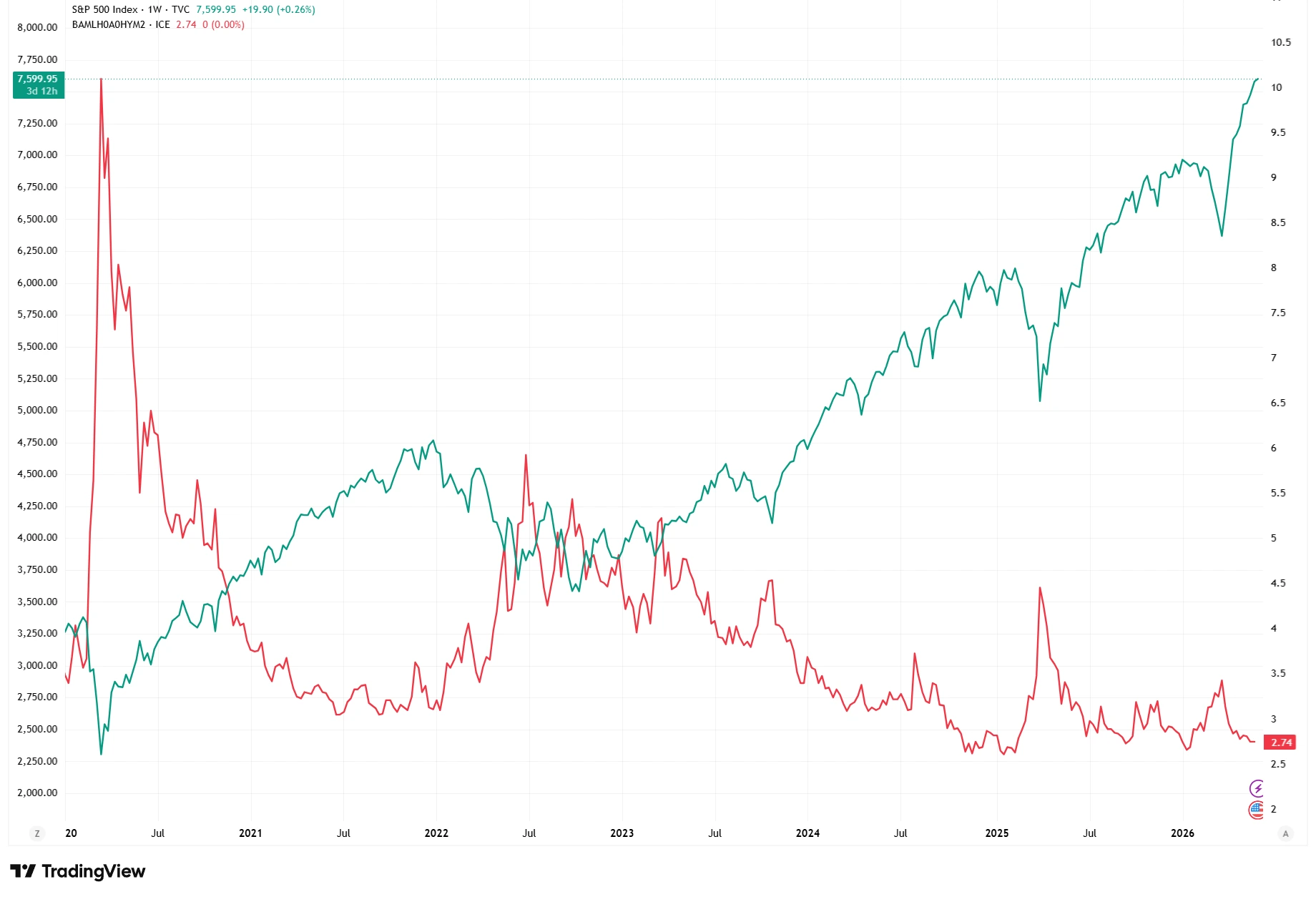
Source: TradingView. Past performance is not a reliable indicator of future performance. Data as of 2 June 2026.
A comparison of US high-yield credit spreads and the S&P 500 shows how periods of rising borrowing costs for riskier companies often coincide with increased market stress and weaker investor sentiment. Credit markets are frequently viewed as an early warning system for broader financial conditions.
Why Credit Markets Are Not Always Right
Although credit markets can provide valuable warning signs, they are not perfect predictors of the future.
Borrowing costs can rise because of temporary events such as geopolitical tensions, market volatility or short-term liquidity concerns without leading to a recession.
Likewise, policymakers can sometimes step in to stabilise financial conditions before broader economic damage occurs.
For this reason, investors rarely rely on credit markets alone. Instead, they use them alongside economic data, company earnings and other market indicators to build a more complete picture of financial conditions.
Bottom Line
Credit markets are often among the first areas of the financial system to reflect changing economic conditions.
When borrowing costs for companies rise sharply, it can signal growing concerns about economic growth, corporate profitability or financial stability. While no single indicator can predict the future, credit spreads have repeatedly provided valuable early warnings during periods of market stress.
For investors, monitoring corporate borrowing conditions can offer important insight into risk sentiment and broader market trends before those concerns become visible elsewhere.