














USD/JPY Hits Highest Level Since 1986 as Fed and BoJ Policy Divergence Widens


The US dollar climbed to its strongest level against the Japanese yen in nearly four decades on Monday, with USD/JPY rising above 162 as investors continued to favour the greenback amid widening interest rate differentials between the United States and Japan.
The move follows last week’s more hawkish Federal Reserve meeting, which reinforced expectations that US interest rates could remain higher for longer. At the same time, the Bank of Japan (BoJ) has maintained a far more accommodative policy stance, leaving the yen under continued pressure.
The latest rally highlights how diverging central bank policies remain one of the dominant themes driving global currency markets in 2026.
Fed and BoJ Policies Continue to Diverge
Much of the momentum has been driven by the Federal Reserve’s latest policy outlook.
Although policymakers left interest rates unchanged, they maintained a higher-for-longer stance, reinforcing expectations that borrowing costs may remain elevated well into next year. Higher US Treasury yields have continued to increase the appeal of dollar-denominated assets, supporting demand for the US currency.
By contrast, the Bank of Japan continues to pursue a far more accommodative approach. While policymakers have gradually adjusted elements of their ultra-loose monetary policy, interest rates remain well below those in the United States.
This widening yield differential has encouraged investors to continue selling the yen in favour of higher-yielding currencies. It has also supported so-called carry trades, where investors borrow in low-interest-rate currencies such as the yen to invest in assets offering higher returns elsewhere.
As long as this interest rate advantage persists, the US dollar is likely to remain well supported against the yen.
USD/JPY Reaches Highest Level Since 1986
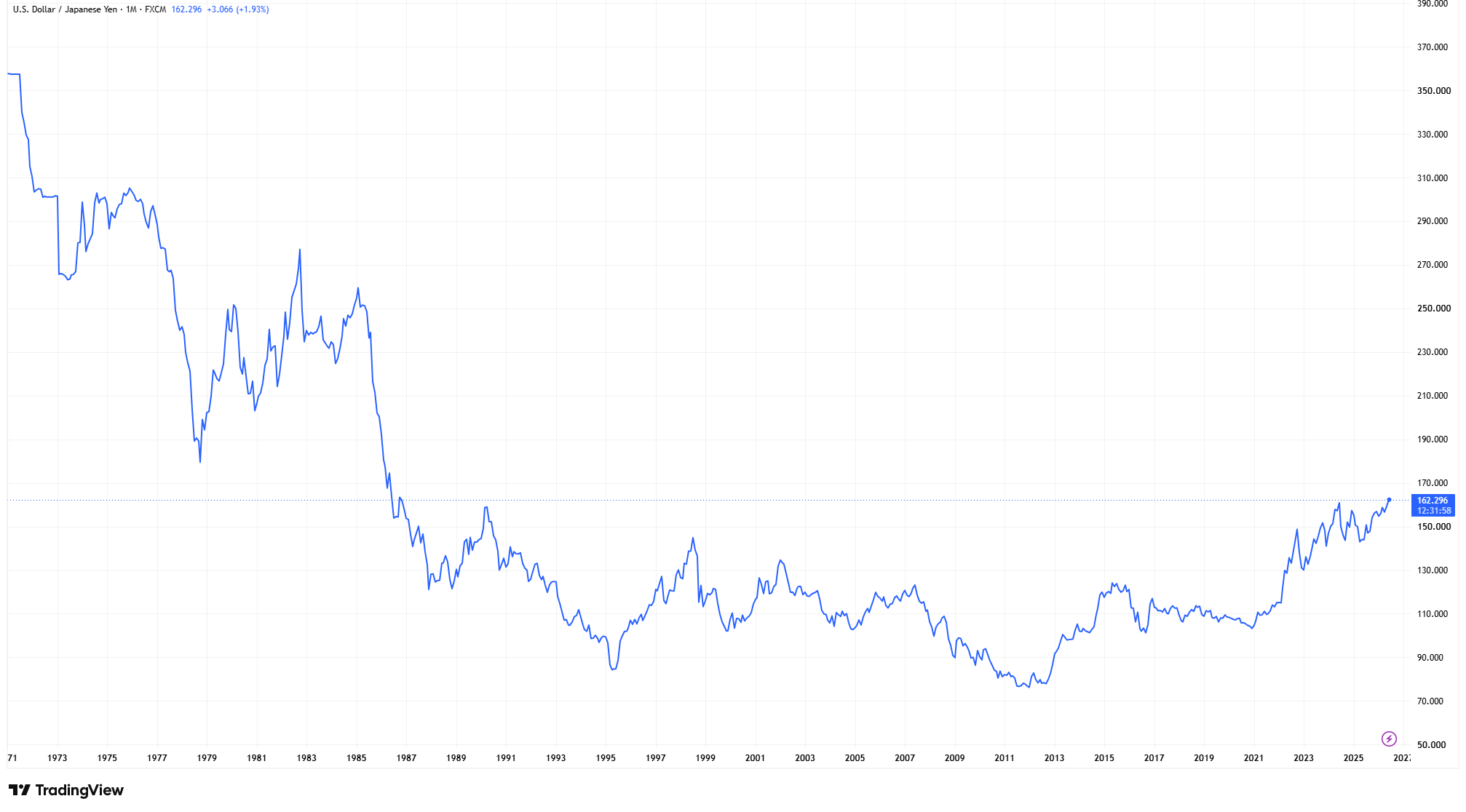
Source: TradingView. Past performance is not a reliable indicator of future performance. Data as of 30 June 2026.
USD/JPY climbed above 162, reaching its highest level since 1986 as widening interest rate differentials between the Federal Reserve and the Bank of Japan continued to support the US dollar.
Why the Move Matters
Reaching levels not seen for almost 40 years underlines just how pronounced the policy divergence between the world’s two largest central banks has become.
The rally reflects sustained confidence in the US dollar alongside prolonged weakness in the Japanese yen, rather than a short-lived reaction to a single economic release.
At the same time, the move has renewed speculation that Japanese authorities could become more vocal if currency weakness accelerates further. While intervention remains a possibility, officials have not signalled that action is imminent, leaving markets focused primarily on interest rate expectations.
The weaker yen also carries wider economic implications. While it can benefit Japanese exporters by increasing the value of overseas earnings when converted back into yen, it also raises the cost of imported goods, energy and raw materials, adding to inflationary pressures for businesses and households.
What Investors Are Watching Next
Attention now turns to the next round of economic data and central bank communication.
Investors will closely monitor upcoming US inflation figures, comments from Federal Reserve officials and future Bank of Japan policy decisions for fresh clues on the direction of interest rates.
Markets will also watch for any comments from Japanese government officials that could signal growing concern over the pace of the yen’s depreciation.
For now, USD/JPY’s climb to its highest level since 1986 reinforces the view that interest rate expectations and central bank policy divergence remain among the most powerful drivers of global foreign exchange markets.
Bottom Line
USD/JPY has reached its highest level in nearly four decades as investors continue to favour the US dollar over the Japanese yen.
With the Federal Reserve maintaining a higher-for-longer policy outlook and the Bank of Japan continuing to keep interest rates comparatively low, the gap between the two central banks remains a key driver of the currency pair.
Unless expectations for monetary policy begin to converge, interest rate differentials are likely to remain the dominant force shaping USD/JPY in the months ahead.