













Something Big is Happening to the Nasdaq 100


At first glance, the idea seems simple. If a market becomes “overbought”, a pullback should follow. That assumption usually comes from RSI, where readings above 70 are often interpreted as a warning that prices may have moved too far, too quickly.
But markets don’t always behave that way, especially when momentum is building.
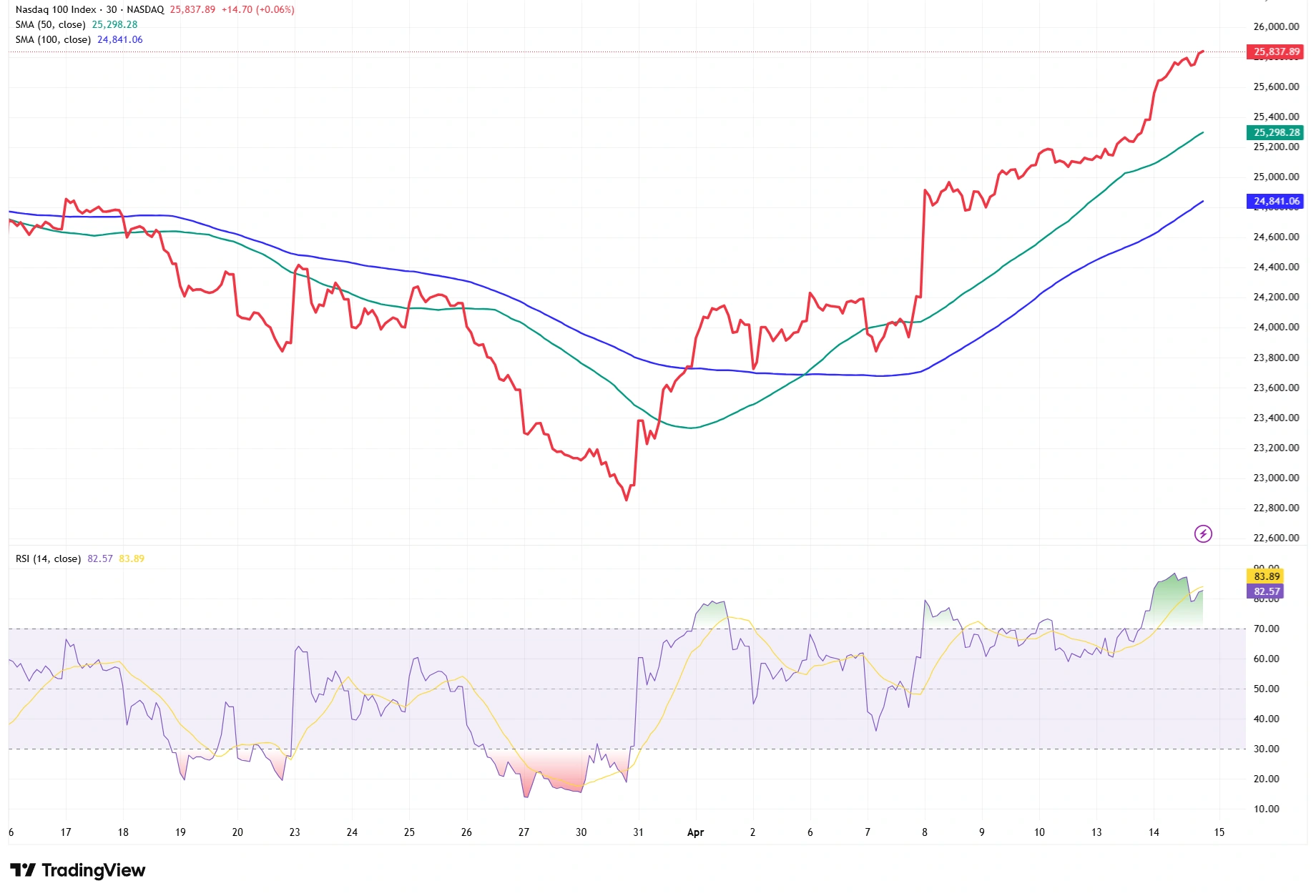
Recent price action in the Nasdaq 100 offers a clear example. Rather than reversing as RSI moves into overbought territory, the index has continued to push higher, with momentum accelerating and price breaking above key moving averages. In this case, overbought conditions are not signalling weakness – they’re reflecting strength.
What the Indicator Is Really Showing
RSI is a momentum indicator that measures the speed and magnitude of recent price changes. It moves between zero and 100, with levels above 70 typically labelled as overbought.
However, RSI does not indicate whether a market is “too high” in absolute terms. Instead, it reflects the intensity of buying or selling pressure.
When RSI moves above 70 and pushes into the 80 region, as seen in the current Nasdaq 100 chart, it often signals strong directional momentum rather than immediate exhaustion. In other words, the market is not just rising, it is accelerating.
From Weakness to Momentum Expansion
Looking at the recent chart, the Nasdaq 100 has moved through a clear transition.
Price initially declined and traded below its moving averages, reflecting a period of weakness. That phase was followed by stabilisation and a gradual recovery, with price reclaiming both the 50 and 100 moving averages.
Once those levels were regained, momentum began to build.
The most recent move shows a sharp rally, with price pushing higher in a relatively tight structure. At the same time, RSI has surged above 80, highlighting a strong expansion in momentum. Rather than fading, the move has strengthened as price continues to climb.
When Overbought Reflects Strength
In this context, overbought conditions are better understood as a confirmation of demand.
The move into the 80 region suggests that buying pressure is not only present but increasing. This type of behaviour is often seen during breakout phases or when markets transition from consolidation into a more directional trend.
Pullbacks during this phase have remained shallow, and price has continued to hold above key moving averages. This indicates that buyers are still active on dips, supporting the overall move higher.
Reading Price and Momentum Together
To interpret this type of setup effectively, it helps to look at both price structure and momentum together.
In the current Nasdaq 100 move, several elements are aligning:
- Price has reclaimed and held above key moving averages
- The recent rally shows a series of higher short-term highs
- RSI has pushed into the 80+ region, confirming strong momentum
Together, these signals suggest that the move is being supported by both structure and momentum, rather than driven by a short-lived spike.
That said, strong momentum does not eliminate risk. Markets can still reverse, particularly if momentum begins to fade or price fails to hold above recent support levels.
Some signs to watch include:
- RSI falling back below the 50 level
- Price breaking below a recent higher low
- A loss of support around key moving averages
These shifts tend to provide more meaningful signals than the initial move into overbought territory.
The chart below highlights this shift in momentum more clearly.
Nasdaq 100: Momentum Expansion as RSI Moves Above 80
Bottom Line
Overbought does not always mean overextended.
In the case of the Nasdaq 100, the recent move into the 80+ RSI region reflects strengthening momentum and sustained buying pressure. Rather than signalling an immediate reversal, it highlights a phase where the market is accelerating.
As always, context matters. Combining indicators like RSI with price structure and key levels provides a more balanced view than relying on a single signal in isolation.
CFDs are complex instruments and come with a high risk of losing money rapidly due to leverage.