


The Psychology of Market Cycles


Table of Contents
- What Is a Market Cycle
- Bull and Bear Markets: What's the Difference?
- Why Do Market Cycles Occur
- The Four Stages of a Typical Market Cycle
- Why Do Investors Often Buy at the Wrong Time
- How Investor Behaviour Can Change Outcomes
- A Historical Example: The COVID-19 Market Cycle
- Can Investors Predict Market Cycles?
- Are All Market Cycles the Same?
- Bottom Line
Market cycles reflect the way financial markets move through periods of rising and falling prices rather than following a straight line. Rising markets can encourage optimism and confidence, while downturns may trigger uncertainty, fear and more cautious investment decisions. These shifts in sentiment can influence how investors respond to economic developments and changing market conditions.
Economic growth, corporate earnings, inflation and interest rates all play important roles in market performance. However, investor psychology can also amplify price movements, particularly when optimism or pessimism becomes widespread.
Understanding the psychology behind these cycles can help investors recognise how sentiment changes over time, why markets sometimes move ahead of economic data and why identifying turning points remains so difficult.
What Is a Market Cycle
A market cycle refers to a period of rising and falling prices in financial markets. Although each cycle develops differently, markets often experience broad phases of recovery, expansion, peak and contraction.
These phases reflect changes in economic expectations, market conditions and investor confidence. However, they do not necessarily follow a predictable sequence or last for a specific period.
Financial markets are forward-looking. Prices reflect expectations about future developments, not just current economic conditions. As a result, markets may begin recovering while economic data remains weak or start declining before a slowdown becomes apparent.
Investor sentiment can reinforce these movements. When confidence increases, investors may become more willing to accept risk. When uncertainty rises, they may reassess their expectations and reduce their exposure to financial markets.
Bull and Bear Markets: What’s the Difference?
Two commonly used terms for describing broader market conditions are bull markets and bear markets.
A bull market generally refers to an extended period of rising prices, often accompanied by improving investor confidence and expectations of future growth.
A bear market refers to an extended period of declining prices, during which uncertainty, weaker expectations or greater risk aversion may influence investor behaviour.
In equity markets, a rise of approximately 20% from a recent low is commonly used to describe a bull market, while a decline of approximately 20% from a recent high is often used to identify a bear market. These thresholds are conventions rather than universally accepted definitions.
Bull and bear markets are not identical to the four phases of a market cycle. They describe broader price trends, whereas market-cycle phases provide a simplified framework for understanding how economic conditions and investor sentiment may evolve.
Why Do Market Cycles Occur
Financial markets constantly respond to new information:
- Economic growth
- Inflation
- Interest rates
- Corporate earnings
- Geopolitical developments
- Investor confidence
When economic conditions improve, investors may anticipate stronger corporate earnings and become more willing to invest. Increased demand can support rising prices, particularly when positive expectations spread across the market.
However, optimism can sometimes extend beyond what underlying economic or company fundamentals justify.
For example, strong market performance may encourage investors to assume that prices will continue rising. As demand increases, valuations may become stretched, meaning shares appear expensive relative to measures such as company earnings.
The opposite can happen when uncertainty increases. Disappointing economic data, weaker earnings or unexpected policy developments may cause investors to reassess their expectations. Greater caution can contribute to selling pressure and declining prices.
Because financial markets reflect expectations about the future, they do not always move in line with current headlines. Prices may rise despite weak economic data if investors anticipate improvement, or fall despite strong recent results if expectations for the future deteriorate.
This interaction between economic fundamentals and collective investor behaviour helps explain why market cycles develop.
The Four Stages of a Typical Market Cycle
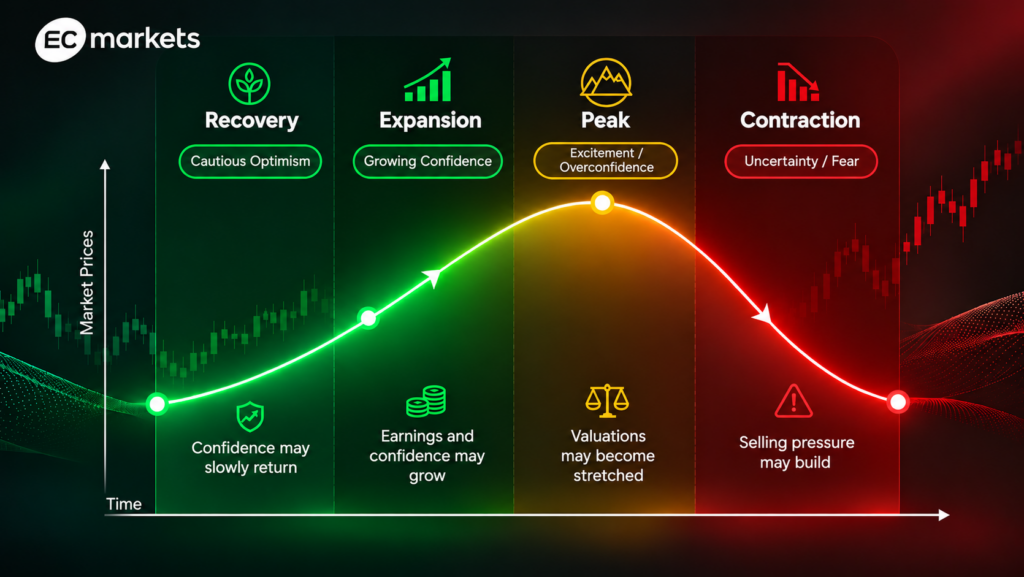
Market cycles do not follow a fixed timetable, and their phases are rarely separated by clearly defined turning points. Nevertheless, four broad stages can help illustrate how market conditions and investor psychology may change over time.
Market Cycles and Investor Psychology at a Glance
| Stage | Typical Market Environment | Common Investor Emotion |
| Recovery | Prices begin recovering while uncertainty remains | Cautious optimism |
| Expansion | Growth and confidence strengthen | Growing confidence |
| Peak | Expectations and valuations may become elevated | Excitement or overconfidence |
| Contraction | Prices weaken and risk aversion increases | Uncertainty or fear |
These emotions are illustrative rather than universal. Market cycles do not always follow the same sequence or produce the same investor behaviour.
1. Recovery: Cautious Optimism
Markets begin recovering after a period of sustained weakness. Economic conditions may still appear challenging, but some investors begin anticipating future improvements.
This can surprise newer investors because markets may start recovering before economic headlines become positive. Confidence gradually returns, although uncertainty may remain high and an initial rebound does not necessarily develop into a sustained recovery.
2. Expansion: Growing Confidence
Economic activity strengthens, corporate earnings may improve and investor confidence grows. As optimism spreads, more market participants may invest, supporting higher prices across multiple sectors.
The expansion phase can continue for an extended period, although its duration and strength vary between market cycles.
3. Peak: Excitement and Overconfidence
Market optimism may eventually develop into widespread excitement. Strong performance attracts increasing attention from the media and investors.
Valuations can become stretched as expectations rise, making future growth projections increasingly difficult for companies to meet.
However, a market peak is usually easier to recognise afterwards than while it is happening. Prices may continue rising even after concerns about high valuations emerge.
4. Contraction: Uncertainty and Fear
Weaker economic data, slowing growth, changing interest rates or disappointing company results may reduce investor confidence.
Selling pressure can increase as investors reassess their expectations. Fear may replace optimism, contributing to falling prices and greater market volatility.
Eventually, sentiment may begin improving, creating conditions for another recovery. However, neither the timing nor the extent of any recovery can be known in advance.
Why Do Investors Often Buy at the Wrong Time
One of the biggest challenges during market cycles is that short-term emotions can influence investment decisions, sometimes leading investors to buy after substantial price increases or sell following significant declines.
When markets have been rising for an extended period, growing confidence and fear of missing out (FOMO) may encourage investors to increase their exposure after prices have already climbed considerably.
Conversely, following sharp market declines, uncertainty and fear of further losses may prompt investors to sell, potentially at a time when valuations have become more attractive.
Several behavioural biases in investing tendencies can reinforce these reactions. Herd behaviour may encourage investors to follow the actions of others, while recency bias can lead them to assume that recent market performance will continue. Loss aversion can also make declines feel more significant than equivalent gains, increasing the likelihood of emotionally driven decisions.
These behaviours do not affect every investor in the same way, but they help explain why investment decisions can sometimes be influenced more by prevailing market sentiment than by underlying fundamentals.
How Investor Behaviour Can Change Outcomes
Consider a hypothetical example of two investors navigating the same market cycle.
During a strong bull market, Investor A becomes increasingly optimistic after watching prices reach new highs and decides to invest a large lump sum. Investor B, meanwhile, follows an established investment plan, contributing a fixed amount each month regardless of short-term market movements.
When the market subsequently declines, Investor A becomes concerned about further losses and sells their holdings, realising a loss. Investor B continues making regular contributions, purchasing investments at different price levels, including during the downturn.
Although both investors experienced the same market conditions, their decisions led to different outcomes. The example illustrates how emotional reactions and adherence to an investment plan can influence results.
However, regular investing does not guarantee better returns than lump-sum investing, nor does maintaining an investment necessarily prevent losses. Outcomes depend on factors including market performance, investment selection, timing and individual circumstances.
The key distinction is not the investment method itself, but how investors respond to changing market conditions. Having clearly defined objectives, understanding personal risk tolerance and following a consistent decision-making process can help reduce the influence of short-term emotions, although no approach eliminates investment risk.
A Historical Example: The COVID-19 Market Cycle
The COVID-19 pandemic provides an example of how rapidly market expectations and investor sentiment can change.
In early 2020, global equity markets experienced sharp declines as the pandemic disrupted economic activity and created substantial uncertainty about future growth.
Major stock indices, including the S&P 500, fell sharply and reached their pandemic-related lows in March 2020.
Investor confidence weakened as businesses faced closures, economic activity slowed and uncertainty surrounding the pandemic increased.
However, equity markets began recovering while economic conditions remained difficult.
This reflected a shift in expectations rather than an immediate return to normal economic activity. Investors began responding to factors including substantial monetary and fiscal support, expectations of economic reopening and the prospect of improving business conditions.
The recovery illustrates the forward-looking nature of financial markets. Prices can begin reflecting anticipated improvements before those developments become visible in economic data.
It also demonstrates how quickly sentiment can change, moving from widespread uncertainty towards renewed optimism.
However, the speed of the 2020 market recovery was unusual and should not be interpreted as evidence that future downturns will follow a similar pattern.
Can Investors Predict Market Cycles?
Not reliably.
Even professional fund managers and economists cannot consistently identify exactly when markets will reach their highest or lowest turning points.
Markets may establish a bottom while economic news remains negative. Similarly, prices can continue rising even after concerns about stretched valuations emerge.
Market turning points depend on numerous interacting factors, including economic conditions, monetary policy, corporate earnings and changing investor expectations.
Although historical patterns can help explain market behaviour, they cannot reliably determine when a cycle will change direction.
Are All Market Cycles the Same?
No two market cycles unfold in exactly the same way.
Some develop gradually over several years, while others involve rapid changes in prices and investor confidence.
The factors driving a cycle can also differ. One downturn may be associated with higher interest rates and slowing economic growth, while another may be triggered by a financial crisis or an unexpected global event.
Different asset classes, sectors and geographic markets may also experience contrasting conditions at the same time.
For example, certain sectors may continue performing strongly while the broader equity market weakens. Similarly, market conditions in one country may differ substantially from those in another.
Historical cycles can provide useful context for understanding how markets behave, but their patterns do not guarantee future outcomes.
Bottom Line
Market cycles reflect the interaction between economic conditions, investor expectations and collective behaviour.
Periods of recovery and expansion may encourage optimism and confidence, while peaks and contractions can bring overconfidence, uncertainty or fear.
These emotional shifts can reinforce market movements, but they do not follow a predictable sequence or provide reliable signals about future prices.
Understanding the psychology behind market cycles can help investors interpret changing market conditions, recognise the influence of sentiment and place periods of rising and falling prices into a broader perspective.
Frequently Asked Questions About Market Cycles
This content is for informational and educational purposes only and does not constitute investment advice or a recommendation to trade. Trading involves risk. Consider your financial circumstances and risk tolerance before making any trading decisions.