













The Policy Gap That's Moving EUR/USD This Year


Interest-rate expectations remain one of the biggest drivers of currency markets in 2026. For EUR/USD, the focus is increasingly centered on the policy gap between the European Central Bank and the US Federal Reserve.
As investors reassess inflation, growth and the timing of future rate decisions, shifts in yield differentials continue to shape both sentiment and price action across the world’s most traded currency pair.
Why the Policy Gap Matters
In foreign exchange markets, central bank policy matters because capital typically gravitates toward the currency offering the higher short-term return.
As of mid-May 2026, the Federal Reserve’s target range sits between 3.50% and 3.75%, while the ECB deposit rate remains at 2.00%. This leaves a policy gap of roughly 1.625% in favour of the US dollar.
Both central banks remain cautious. The Fed continues to signal that US inflation remains too elevated, while the ECB faces a more complex backdrop of persistent inflation risks alongside slowing economic growth.
This balance matters for EUR/USD because the pair rarely moves based on interest rates alone. Instead, price action is largely driven by changes in expectations around which economy, and which central bank, is shifting faster.
In mid-April 2026, US government bonds yielded roughly 1.135% more than German bonds, reinforcing support for the dollar as investors continued to favour higher US returns.
At the same time, expectations that the ECB may continue tightening policy have helped prevent a broader one-directional move higher in the dollar.
Markets are now watching whether the rate gap narrows enough to provide the Euro with more sustained support.
What the Chart is Showing
This policy tension is visible on the chart.
By late April 2026, EUR/USD had moved back above its 200-day moving average, an important long-term technical level often used to gauge broader trend direction.
That move improved the medium-term outlook for the Euro. However, price action over the past month has remained largely sideways, suggesting traders are still hesitant to fully commit to a stronger bullish trend.
The chart currently provides several key technical areas to monitor.
Floor (Support):
The 200-day moving average remains the first major support zone for EUR/USD.
Holding above this level would help maintain the current recovery structure and support the argument that bullish momentum is gradually improving.
Ceilings (Resistance):
On the upside, EUR/USD continues to face significant resistance overhead.
The most important barrier remains the psychological resistance zone near the January 2026 highs, where previous rallies lost momentum as US rate expectations strengthened.
EUR/USD Spot Price vs US-German Two-Year Yield Spread
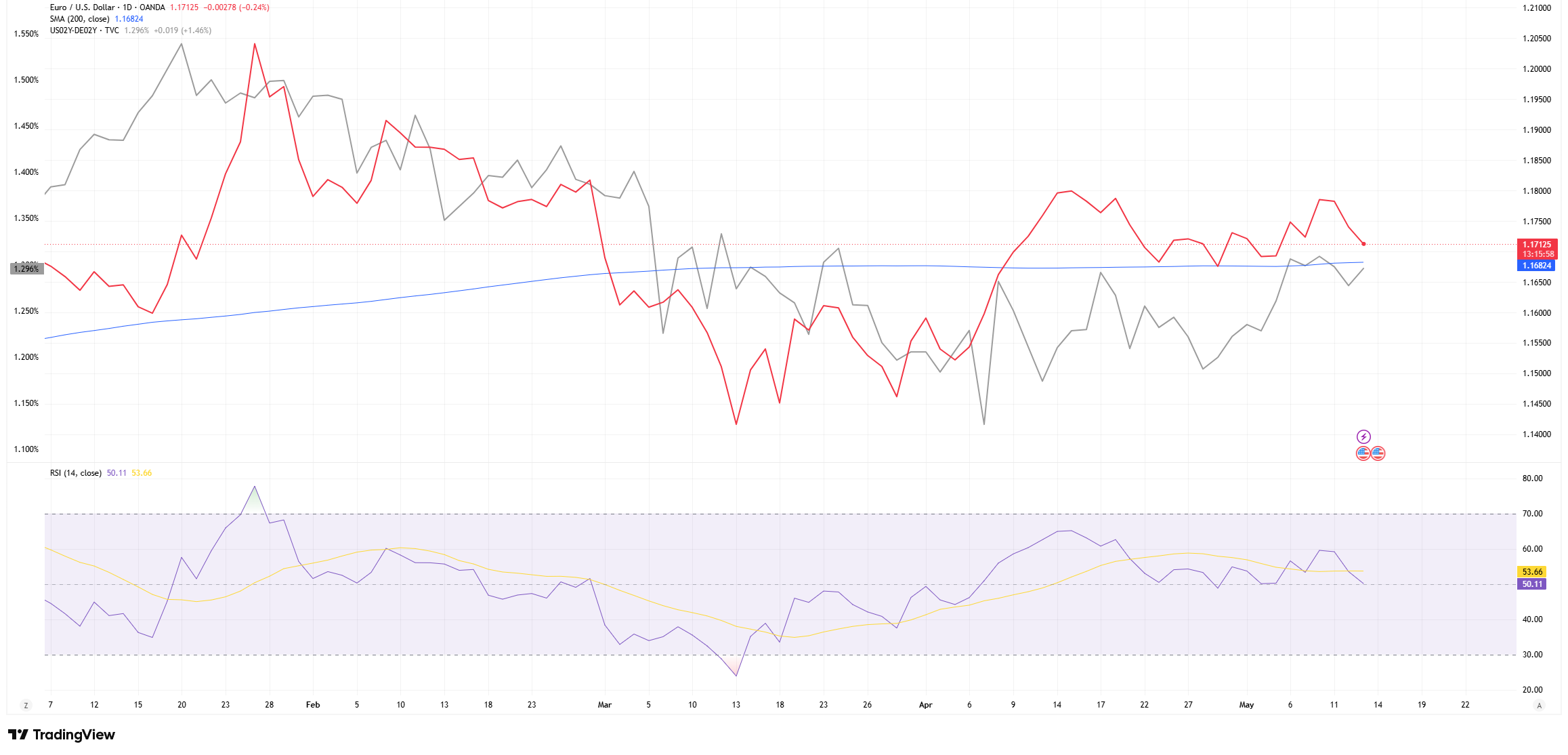
Source: TradingView. Past performance is not a reliable indicator of future performance. Data as of 13 May 2026.
A comparison of EUR/USD and the US-German two-year yield spread highlights how shifts in rate expectations continue to influence the direction of the currency pair.
How Traders Connect Policy With Price
This environment is where macroeconomics and technical analysis intersect.
If the economic outlook in Europe begins improving relative to the US, traders will look for EUR/USD to hold above key support levels and challenge overhead resistance more convincingly.
In practical terms, sustained upside momentum becomes more credible when price can remain above long-term support levels consistently, rather than briefly breaking above them during periods of short-term volatility.
Recent market developments highlight how quickly this balance can shift.
By late April 2026, investors increasingly expected the ECB to raise interest rates at least twice more this year in response to persistent inflation pressures. That shift in expectations helped support the Euro.
However, sentiment changed sharply following hotter-than-expected US inflation data released on 12 May 2026.
The stronger inflation reading forced markets to reassess the likelihood of further Fed tightening, driving renewed demand for the US dollar and pressuring EUR/USD lower.
By 13 May 2026, the pair had eased back toward 1.1714, illustrating how quickly changing interest-rate expectations can alter FX momentum.
Bottom Line
The key driver for EUR/USD is not simply which central bank appears more hawkish.
What matters more is whether the policy gap between the Fed and ECB is widening or narrowing, and whether price action confirms that markets are reacting to those shifts.
At present, the Federal Reserve continues to offer a higher yield advantage. However, expectations that the ECB may need to keep rates elevated for longer have helped provide underlying support for the Euro.
While central bank commentary often drives headlines, technical structure remains equally important.
Support, resistance and momentum continue to provide valuable insight into whether macroeconomic developments are translating into sustainable FX trends.