













Why is the Global Economy so Dependent on Shipping?


Global trade still depends heavily on the sea. According to the United Nations Conference on Trade and Development (UNCTAD), around 80% of world trade by volume is carried by maritime transport. That is why shipping routes are far more than a logistics story.
When a major trade route is disrupted, the effects can spread quickly through supply chains, freight costs and commodity prices before eventually appearing in inflation or growth data.
For investors, these routes matter because they influence the movement of energy, raw materials, and consumer goods across the global economy. A disruption in one region can quickly ripple through financial markets elsewhere, affecting everything from oil prices to investor sentiment.
The Shipping Routes Markets Watch Closely
Certain routes are especially important because of the volume and type of goods that move through them.
The Suez Canal remains one of the world’s most significant trade corridors, linking Asia and Europe through the shortest major maritime route available. According to UNCTAD, around 12% to 15% of global trade moved through the canal in 2023.
The Panama Canal also plays a major role in global trade flows, particularly between Asia and the Americas. Around 5% of global maritime trade normally passes through the canal.
However, drought conditions during 2023 and 2024 reduced water levels and forced authorities to limit daily ship crossings. At one stage, transits were cut from 36 vessels per day to as few as 24, contributing to delays and higher freight costs.
Energy markets pay especially close attention to the Strait of Hormuz.
The International Energy Agency estimates that almost 20 million barrels of oil per day moved through the strait in 2025, equal to roughly one-quarter of global seaborne oil trade.
How Disruptions Affect Markets
When shipping routes are blocked, delayed or threatened, markets tend to react quickly.
Oil and gas prices can rise if traders fear supply shortages, while shipping costs often increase as vessels are rerouted onto longer and more expensive journeys.
Freight markets reflected this clearly during recent disruptions.
Container spot rates from Shanghai more than doubled between December 2023 and February 2024 as supply chains tightened. By October 2024, the Shanghai Containerized Freight Index remained more than twice its 2023 average.
Oil markets also reacted sharply to geopolitical tensions surrounding key shipping routes.
In March 2026, disruptions linked to the Strait of Hormuz pushed Brent crude prices above $90 per barrel, while shipping insurance costs and bunker fuel prices also moved higher.
These disruptions matter because higher transport costs can feed directly into inflation. If businesses pay more to move goods, those costs are often passed on to consumers through higher prices.
Brent Crude Oil vs VIX Volatility Index
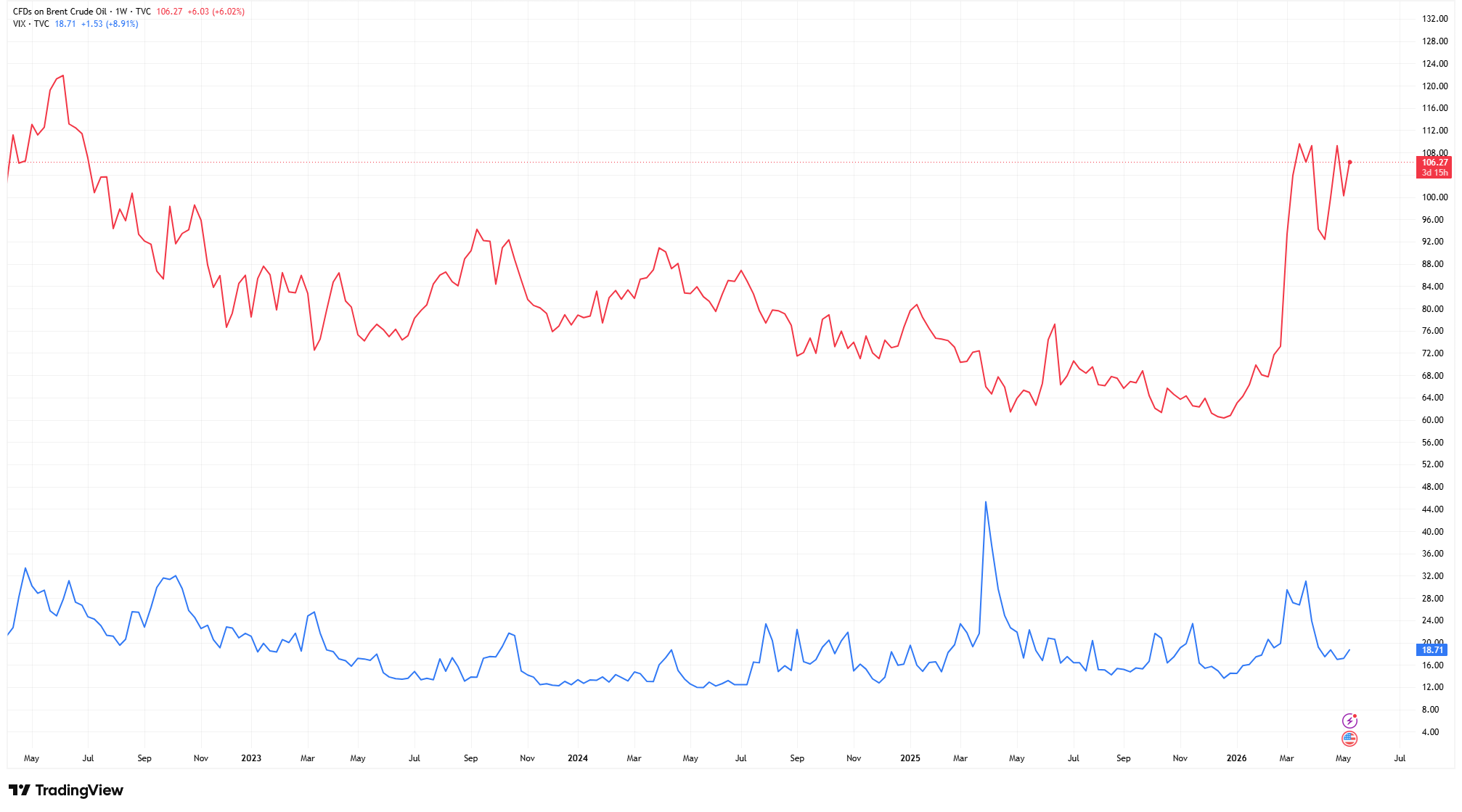
Source: TradingView. Past performance is not a reliable indicator of future performance. Data as of 12 May 2026.
A comparison of Brent crude oil prices and the VIX volatility index highlights how disruptions to trade flows and geopolitical tensions can coincide with rising market uncertainty and shifts in investor sentiment.
Shipping Data as an Early Warning Signal
Markets are forward-looking, which means investors try to anticipate economic changes before they appear in official data releases.
Rather than waiting for quarterly GDP or inflation reports, traders often monitor shipping-related indicators in real time to assess whether supply chains are tightening or whether inflationary pressures may be building again.
Freight indices, shipping insurance costs and vessel rerouting data can all provide early clues about potential supply bottlenecks or commodity price swings.
The Baltic Dry Index, which tracks the cost of shipping raw materials such as coal, iron ore and grain, is often watched as an indicator of global trade demand.
Meanwhile, tools such as the IMF PortWatch platform and the New York Fed Global Supply Chain Pressure Index help track congestion, shipping activity and wider supply-chain conditions.
A sudden rise in freight costs or a sharp decline in canal traffic can signal that inflationary pressures are starting to increase again.
Why This Matters for Global Markets
Modern supply chains are highly interconnected and often operate with limited spare capacity. That means even relatively small disruptions can spread quickly across sectors.
Manufacturers may face delays receiving parts, retailers can experience higher import costs, and companies may see pressure on profit margins.
Shipping disruptions can also affect inventory management and delivery times, creating broader uncertainty for businesses and consumers alike.
These effects often extend well beyond the shipping industry itself and influence equities, commodities, currencies and bond markets.
Oil and gas prices may rise if energy flows are threatened, while equity markets can weaken if investors begin to expect slower growth or renewed inflation pressure.
Bottom Line
Shipping routes are not just trade infrastructure. They are an important part of how global markets function.
Disruptions to major trade flows can influence inflation, commodity prices, interest rate expectations and investor sentiment at the same time.
In today’s environment, markets are paying closer attention to shipping activity because it offers early insight into supply-chain pressures, geopolitical risks and broader economic conditions.
For investors, understanding how trade flows affect financial markets can provide valuable context when interpreting shifts in volatility, inflation and global risk sentiment.