












Play the Long Game: How Preparation Builds Better Trades


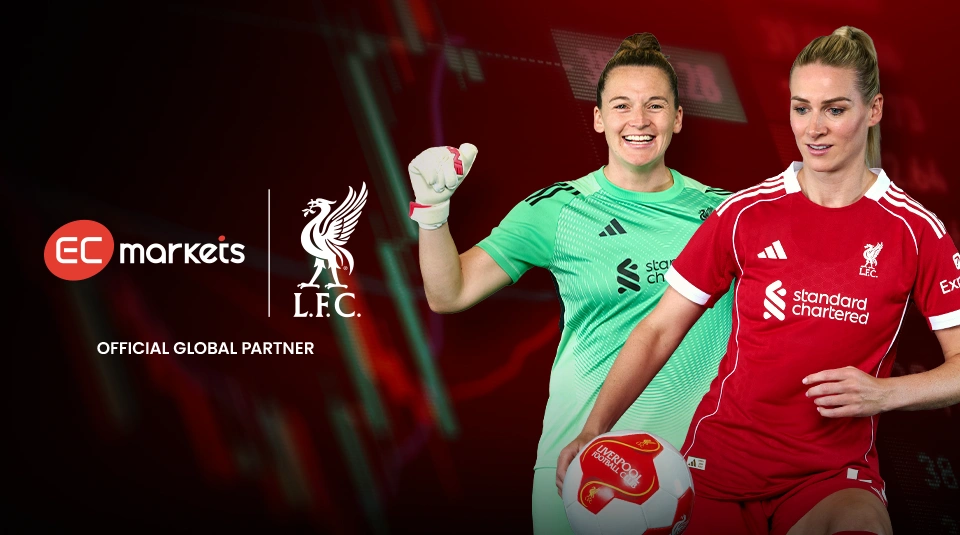
What you see on match day is just the tip of the iceberg.
Every goal scored during the game was 100 missed during training sessions.
Every cross, tackle, and pass is a carefully controlled move that has been drilled day in, day out until the players are comfortable enough to bring their best to the pitch.
Precision is only possible with the right preparation.
Trading is no different.
Preparation is what helps improve decision-making, manage risk, and act with greater precision when opportunities appear.
EC Markets x LFC Women Crossbar Challenge
In the video below, you’ll see how we put LFC Women to the test with a special EC Markets crossbar challenge.
Liverpool FC Women’s players Martha Thomas, Rachael Laws, and Gemma Bonner take on the EC Markets crossbar challenge.
Precision is rarely down to luck. With the right preparation, tools, and repetition, accuracy becomes a skill that can be developed over time.
Takeaways:
- Long-term trading success depends on a strong plan.
- Decide (before using real money) what, how much, and when you’ll trade.
- Reduce risk with the right trading tools, routines, and mindset.
- Continuously review, learn, and improve.
Find Your Motivation
People get into trading for many reasons.
Maybe you want to build financial independence, explore a new income stream, or get a deeper insight into why the world’s economy works the way it does.
All of these and more are valid reasons.
Trading – when performed with a strong plan – can build options, security, and freedom for the future.
It can also chisel you into a leader; one who can make decisions under pressure, develop winning strategies, and invest in yourself, as well as your community.
Whatever your reason, find it, and hold on to it. Write it down, if that helps. This will guide your precision and prepare your mindset for long-term performance.
Get the Basics Right
Trading can feel complex at first, but once you understand the basics and build a clear routine, it becomes far easier to navigate.
Learn Common Trading Terms
Whatever your approach – reading, writing, or even teaching them to others – learning some common trading terms will take you a long way.
This means that when it comes time to trade, you’ll understand everything your broker is telling you.
Need help? Check out our trading Glossary.
Start With a Demo Account
Everything becomes clearer with a demo trading account.
There you can try out new strategies, assets, get comfortable with your chosen platform, and build confidence with no concerns of losing real money.
That said, the best way to learn from a demo account is to treat it seriously – as you’d do with a real account. That way you can still build genuine discipline.
Read the Market
You don’t need to go diving in on complex chart movements or algorithms to begin with.
Keeping up with the economic calendar, financial news, and key geopolitical headlines will give you plenty of insight into how markets move.
You can also read market analysis to discover:
- Why prices change
- Which events matter most
- Where volatility may emerge
These resources aren’t fortune tellers, but they can help you know when to enter or exit a trade, how to read the charts, and how to make good decisions in the heat of the moment.
Prepare Your Mindset
Tools and techniques are important in trading, but nothing decides long-term success more than your mindset.
Strong mindset habits help traders remain disciplined when profits fluctuate, losses occur, or markets become emotional.
“You are going to fail at things, but it’s how you react and get through it that matters.”
– Rachael Laws, Goalkeeper for Liverpool FC Women, talking to EC Markets.
Here are some good mindset techniques:
- Keep a journal: Writing down the thought process behind your moves will help you map your progress and spot patterns in your decision-making.
- Embrace the process: Accept losses and break-even trades as part of the process. Long-term performance is shaped by consistency, not perfection.
- Stick to the plan: A trading plan can help make sure you’re trading smart and not acting on impulse.
- Think of the long game: Volatility creates opportunity, but reacting emotionally to every move can damage long-term results. Focus on process over short-term noise.
Set Goals
Clear goals give structure to your trading. They help measure progress, maintain discipline, and reduce emotional decision-making during difficult periods.
When setting goals, try to include:
- Deadlines: Give every goal a timeframe, short or long-term, for a clear sense of purpose and an easy way to measure your success.
- Realistic growth targets: These can include percentages or ratios for the growth you want to see, without tying you to exact profit margins.
- Wellbeing checkpoints: Ensure you’re staying consistent, following a good trading routine, and looking after yourself.
Some example goals across different time spans:
- Long term: Follow my risk management rules consistently for the next 3 months.
- Mid-term: Complete 20 trades with disciplined entries and exits.
- Short term: Improve my journalling and weekly review habits.
Choose Your Instruments
Instruments are the assets you choose to buy or sell, whether that’s currency pairs, shares, oil, gold, or indices.
Every market behaves differently. Preparation means understanding what drives each instrument before risking capital.
- Forex: Interest rate decisions, inflation data, and central bank policy.
- Commodities: Geopolitics and macroeconomic sentiment.
- Indices: Corporate earnings, economic data, and broader market sentiment.
- Cryptocurrencies: Regulatory developments, market sentiment, and macroeconomic risk appetite.
Pick a Time
Your available time should shape your strategy.
Some traders prefer active market sessions with higher volatility, while others focus on longer-term positions that require less screen time.
| Exchange | Hours | Time Zone |
| London Stock Exchange | 8am – 4:30pm | GMT |
| New York Stock Exchange | 9:30am – 4pm | ET |
| Nasdaq | 9:30am – 4pm | ET |
| Shanghai Stock Exchange | 9:30am – 11:30am & 1pm – 3pm | UTC+8 |
| Tokyo Stock Exchange | 9am – 11:30am & 12:30pm – 3pm | JST |
Many traders like to take advantage of overlapping sessions.
The London-New York overlap, for instance, is one of the most active periods for forex, with higher volatility and tighter spreads.
Consider Your Risk Appetite
Trading involves risk, which is why defining your risk tolerance before entering the market is essential.
Decide how much capital you can afford to risk, and what level of volatility you are comfortable with. Never use money that you cannot afford to lose.
How to work out your risk appetite:
- Ratios: Some traders use risk-reward ratios to assess opportunities. A 1:3 ratio means risking 1 unit of potential loss to target 3 units of potential gain.
- Percentages: Some traders only risk a certain percentage of their account on a single position (say 1-2%), or only allocate up to 10% of their overall portfolio on a trade.
Lower Risk Strategy
Newer traders, generally speaking, prefer to take on lower risk levels.
This can involve:
- Smaller position sizes
- Disciplined stop-loss-use
- Limiting exposure to highly volatile conditions
Higher Risk Strategy
Some traders prefer to take on higher levels of risk in pursuit of bigger profits.
This can involve:
- Opening more positions
- Larger position sizes
- Holding through volatility
Make a Watchlist
Once you’ve got an idea of which instruments you’d like to trade – or at least, which ones you’re interested in – you can set up a watchlist.
A watchlist makes it easy to monitor certain instruments. Once you’ve added an instrument to your watchlist, you’ll get real-time updates such as its price movements and market conditions (you can customise which of these indicators you see too).
A watchlist helps traders stay focused on certain markets, monitor price movement efficiently, and avoid unnecessary noise.
Tip: You can often set up a watchlist via a demo trading account.
Bottom Line
Footballers put in many hours behind the scenes before matchday. With preparation comes precision, and with precision comes success.
Great trades rarely begin at the moment of entry. They begin beforehand with preparation, structure, and disciplined decision-making.