














Why Oil Is One of the Best Reads on Global Risk Appetite


Global financial markets are heavily influenced by changes in investor sentiment, often described as “risk-on” and “risk-off” behaviour. While many factors shape this, energy markets, particularly oil, play a central role. Oil sits at the intersection of economic growth, inflation and geopolitical risk.
When prices move sharply, it is rarely just about supply and demand. Instead, these moves often reflect broader uncertainty. In practice, large swings in oil prices tend to coincide with shifts in how investors view risk across global markets.
Why Energy Markets Matter for Sentiment
Oil remains a core input for the global economy, affecting transportation, manufacturing, and overall growth expectations. Because of this, changes in oil prices can quickly influence how investors interpret the economic outlook.
A sharp rise in oil prices can signal strong demand, which may reflect a resilient global economy. However, it can also point to supply disruptions or geopolitical tensions. The distinction matters, but in both cases, markets tend to react.
Recent data illustrates this clearly. In March 2026, Brent crude rose by nearly 40% within a few weeks as tensions in the Middle East intensified. A similar pattern was seen in early 2022, when oil climbed by around 15% in just two weeks following the start of the Russia-Ukraine conflict. In both cases, the move in oil prices acted as a signal of rising uncertainty rather than just a change in energy supply.
From Oil to Inflation and Interest Rate
Energy prices feed directly into inflation, and this is where their impact on markets becomes more pronounced. When oil prices rise, businesses face higher costs for fuel, transportation and production. These costs often pass through to consumers, pushing overall price levels higher.
Even though energy accounts for only a small share of consumer spending, its indirect impact is significant. Higher transport and manufacturing costs affect a wide range of goods and services.
This has been reflected in market pricing. In early 2026, as oil prices surged, US one-year inflation swaps rose from around 2.5% to approximately 3.2%, an increase of around 70 basis points. This shows how quickly markets adjust expectations when energy prices rise.
Central banks then respond to these shifts. If inflation appears persistent, policymakers may delay rate cuts or maintain tighter monetary policy. In March 2026, US two-year Treasury yields rose as markets priced in higher inflation risks linked to energy prices. In simple terms, higher oil prices led investors to expect interest rates to remain elevated for longer.
How Markets React Across Asset Classes
The impact of energy-driven inflation is felt across financial markets. Rising inflation expectations typically push bond yields higher. For example, US 10-year Treasury yields climbed to around 4.45% by early May 2026, reaching their highest levels since mid-2025 during a period of renewed energy volatility.
Higher yields increase borrowing costs and reduce liquidity, which can weigh on equity markets. Growth stocks are particularly sensitive, as their valuations depend more heavily on future earnings.
At the same time, periods of rising energy prices often coincide with increased market volatility. In early March 2026, the VIX rose to 28.15, marking a 31% intraday increase, while the S&P 500 fell by more than 2% during the same session.
Brent Crude Oil vs VIX (Volatility Index)
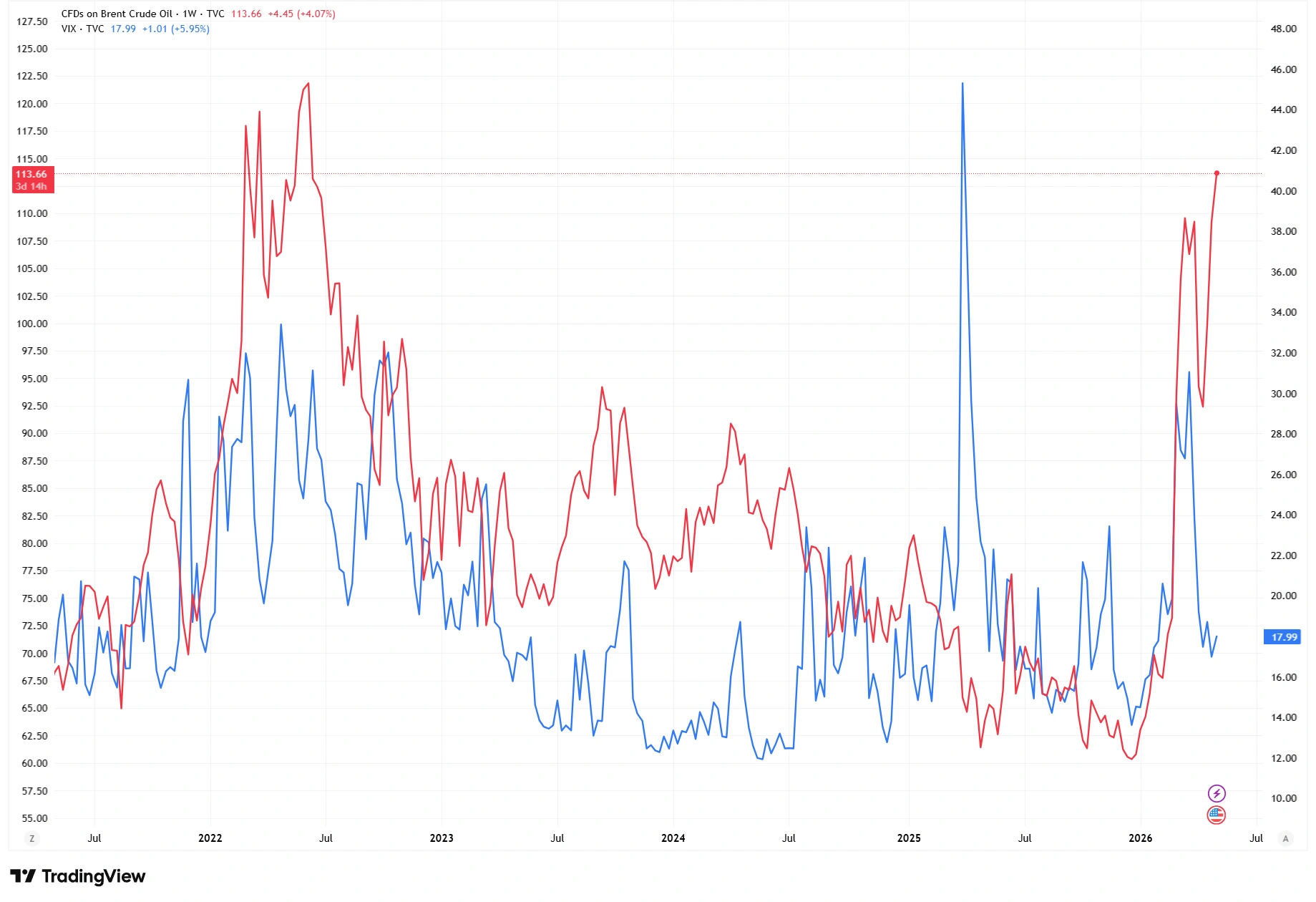
A comparison of Brent crude oil and the VIX shows how sharp moves in energy prices often coincide with rising market volatility, reflecting shifts in global risk sentiment.
Safe-haven assets also tend to benefit. Government bond yields and the US dollar often rise during risk-off periods.
During the March 2026 market move, the dollar strengthened by around 2.6%, reflecting a shift toward safer assets. Interestingly, gold did not follow its typical pattern and declined slightly, highlighting that market reactions can vary depending on the broader context.
Why the Relationship Is Not Always Straightforward
While the link between energy prices and risk sentiment is clear, it is not always one-directional. Falling oil prices can ease inflation pressures and support consumer spending, which may be positive for equities.
However, lower energy prices can also signal weaker global demand. In that case, declining oil prices may reflect slowing economic activity rather than improving conditions.
Similarly, rising oil prices driven by strong demand may coincide with healthy economic growth, while price increases driven by supply disruptions are more likely to trigger risk aversion. Markets therefore focus not just on the direction of energy prices, but on what is driving those moves.
Bottom Line
Energy markets act as a key link between geopolitics, inflation, and financial markets. Large moves in oil prices often reflect shifts in global uncertainty and feed directly into inflation expectations.
In the current environment, rising energy prices have tended to push bond yields higher, increase market volatility and weigh on equities, while supporting safer assets such as the US dollar. While the relationship is not always straightforward, the overall pattern has become more visible.
For investors, keeping an eye on energy markets can provide valuable insight into how risk sentiment may evolve and how different asset classes are likely to respond.
Energy Markets and Risk Sentiment FAQs
Why do oil prices affect stock markets?
Oil prices influence inflation and interest rate expectations. When oil rises sharply, it can increase costs across the economy, push yields higher and weigh on equity valuations.
What does risk-on and risk-off mean?
Risk-on describes periods when investors favour higher-risk assets like equities, while risk-off refers to periods when investors move toward safer assets such as bonds or the US dollar.
Why do higher energy prices increase volatility?
Sharp moves in energy prices often reflect geopolitical risk or supply disruptions, which increase uncertainty and lead to more volatile market conditions.
How do energy prices affect interest rates?
Higher energy prices can push inflation higher. In response, central banks may delay rate cuts or keep interest rates elevated, which impacts borrowing costs and asset prices.