




Black Friday Is Bigger Than the Checkout: How It Affects Financial Markets


Discover how to trade around Black Friday 2026, from interpreting consumer spending data and its impact on financial markets to navigating holiday trading conditions.

Table of Contents
- A $275 Billion Test of Consumer Strength
- Are Consumers Spending More or Paying More?
- Record Sales. But at What Cost?
- Which Stocks Should Traders Watch This Black Friday?
- Beyond Retail: How Black Friday Could Affect Indices, Forex and Gold
- Can Black Friday Help Broaden a Market Recovery?
- How to Trade Around Black Friday
- Bottom Line
Black Friday may be synonymous with discounts, but for financial markets, the real story is what consumers are willing and able to spend.
With US online holiday spending forecast to reach $275.1 billion in 2026, retailers are preparing for another potentially record-breaking shopping season. Yet recent weakness in US equity markets raises an important question: can consumer spending remain resilient against a less supportive financial backdrop?
The answer has implications well beyond retail stocks. Consumer demand influences corporate earnings, economic growth, inflation and interest rate expectations, with potential consequences for stock indices, currencies and commodities.
While preliminary Black Friday spending figures are unlikely to materially shift monetary policy expectations on their own, they offer an early indication of consumer resilience ahead of official retail sales data and subsequent corporate earnings announcements.
With Black Friday falling on 27 November and Cyber Monday on 30 November, here’s what traders should watch and how to interpret the market signals emerging from one of the biggest spending events of the year.
A $275 Billion Test of Consumer Strength
With household consumption accounting for approximately two-thirds of US economic activity, the holiday shopping season provides an important indication of the strength of domestic demand.
According to Adobe Analytics, US online expenditure is projected to increase by 6.7% year on year between November and December 2026.
Black Friday spending is expected to grow faster than Cyber Monday, although the latter is forecast to remain the largest online shopping day of the year.
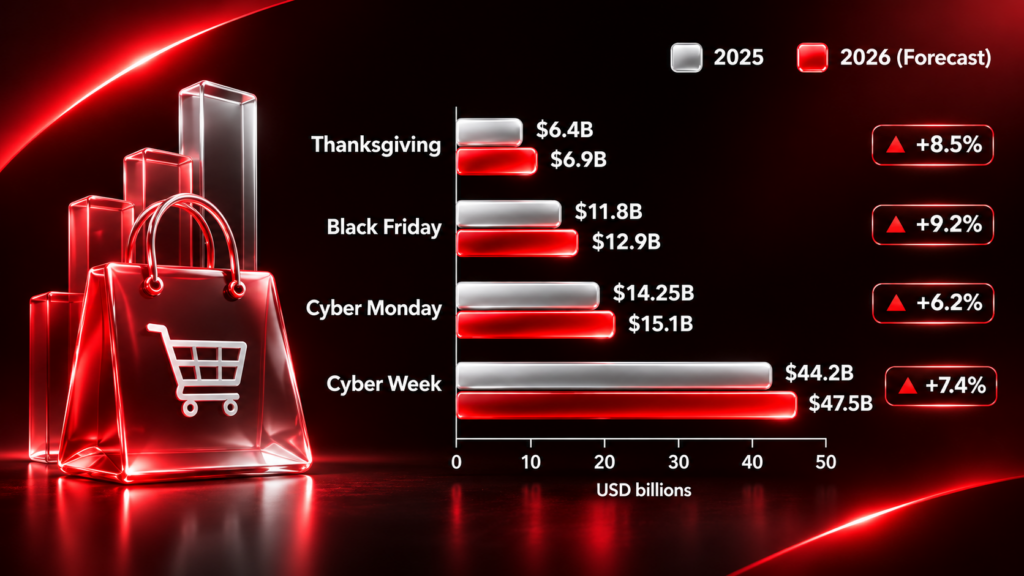
Source: Adobe Analytics, 2026 US Holiday Shopping Forecast. Cyber Week covers Thanksgiving through Cyber Monday.
For traders, however, the significance lies less in whether spending reaches a record and more in whether it exceeds expectations.
With strong sales already forecast, an impressive headline figure may have limited market impact. A meaningful deviation from expectations could influence retail earnings expectations and investor sentiment, although its broader economic significance will depend on whether subsequent official data confirms the trend.
Are Consumers Spending More or Paying More?
Higher expenditure does not necessarily mean consumers are purchasing more goods.
The Mastercard Economics Institute’s 2026 holiday forecast projects US retail sales growth of 5.5%, excluding fuel and automotive purchases. Crucially, 2.8 percentage points of that growth are attributed to inflation.
In other words, approximately half of the anticipated increase reflects higher prices.
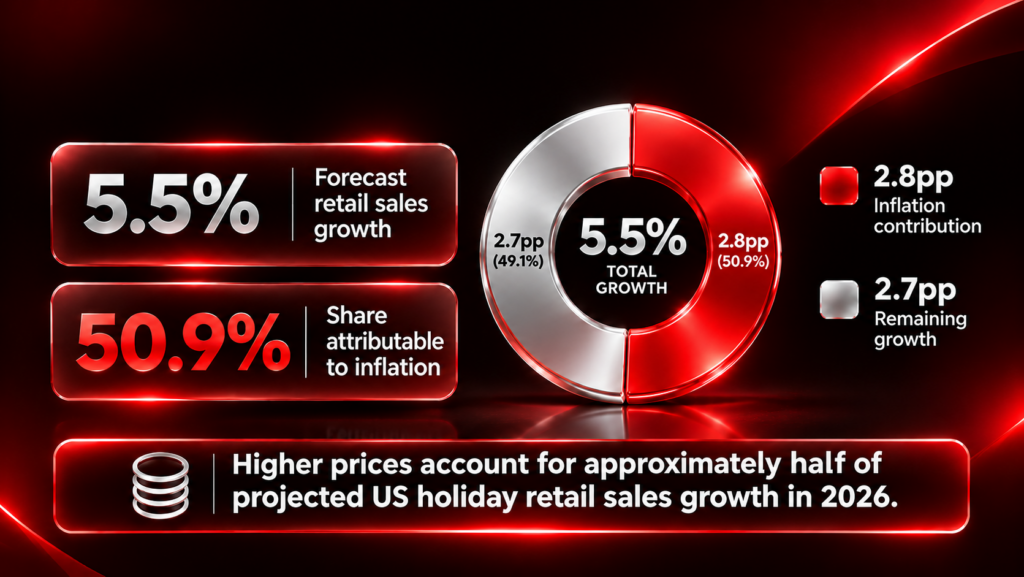
Source: Mastercard Economics Institute and SpendingPulse, 2026 Holiday Forecast.
The composition of spending is equally revealing. Adobe expects online grocery sales to grow by 10.3%, compared with 5.9% for electronics and 4.7% for apparel.
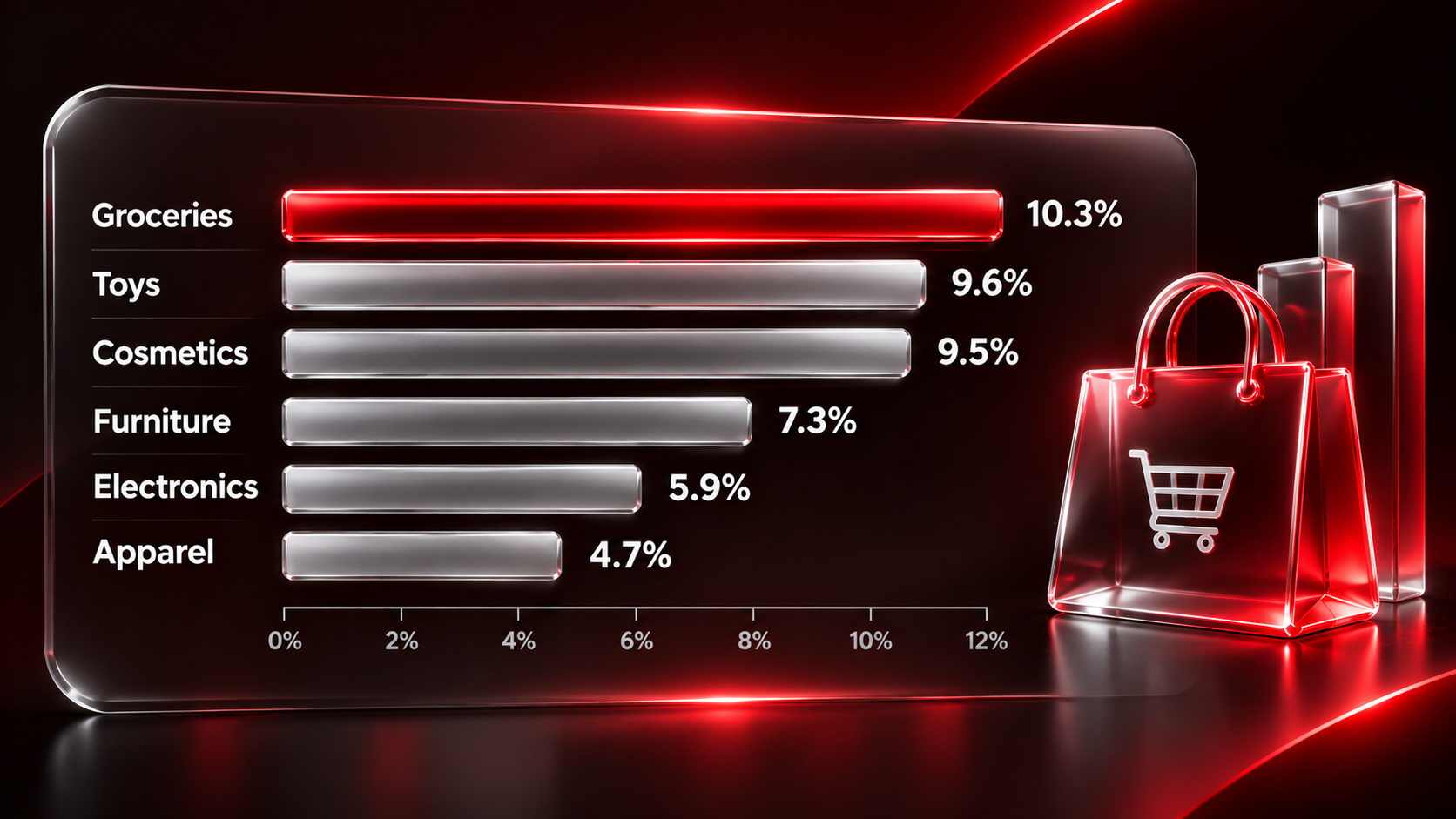
Source: Adobe Analytics, 2026 US Holiday Shopping Forecast. Figures represent year-on-year growth in nominal online expenditure.
Buy now, pay later (BNPL) expenditure is also forecast to reach $21.3 billion during the holiday season.
Neither greater spending on essentials nor increased use of flexible payment methods necessarily indicates financial distress. Both can reflect changing shopping habits. However, alongside inflation and household borrowing costs, these indicators can help traders assess the strength and sustainability of consumer demand.
That distinction matters when evaluating the outlook for consumer discretionary stocks relative to consumer staples, as well as the broader economy.
Record Sales. But at What Cost?
Retail sales growth is not the same as earnings growth.
With holiday discounts expected to reach 30% in some product categories, retailers face a familiar challenge: increasing sales without sacrificing profitability.
Aggressive promotions can help businesses clear inventory, attract new customers and gain market share. However, if discounting simply brings forward purchases that would have occurred anyway, businesses may be sacrificing margins without generating meaningful additional demand.
This distinction between generating more activity and creating more value extends beyond retail. As we explored in our recent Finance Magnates article on the economics of Black Friday promotions in the brokerage industry, stronger short-term performance metrics do not necessarily translate into sustainable growth.
For traders assessing retail stocks, the same principle applies. Gross profit margins, inventory turnover and forward earnings guidance may ultimately prove more influential than Black Friday sales figures alone.
Which Stocks Should Traders Watch This Black Friday?
Different retail business models offer different exposure to holiday spending. Understanding how each company generates revenue can help traders interpret the significance of its performance.
| Company | Ticker | What Traders Should Monitor |
| Amazon | AMZN | Marketplace activity, advertising revenue and retail margins. |
| Walmart | WMT | Grocery demand, value-conscious consumers and market share. |
| Target | TGT | Discretionary spending, inventory management and discounting pressure. |
| Shopify | SHOP | Merchant sales volumes, payment transactions and e-commerce activity. |
| eBay | EBAY | Marketplace transactions and demand for lower-cost alternatives. |
Amazon and Shopify offer exposure to the growth of digital commerce, while Walmart and Target can help investors assess how households are allocating expenditure between necessities and non-essential purchases.
Walmart’s emphasis on groceries and everyday essentials provides a different consumer exposure from Target’s greater reliance on discretionary categories. Relative share price performance can therefore provide additional insight into how investors are interpreting consumer behaviour.
However, these businesses are not exclusively exposed to holiday spending. Amazon’s cloud computing operations, for example, can have a substantial influence on its valuation independently of retail performance.
Company-specific earnings expectations, valuations and wider market conditions remain important.
Beyond Retail: How Black Friday Could Affect Indices, Forex and Gold
Consumer spending influences more than retail earnings. Its implications for economic growth and monetary policy can extend across multiple asset classes.
However, preliminary Black Friday spending figures are more likely to influence sentiment towards retailers than directly shift expectations for Federal Reserve policy. Official retail sales, personal consumption expenditure and inflation data will provide a more comprehensive assessment of consumer demand and its implications for interest rates.
US stock indices
Stronger consumer demand could support earnings expectations across the S&P 500, particularly among consumer-facing businesses.
For the Nasdaq 100, however, the relationship is more complicated. If stronger holiday spending is subsequently reflected in official economic data and reinforces inflation concerns, reduced expectations for Federal Reserve rate cuts and higher Treasury yields could put pressure on technology and growth stock valuations.
Positive economic news could therefore support parts of the equity market while weighing on others.
Traders should monitor US Treasury yields alongside the performance of the S&P 500 and Nasdaq 100 when assessing the market’s response to holiday spending data.
Forex
For currency traders, Black Friday spending is more useful as an early indicator of consumer demand than as a standalone catalyst for the US dollar.
If resilient holiday consumption is subsequently confirmed by official retail sales and inflation data, it could reinforce expectations that the Federal Reserve will maintain higher interest rates for longer, potentially supporting the US dollar against other major currencies, with implications for currency pairs such as EUR/USD and GBP/USD.
Conversely, evidence of weakening consumption across subsequent economic releases could strengthen expectations for monetary easing, potentially weighing on the dollar.
The reaction will also depend on relative monetary policy expectations and global risk sentiment. Economic weakness does not automatically translate into dollar weakness, particularly when investors are seeking defensive assets.
Gold
Preliminary Black Friday spending figures are unlikely to be a significant standalone catalyst for gold. Instead, its response will depend more on movements in the US dollar, real yields and interest rate expectations, particularly as subsequent economic releases provide a clearer picture of consumer demand and inflation.
Higher real yields can increase the opportunity cost of holding non-interest-bearing assets such as gold. However, concerns about economic growth or financial market stability could support defensive demand.
Monitoring these relationships can help traders distinguish between a gold price movement driven by monetary policy expectations and one driven by risk aversion.
Black Friday market scenarios: What to watch
| Spending scenario | Potential market implication | Markets to monitor |
| Sales exceed expectations without additional discounting | Stronger demand and earnings expectations | Retail stocks, S&P 500 |
| Record sales driven by aggressive discounting | Potential margin compression | Retail stocks |
| Strong consumption alongside persistent inflation | Reduced expectations for monetary easing | USD, Treasury yields, Nasdaq 100, gold |
| Spending disappoints | Weaker growth and earnings expectations | US indices, USD, gold |
| Spending growth favours essential goods | Potentially more defensive consumer behaviour | Consumer staples vs discretionary stocks |
These scenarios illustrate potential market reactions rather than directional forecasts. Actual price movements will depend on prevailing economic conditions, market positioning and what investors have already priced in.
Can Black Friday Help Broaden a Market Recovery?
Historically, the period surrounding Thanksgiving has been associated with favourable equity market seasonality. This year, however, markets enter the holiday period against a less supportive backdrop.
As of 23 November, both the S&P 500 and Nasdaq 100 had reportedly broken below their 200-day moving averages, with much of the recent weakness concentrated in AI-related and technology stocks.
Against this backdrop, the significance of Black Friday may lie less in its ability to reverse the sell-off and more in what it reveals about the strength of the economy beyond technology.
Resilient consumer spending could support earnings expectations across retailers, consumer-facing businesses and other sectors, potentially helping any subsequent equity market recovery broaden beyond the technology companies that have dominated market performance.
The timing also introduces another consideration: the wealth effect.
When equity valuations rise, households with significant financial assets may feel more confident about spending. When those valuations decline, the opposite can occur, potentially weakening discretionary consumption.
Holiday spending figures could therefore offer an early indication of whether consumer demand remains resilient despite recent equity market weakness.
There are also two seasonal factors to consider:
- The pre-holiday effect: The historical tendency for equity markets to perform favourably ahead of certain public holidays.
- The turn-of-the-month effect: Investment flows and portfolio adjustments around the end of one month and the beginning of another.
With Cyber Monday falling on the final trading day of November, holiday spending figures and month-end portfolio flows could influence markets simultaneously.
Neither seasonal pattern guarantees a recovery. Beyond monitoring whether major US indices can reclaim their 200-day moving averages, traders should pay attention to market breadth, sector rotation and the relative performance of equal-weighted and market-cap-weighted indices.
A recovery supported by a wider range of sectors could indicate broader market participation rather than a rebound driven primarily by a handful of technology stocks.
How to Trade Around Black Friday
Trading around Black Friday requires an understanding of both the economic information emerging from the shopping event and the changing conditions in which trades are executed.
1. Compare Actual Spending Against Expectations
With record sales already forecast, the headline figure alone may reveal little. The size and nature of any surprise are likely to be more significant for markets.
For example, Black Friday online sales of $12.5 billion would exceed 2025’s $11.8 billion but fall short of the $12.9 billion forecast. Despite setting a new spending record, the result could disappoint investors.
2. Distinguish Between Revenue and Profitability
Monitor discounting, inventory levels and earnings guidance when assessing retail stocks. Strong sales accompanied by declining profit margins may not justify higher valuations.
3. Look for Cross-Market Confirmation
If preliminary Black Friday spending exceeds expectations, monitor the response of retail and consumer discretionary stocks, alongside broader equity market performance.
As subsequent official retail sales and inflation data are released, observe how Treasury yields, the US dollar and equity indices respond. Their relative performance can help identify whether markets are prioritising economic growth or inflation risks.
For example, rising Treasury yields and a strengthening dollar alongside falling technology stocks could indicate that investors are focusing on the interest rate implications of stronger demand rather than its potential benefits for corporate earnings.
4. Adapt to Holiday Trading Conditions
Reduced market depth can lead to wider spreads and increased slippage. Limit orders can provide greater control over execution prices, although they do not guarantee a fill.
Check instrument-specific trading hours before opening or managing positions, particularly as preliminary spending figures may emerge after Friday’s shortened US equity trading session.
5. Manage Leverage and Weekend Exposure
Review position sizes, margin requirements, overnight financing costs and weekend gap risk. Stop-loss orders may execute at less favourable prices during price gaps or periods of reduced liquidity.
6. Look Beyond Black Friday
Preliminary Black Friday reports provide an early indication of consumer demand, not a complete economic assessment. Official retail sales data, inflation releases and subsequent corporate earnings announcements will help determine whether holiday spending reflects sustained economic strength or a temporary, promotion-driven increase in demand.
Bottom Line
Black Friday 2026 brings together record consumer spending forecasts, an AI and technology-led equity market correction and uncertainty surrounding the outlook for inflation and interest rates.
The key question is not simply whether consumers will spend more, but whether that spending reflects genuine economic resilience, higher prices or greater reliance on promotional incentives and flexible payment options.
For equity traders, resilient consumption could provide insight into whether a potential market recovery can extend beyond technology stocks. For forex and gold traders, the greater significance will come from whether subsequent official economic data confirms the spending trends and influences monetary policy expectations.
Black Friday provides an early signal, not the complete economic picture.
While shoppers focus on price, traders should focus on what drives it.