


Why Inflation Data Moves Forex Markets


Understanding how inflation affects forex markets isn’t always straightforward. A higher-than-expected inflation reading might strengthen a currency, weaken it or produce little lasting movement. Why? Because forex markets respond not just to inflation itself, but to what the figures suggest about future interest rates.
GBP/USD offers a useful example. As a currency pair influenced by monetary policy in both the United Kingdom and the United States, it can react to inflation releases from either economy. Yet the size and direction of those reactions often depend on how the data compares with expectations already reflected in market prices.
These reactions are an important part of fundamental analysis, particularly when major economic announcements trigger sudden changes in currency prices.
What Is Inflation?
Inflation is a general increase in the prices of goods and services over time. As prices rise, the purchasing power of money declines because the same amount buys fewer goods and services.
One of the most widely followed measures is the Consumer Price Index (CPI), which tracks changes in the prices consumers pay for a representative group of goods and services.
Two measures are particularly relevant when analysing inflation reports:
- Headline CPI: Includes all categories covered by the index, providing a broad measure of consumer price changes.
- Core inflation: Excludes certain volatile categories to provide another perspective on underlying price pressures. In the United States, this generally means food and energy, while the UK measure also excludes alcohol and tobacco.
Both figures can influence financial markets, particularly when they suggest different trends in inflation.
How Does Inflation Affect Forex Markets?
Inflation matters to forex markets because it can influence expectations about future interest rates.
Central banks use monetary policy, including interest rates, to help control inflation. In the United Kingdom, this responsibility lies with the Bank of England (BoE), while the Federal Reserve (Fed) sets monetary policy in the United States.
When inflation exceeds expectations, traders may anticipate that a central bank will raise interest rates or keep them elevated for longer. Higher expected rates can sometimes support a currency because interest-bearing assets denominated in that currency may become relatively more attractive.
Conversely, weaker-than-expected inflation may increase expectations for lower interest rates, potentially placing pressure on the currency.
However, higher inflation does not automatically mean a stronger currency. The reaction depends on what markets were expecting, how the figures influence the anticipated path of monetary policy and whether other economic developments change that outlook.
For GBP/USD, this relationship works in both directions. Changes in expectations for UK interest rates can influence sterling, while changes in expectations for US rates can affect the dollar. The exchange rate reflects the relative value of both currencies.
Why Inflation Surprises Matter More Than the Headline Number
Financial markets are forward-looking. Before an inflation report is published, economists produce forecasts that contribute to a market consensus, and traders may adjust their positions in anticipation.
As a result, an inflation figure can be relatively high or low without necessarily surprising the market.
Consider a simplified hypothetical example:
Suppose annual inflation is expected to reach 3.0%.
- Actual inflation of 3.4%: An upside surprise that could encourage traders to reduce expectations for interest rate cuts or increase expectations for rate rises, potentially supporting the currency.
- Actual inflation of 2.6%: A downside surprise that could strengthen expectations for lower interest rates, potentially weighing on the currency.
- Actual inflation of 3.0%: A result matching forecasts that may have a more limited impact if it confirms expectations already reflected in market prices.
The key distinction is between the inflation figure itself and the new information it provides.
Even a substantial surprise may have a limited or short-lived effect if other economic indicators or central bank communications point towards a different monetary policy outlook.
This is a simplified hypothetical example for educational purposes only and does not represent an actual inflation release.
GBP/USD Around Selected Inflation Releases
Inflation reports do not all produce the same market reaction. Even when the reported figures are similar, GBP/USD can respond differently depending on the size of the surprise, existing interest-rate expectations and how investors interpret the implications for monetary policy.
Five UK and US inflation releases between July and October 2026 illustrate these differences.
22 July 2026: UK Inflation Falls Below Expectations
On 22 July, data for June showed that UK annual CPI had slowed from 2.8% to 2.6%, below the 2.7% consensus.
Sterling weakened modestly immediately after the release but was broadly steady at approximately $1.3375 later in the session.
The downside surprise initially placed pressure on the pound, consistent with the possibility that weaker inflation could reduce expectations for higher interest rates.
However, the limited movement later in the session demonstrates that an inflation surprise does not necessarily translate into a sustained currency trend.
19 August 2026: UK Inflation Matches Forecasts
UK annual inflation for July increased to 2.9%, matching market expectations.
Sterling was approximately 0.1% higher against the dollar in early trading, but the result provided little new information about the likely path of interest rates.
This illustrates an important distinction: inflation can increase without materially changing market expectations.
When the published figure aligns with forecasts, much of the anticipated information may already be reflected in currency prices, potentially limiting the reaction.
11 September 2026: US Headline and Core Inflation Send Different Signals
US headline CPI for August increased by 0.4% over the month and 3.4% over the year, matching forecasts.
However, monthly core CPI rose by 0.3%, compared with an expected 0.2%.
GBP/USD initially fell towards $1.3470 as markets increased the probability of a Federal Reserve rate rise. It later recovered towards $1.3524 as the initial response faded and traders considered other economic information.
The release highlights why traders look beyond headline inflation.
Although the headline figure matched expectations, stronger-than-expected core inflation suggested additional underlying price pressures. That distinction influenced the initial market response.
The subsequent recovery also shows how quickly currency markets can reassess the implications of economic data.
14 October 2026: Stronger US Inflation Triggers a Sharper Reaction
US annual inflation for September reached 3.7%, above the 3.6% forecast. Monthly core inflation was also stronger than expected.
Sterling fell by approximately 0.7% against the dollar, reaching its lowest level since late November 2025 before recovering part of the movement.
The stronger inflation figures encouraged expectations that the Federal Reserve could maintain a tighter monetary policy stance, supporting the dollar relative to sterling.
However, over the following days, comments from Federal Reserve officials encouraged traders to reduce expectations for an immediate rate rise.
This example demonstrates how a stronger inflation surprise can produce a more pronounced currency reaction, while subsequent central bank communication can alter the market’s interpretation.
The initial response was important, but it did not tell the entire story.
21 October 2026: UK Inflation Rises, but Sterling Barely Moves
UK annual CPI for September rose to 3.5%, slightly above the 3.4% consensus.
Sterling briefly dipped to approximately $1.3365 before recovering towards $1.34, leaving it little changed on the day.
Despite the upside surprise, markets had already priced in a high probability of a Bank of England rate rise in November. The inflation data therefore did little to change expectations.
This is perhaps the clearest example of why the direction of inflation alone cannot reliably predict a currency’s response.
An inflation report can exceed forecasts without producing a sustained rally if investors have already anticipated the likely monetary policy outcome.
What the GBP/USD Reactions Reveal
The five releases demonstrate that inflation data influences currencies through expectations rather than a fixed relationship between rising prices and exchange rates.
| Inflation release | Market reaction | What it illustrates |
| 22 July – UK | Sterling weakened initially but was broadly steady later. | A downside surprise does not guarantee a sustained decline. |
| 19 August – UK | Sterling rose approximately 0.1% in early trading. | An in-line result may provide little new information. |
| 11 September – US | GBP/USD fell initially before recovering. | Core inflation can influence expectations even when headline CPI matches forecasts. |
| 14 October – US | Sterling fell approximately 0.7% before partially recovering. | A stronger surprise can produce a sharper reaction, while subsequent policy commentary may change expectations. |
| 21 October – UK | Sterling dipped briefly but finished little changed. | A surprise may have limited impact when the expected policy response is already priced in. |
Taken together, these examples show that the size of the inflation surprise, existing market positioning and the expected central bank response can matter more than whether inflation is simply rising or falling.
They also demonstrate why an immediate market movement should not be confused with a lasting trend.
GBP/USD Around Selected UK and US CPI Releases
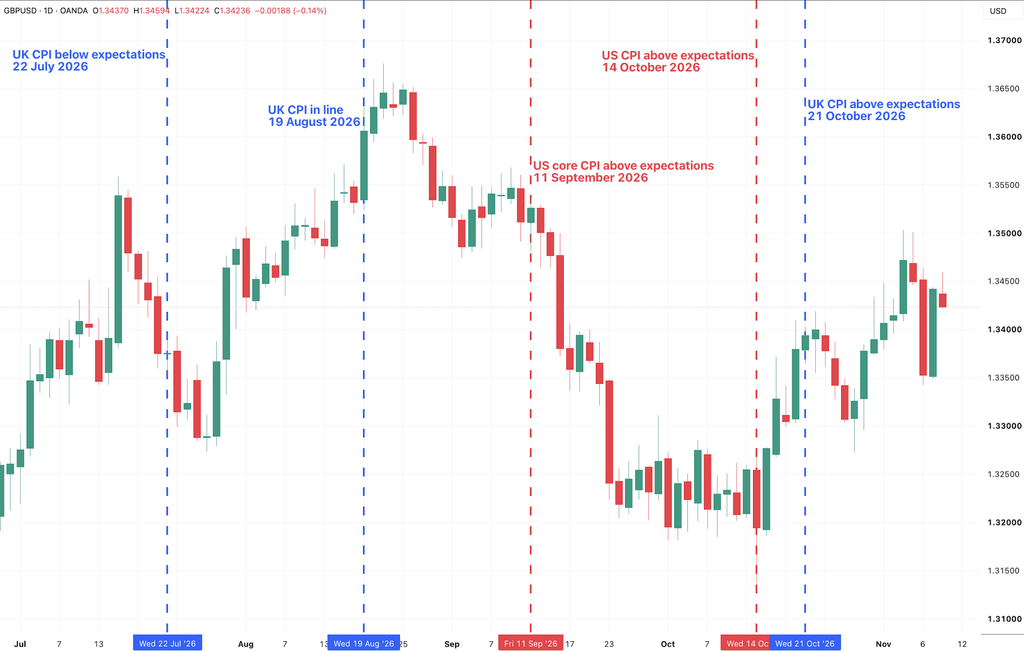
Source & Methodology: TradingView, UK Office for National Statistics and US Bureau of Labor Statistics. The chart shows the daily GBP/USD exchange rate from 1 July to 10 November 2026. Vertical markers identify selected UK and US Consumer Price Index publication dates between July and October 2026. UK releases are shown using blue markers, while US releases are shown using red markers. The inflation figures refer to the periods stated in the official releases, while the markers are positioned on the publication dates. GBP/USD represents the number of US dollars required to purchase one British pound. Currency movements reflect numerous economic, political and market influences and should not be attributed to inflation data alone. The chart was created from the underlying TradingView data and does not reproduce a third-party chart. Past performance is not a reliable indicator of future performance. Data as of 10 November 2026.
The chart marks three UK releases and two US releases. GBP/USD reacted most clearly following the stronger-than-expected US report on 14 October, when the dollar strengthened before part of the movement was reversed.
By comparison, the UK releases generally produced more limited reactions, either because the results matched forecasts or because the likely policy implications were already reflected in market expectations.
The chart uses daily candles, meaning an immediate reaction may not always match the final direction of the release day’s candle. This distinction is particularly important when assessing short-term market responses to economic announcements.
Why Inflation Surprises Don’t Always Move Currencies as Expected
Inflation reports are only one part of the information markets use to assess future monetary policy.
A stronger-than-expected CPI reading may support a currency if it increases expectations for higher interest rates. However, that response can be limited when traders have already anticipated the outcome or when other economic indicators suggest a different policy direction.
Several factors can complicate the relationship:
- Headline versus core inflation: These measures can send different signals about underlying price pressures.
- Monthly versus annual inflation: The two measures may move in different directions, influencing how traders interpret the overall trend.
- Other economic indicators: Employment, economic growth and energy prices can affect interest-rate expectations alongside inflation.
- Central bank communication: Comments from policymakers can reinforce or challenge the expectations created by an inflation release.
- Relative monetary policy: GBP/USD reflects expectations for both the Bank of England and Federal Reserve, meaning developments in either economy can influence the pair.
In the United States, traders also monitor the Personal Consumption Expenditures (PCE) price index alongside CPI. Understanding the differences between CPI and PCE can provide additional context when assessing inflation trends and Federal Reserve policy expectations.
Political developments and broader changes in market sentiment can also affect exchange rates independently of inflation. This helps explain why some releases produce sharp but short-lived movements, while others have little impact despite surprising forecasts.
For fundamental analysis, inflation is therefore most useful when considered alongside the broader economic outlook rather than as an isolated indicator.
Bottom Line
Inflation data can influence forex markets by changing expectations for interest rates, but the relationship is rarely as simple as higher inflation strengthening a currency or lower inflation weakening it.
The GBP/USD reactions examined here show that the size of the inflation surprise, existing market expectations and subsequent central bank communication can all shape the outcome. Even when a release produces an immediate movement, that reaction may fade or reverse as investors reassess the wider economic picture.
For traders analysing inflation releases, the more useful question is not simply whether prices are rising or falling, but what the latest figures change about the expected path of monetary policy.